

This series will provide detailed and enthusiastic commentary on Japan's ski resorts from various perspectives. This time, we will be looking at the cableway, a service that all skiers and snowboarders rely on. You will gain a deeper understanding if you start by reading the first part
Only those who can talk about cable car trivia can be called advanced skiers
the first part , we summarized the three technical classifications of cable cars and the details of each, but in the second part, we will organize the history and characteristics of each of the general classifications: chairlifts, gondolas, and ropeways. If you are an advanced skier, you may find yourself annoying your friends by persistently talking about the cable car trivia written here.
[Ropeway] The instantaneous mobility is overwhelming! Its existence itself is a tourist attraction
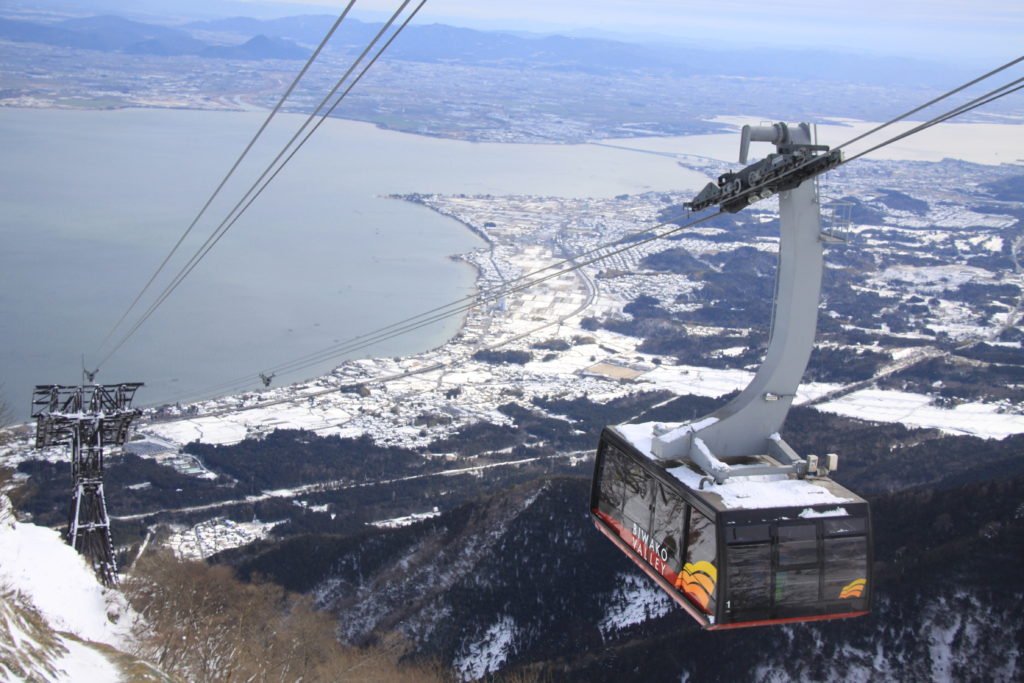
As mentioned in the previous article, there are facilities that call ordinary circular cableways, commonly known as "gondola," "ropeways," but here we will refer to those that transport medium to large box-shaped carriers in a cross-type manner as "ropeways."
The history of facilities calling themselves ropeways is surprisingly long. They existed as far back as the Meiji period. However, they were simple structures consisting of a single small carriage that went back and forth
According to research by this website, the first ropeway to appear at a ski resort in Japan was installed in what is now Zao Onsen in 1956. Currently, the main ski resorts with ropeways include Otaru Tenguyama , Furano , Hakkoda , Shizukuishi , Tengendai , Zao , Muikamachi Hakkaisan , Yuzawa Kogen , Gala , Kagura , Tanigawadake Tenjindaira , Ryuo, Tsugaike Kogen, Pilatus Tateshina , Senjojiki , Biwako Valley , and Ishizuchi .
Of these, Zao Onsen currently has two: the Zao Ropeway Sanroku Line and the Zao Chuo Ropeway (there is also the Zao Ropeway Sanchoku Line, which is a circular Funitel). Yuzawa Kogen also has one of the world's largest ropeways, carrying 166 people, and is connected to Gala Yuzawa by a ropeway called "Lando." Kagura also has two ropeways.
Ropeways are a major tourist attraction in themselves, and many of these ski resorts have become year-round tourist destinations.
All cableways do not have a power unit in the carriage itself. A motor at the terminal station rotates a pulley, which pulls the rope to move the carriage. Ropeways, in particular, require a lot of electricity. At Yuzawa Kogen, where a huge ropeway is located, the electricity used to pull the rope up to the summit through wires buried in the slope is 6,600 volts.
Ropeways are vulnerable to strong winds, so standards for slowing down or stopping the ropeway are set based on wind speed. However, wind direction may not have any effect. For this reason, staff sometimes make decisions about how much to slow down the ropeway based on experience. In fact, lightning is a bigger enemy than strong winds, and any flash or thud will immediately stop the operation.
The Yuzawa Kogen ropeway's carrier weighs approximately 10 tons. When it's filled with people holding boards, it reaches nearly 20 tons. The tough ropes that suspend it form the backbone of a highly safe ropeway system
[Gondola] Constant mobility is number one! In fact, it has the newest history at ski resorts
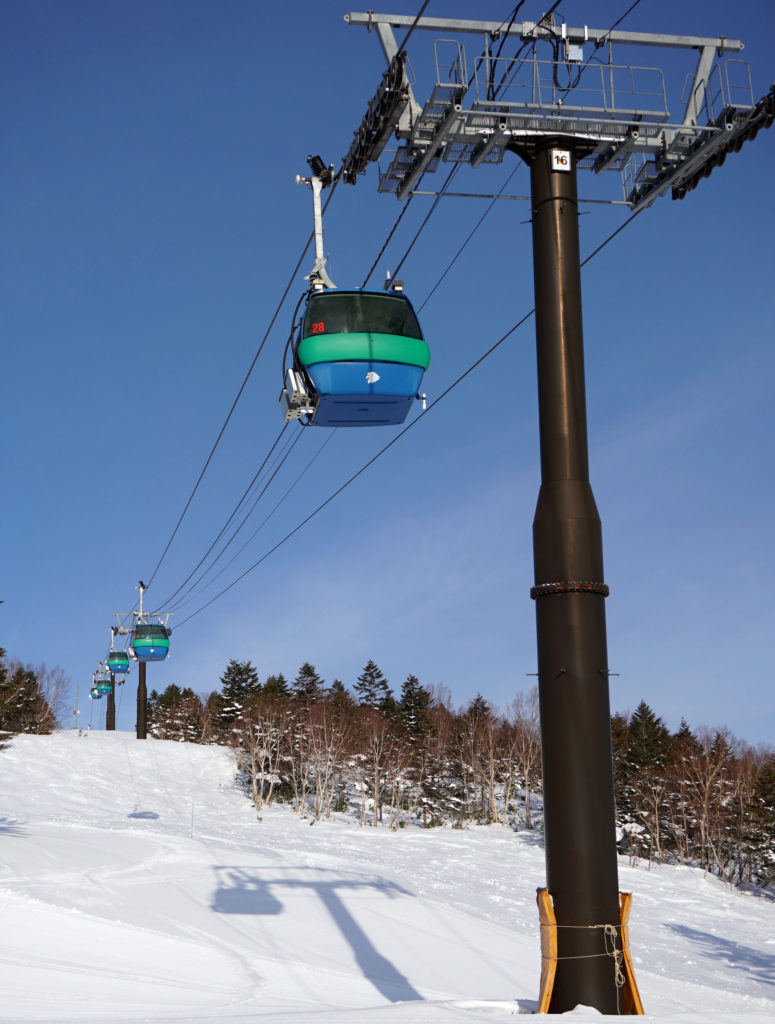
Compared to chairlifts, gondolas have a wider variety of carriage designs and sizes.
Their strength is their constant maneuverability. Compared to ropeways, they are inferior in the number of people that can be carried at one time per carriage, but if you were to compare how many people can be carried in an hour, for example, gondolas, which circulate their carriages, would win.
They first appeared in domestic ski resorts in 1973, much later than ropeways. They were installed at what is now Hakuba Goryu and Yokotsudake in Hokkaido (currently closed).
The famous egg-shaped gondola (now partially rebuilt) was erected at Higashidateyama in Shiga Kogen Hakuba Happo-one (built in 1958) was renovated into a gondola in 1983. The Naeba gondola debuted in 1985.
The long queues of over an hour waiting for gondolas at these popular slopes were a symbolic event of the ski boom of the late 1980s.
So, how fast do the gondolas go? It varies depending on the facility, but at Maiko Resort, for example, the maximum speed is 5 meters per second. You can accelerate or decelerate by pressing a button that can adjust the speed in 1 meter increments
A weakness of gondolas is crosswinds. Funitel is a type that compensates for this weakness, but it is still a minority in Japan. In Maiko, the general rule is to slow down when the wind speed reaches 10 m/s, and stop when it reaches 15 m/s. However, the situation changes depending on the wind direction. If there is a crosswind, the gondola may slow down even at a wind speed of 5 to 6 m/s
At night, the gondolas are stored in the station. The number of carriages in operation varies depending on the day, with a maximum of 100 and a minimum of 80 at Maiko, as mentioned above. In other words, the number is increased or decreased depending on the predicted congestion. In the case of gondolas, the only equipment required inside the carriage is "a device that allows mutual communication between the stop and the carriage, and between each stop." Although there is no particular limitation, it is often a radio
Currently, many ski resorts are facing a challenge regarding gondolas: how to accommodate fat skis and twin-tip skis. While an increasing number of ski resorts are renovating their ski racks, there are still some that have not yet fully adapted
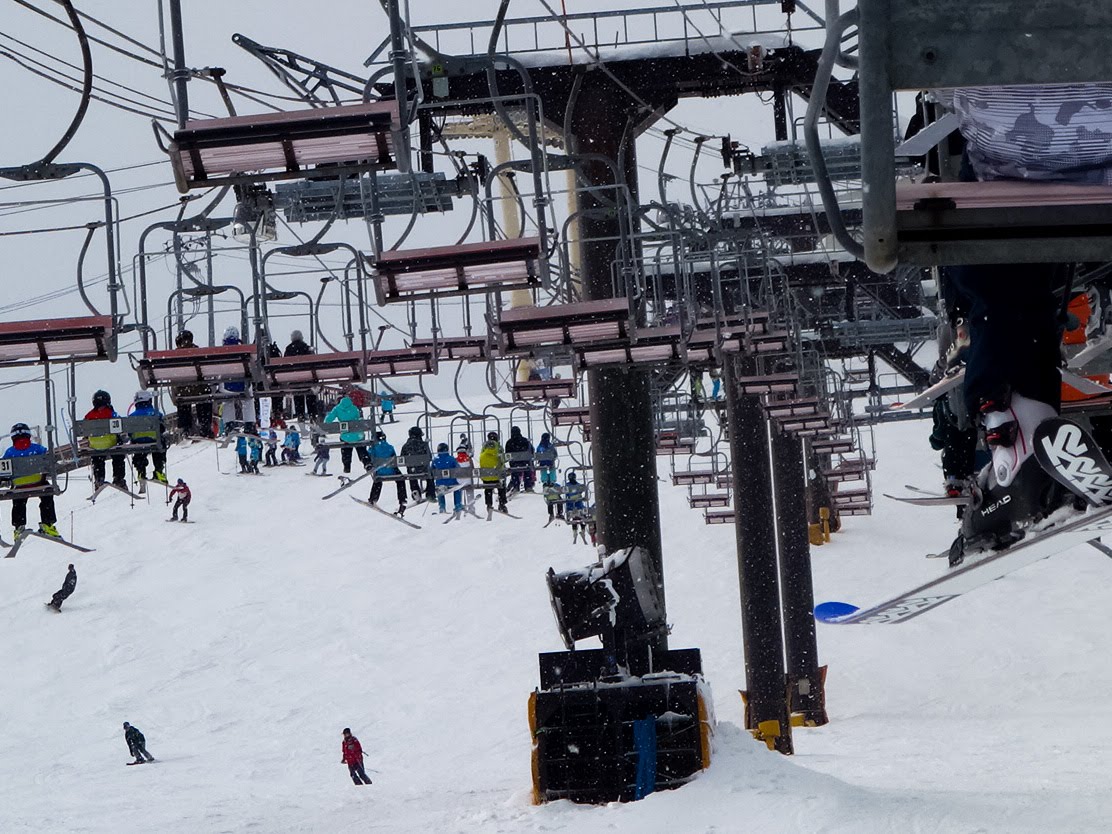
[Chairlift] The most common type of cable car. It evolved significantly in the 1980s
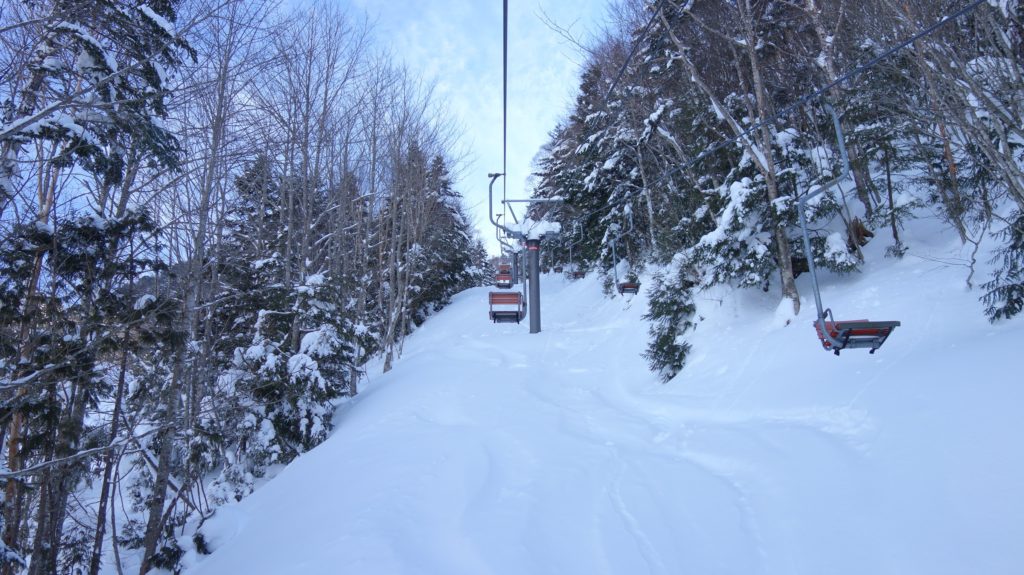
A chairlift is literally a chair lift. Generally, when we say "lift," we are referring to this type. As mentioned in
the previous article It is usually the former.
In fixed-circulation lifts, the carriages are fixed to a rope, so the speed cannot be changed between the carriages used for boarding and disembarking and the carriages used for travel. However, staff may slow down the lifts at bus stops, for example, when children board.
Also, while there are ways to make faster lifts safer by installing auxiliary devices such as conveyor belts at bus stops, there are few such devices in Japan. For this reason, these lifts are unlikely to be used as the main lifts at ski resorts today, and are not suitable for long-distance routes.
On the other hand, automatic circulating lifts can travel at high speeds, but slow down when boarding and disembarking, making it easy for beginners and children to get on and off. From a passenger-first perspective, there are only advantages. However, for ski resorts, the fact that they are more expensive than fixed circulating lifts is a negative factor.
Chairlifts also differ in the capacity of the carrier. Surprisingly, the first chairlift in Japan, built for the occupying forces, carried two people back to back. However, this is an extremely unusual example. After 1948, as chairlifts became more widespread in Japan, they were generally single-carrier lifts.
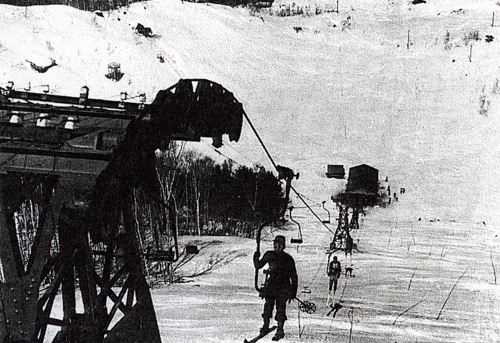
Shiga Kogen Maruike Ski Lift Source: Kajima Corporation
There are various theories about the first civilian pair lift, but in any case, it began to spread in the 1970s. Then, in the early 1980s, on the eve of the unprecedented ski boom, the automatic circulating triple lift (for three people) appeared, followed soon after by the quad lift (for four people). Chairlifts entered an era of increasing speed. Note that current regulations state that the maximum speed for automatic circulating lifts is 5 meters per second
Furthermore, around 1988, during the booming bubble economy, hooded lifts were introduced. It is also worth noting that safety bars were also installed on lifts from this era. Since then, chairlifts have continued to evolve, with the introduction of footrests to stabilize passengers' feet and cushioned seats to improve ride comfort
Finally, I'd like to address a question that has crossed every skier's mind while riding a chairlift:
Does anyone ever fall off a chairlift?
The answer is yes. Apparently it does happen on rare occasions. However, in Japan, the height of chairlift carriages is regulated by law, so even if someone falls, it is unlikely to result in a serious accident.
[Bonus] A little tidbit about cable cars
Finally, I would like to list some trivia about cable cars in a Q&A format
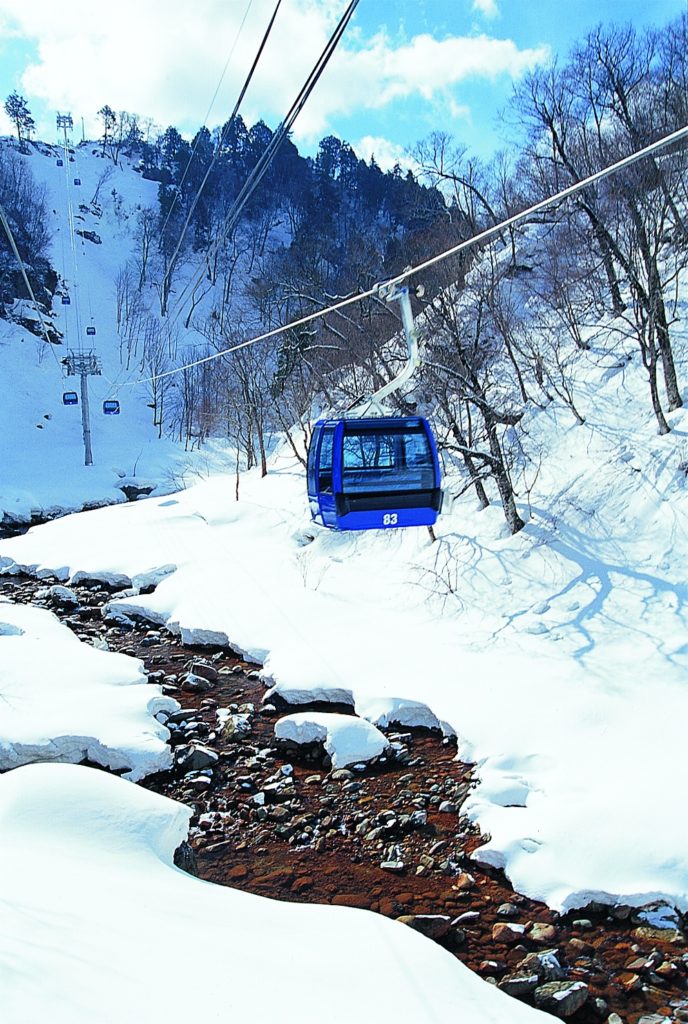
Q1: What are the longest and shortest cableways in Japan?
the Dragon Gondola which spans between Naeba and Kagura . It is 5,481m long, making it one of the longest in the world. The longest chairlift still in operation the Sailer Quad (2,143m) at Appi Kogen . Conversely, the shortest chairlift in Japan is the No. 6 Lift at Heavens Sonohara , which is just 85m short.
The gondola with the greatest elevation change is Shizukuishi No. 1 Gondola (849m) . However, it ceased operation in 2008. The lift is the Sailer Quad (612m) .
Q2 How many people are required for one cableway?
At least four people work on each lift, and about seven on each gondola, splitting into two teams working at the boarding and disembarking areas. The person in charge of these teams, constantly patrolling and checking the site, is a staff member qualified as a "ropeway technical manager" under the jurisdiction of the Ministry of Land, Infrastructure, Transport and Tourism. Obtaining this qualification once is not enough; they are required to constantly update their knowledge and skills by regularly attending training sessions
Q3 How do the cable car staff go up first thing in the morning?
For gondolas and ropeways, the equipment that pulls the ropes is located at the top of the mountain, and someone has to start it first thing in the morning. The staff in charge of this work don't go up the mountain on snowmobiles... but rather stay in the duty room at the top of the mountain and get up early to operate the equipment, according to interviews at Yuzawa Kogen and Maiko Snow Resort
Q4 What does "Romance Lift" mean?
In the days when single lifts were the norm, even if a couple went skiing together, both of them were alone on the lift. This name was likely chosen to add value to the newly introduced two-seater lift
Edited by STEEP Editorial Department. Edited by STEEP.
Source: Re-edited from 2018 BRAVOSKI vol.2.