


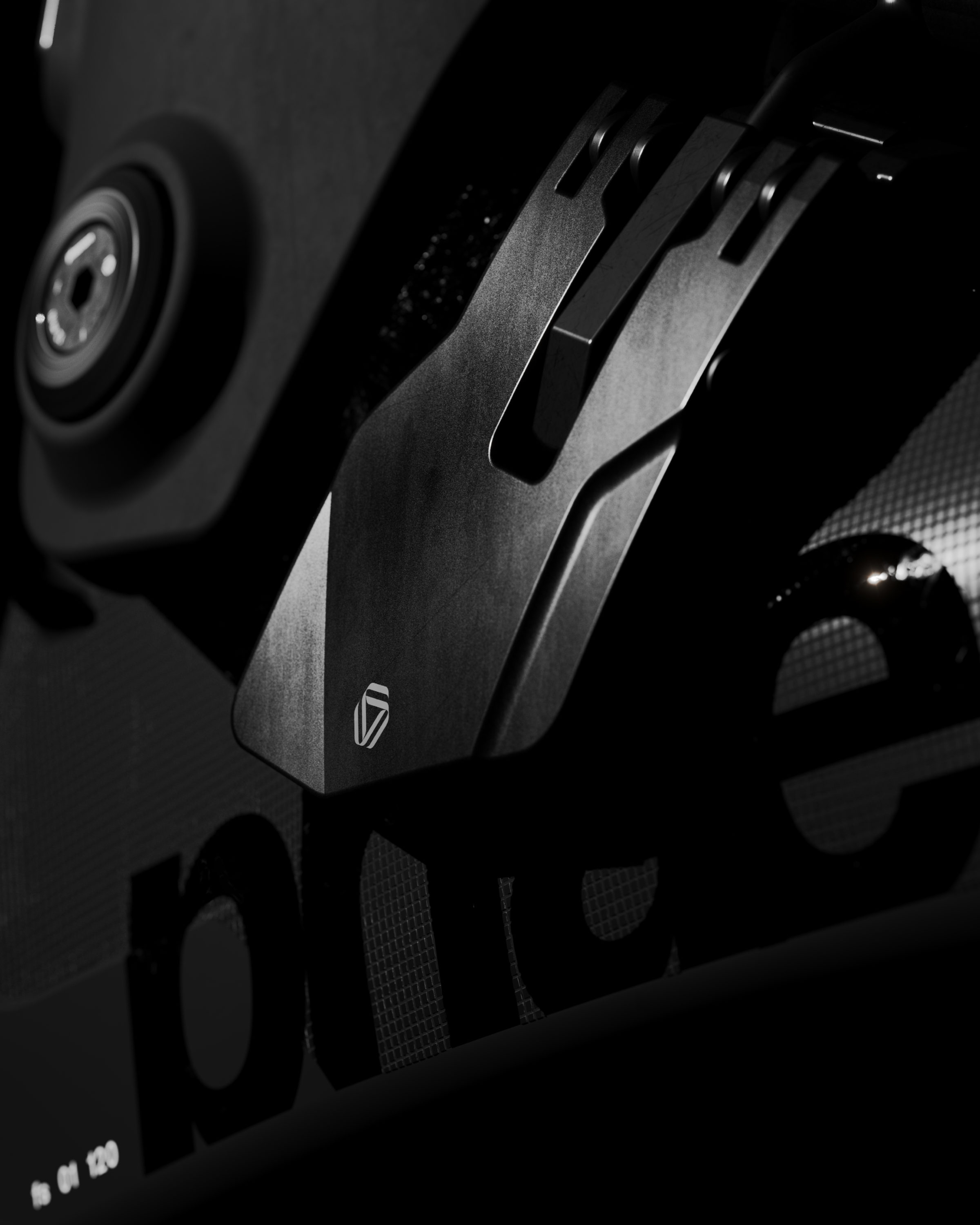
A jet black form with a matte finish. A three-piece hybrid structure. A unique system with two buckles and a wide rubber strap that sets it apart from the rest
In the 2024-2025 season, a new boot brand called "Phenom" appeared on the scene, and was worn by many notable freestyle and freeride skiers such as Hoshino Kouga, Antti Ollila, and Daniel Roussley
Since these boots are completely new, there is almost no accumulated information, and there is little information to judge what kind of boots they are
So, as the best way to know about boots is to get a feel for them from people who actually wear them, we asked Hoshino Kouga and Fukaya Sho of Locus guide service, who have both been wearing them since the start of the season, for their impressions of the boots
Five points to know about the "Phenom," which was born from a completely new mold
Before we get into that, let's briefly review the Phenom boots
・Two types of boots
There are two types: the "FR 01" with a walk mode on the back that is suitable for comfortable climbing and high-speed skiing, and the "FS 01" without a walk mode that is well-known for its freestyle movements
Each has several flex patterns: the FR has four types: 100/110/120/130, while the FS has two types: 100/120
Hybrid shell
The Phenom features a hybrid construction that combines the best of both worlds: overlap for superior grip and edge control, and a three-piece design for a supple flex. The toe box is quite roomy, and it's available in two last widths: 102mm and 98mm

- Unique straps and buckles
All models feature Phenom's signature wide, 7cm rubber strap, a recycled material that provides excellent rebound, shock absorption, and flex control. The two buckles provide just the right amount of tightness, and their size makes them durable and easy to use

- A highly refined liner
The checkered outer sole is designed to absorb the shock and vibration transmitted from the ski boots, reducing fatigue in the legs and making landings more comfortable. It also has excellent grip, making it suitable for short car rides
The footbed of each liner was developed in collaboration with Lentz and a renowned orthopedic surgeon, and features cork under the heel for optimal vibration absorption

・Reason for all black
The reason why all the parts are black is not only to give a sophisticated look, but also to encourage the repair and reuse of each part. Almost all parts, even the smallest screws, are designed to be recyclable, which not only extends the life of the boots but also considers their circulation after they can no longer be used. This is why the boots are black
2 The image of a loose buckle is prevalent. I don't feel that way at all. - Koga Hoshino
Now that we have an overview of Phenom Boots, let's hear what the two have to say
Editorial Department: Please tell us what models each of you use
Hoshino Kouga (hereinafter Kouga) : There are two: FS 01 120 (flex pattern 120) and FR 01 130 (flex pattern 130).

・fs 01 120
Flex = 120
Weight = 1950g
Last width = 102mm
Size = 24/.5, 25/.5, 26/.5, 27/.5, 28/.5
Fukaya Sho (hereinafter Sho) : Mine is ``FR 01 110 (flex pattern 110).''

・fr 01 130
Flex = 130
Weight = 1980g
Last width = 102mm
Size = 24/.5, 25/.5, 26/.5, 27/.5, 28/.5
・fr 01 110
Flex = 110
Weight = 1980g
Last width = 102mm
Size = 24/.5, 25/.5, 26/.5, 27/.5, 28/.5
Editorial Department: Why did you choose that model?
Kouga : The FS 01 120 has the most flex in the freestyle line. I chose this model because it suits my style of boarding, which involves hard jumps and charging into uneven terrain.
I use the "FR 01 130" when hiking uphill in the backcountry. Compared to the "FS 01 120," the FR's flex seems a little lower, so even with a flex pattern of 130, I feel like I can push forward with the same feeling as with the 120
Sho : I was using Dynafit's Radical Pro during the guided tour, but because of the walk mode design, I wanted the flexibility (of the upper shell) to feel more like a ski boot when skiing down the slopes. I usually prefer a flex of around 130, but for the Phenom I'm using a model with a flex pattern of 110.
The reason is that I used to wear FT's "Ascendant SC" on the slopes, and I like a position that allows me to lean forward. This model also allows me to lean forward easily. The ease of movement, such as the ability to follow my movements and the looseness in a good way, gives me the impression that it is similar to the feeling of the boots I used to like
Editorial Department: What are your impressions after using it?
Kouga : I think the difference between freeride and freestyle is whether or not it has a walk mode.
Both boots have a sturdy ankle, and although they have two buckles, they are thick and have a wide tightening area. The toe area is slightly wider, making them ideal for freestyle movements, and when buttering, the soles of the feet can be adjusted easily, making them easy to move around in
There is a rubber buckle at the top of the cuff, which acts like a booster, providing a sense of bounce and bounce back. It gives a strong impression of bouncing back firmly when turning
I saw many basic skiers try these boots on and say they were their favorite type
Editorial Department: What are your impressions of the rubber straps that were mentioned?

Sho : Most regular boots have nylon straps that don't stretch. I've often customized my boots for boosters, but I've found that there's no need to do that.
Additionally, by adjusting the walk mode lever, you can adjust the angle to three levels: 13 degrees, 15 degrees, and 17 degrees. I felt that these boots had something that I was missing. The angle was perfect for my style of skating, making it very easy to slide, and even the "FR 01 110" boots, which seem to have a softer feel, were no problem at all
Boots with a walk mode that allows you to adjust the forward lean angle are rare - Sho Fukaya
Editorial Department: The design is different from previous boots, with buckles and rubber soles, but how do you feel about that?
Kouga : There may be a general impression that "two buckles are loose," but that's not my experience at all. The large buckle has a wide tightening range, so you can tighten the desired area stably. I
see the slight play in the toe area as a positive aspect, as it makes it easier to make fine adjustments. It's not actually a problem.
Sho : I also feel that there aren't many flaws. I used to wear Salomon Ghost boots, so I had the impression that two-buckle boots were a little loose.
But the Phenom boots have a firm grip at the top of the cuff, so they don't bend too much even when you lean forward. That said, it doesn't feel like the force is escaping around the ankle. I don't want to mention the model name, but they feel just as good as FT's Ascendant SC.
Editorial Department: What about other elements such as the liner notes and other points that you like about it?
Kouga : I tighten the liner's shoelaces tightly and then put on the boots. If I tighten the rubber strap too much, my calves go numb, so I try not to tighten it too much. The liner is thick and sturdy, so it leaves a good impression.
We recommend tightening the shoelaces tightly to prevent movement around the ankle, and then wearing the shoes without tightening the buckle too much
Sho : I often find myself in situations where I alternate between hiking up a slope and sliding down, so I don't use liner laces.
I feel like tightening the laces on the slopes helps prevent my ankles from slipping out of place, so I tighten them when I'm skiing hard
For now, I'm using it to take advantage of how easy it is to adjust the buckle and rubber strap
The two-buckle system saves time when changing between walking and skiing modes, but since you have to pull up your pants to loosen the rubber strap, the adjustment time is not much different from previous boots
However, I don't really care about the skiing performance because it outweighs the time advantage. If the skiing is good, the pleasure index on the mountain increases
Kouga : Being able to adjust the forward lean angle is great. My style of skating favors a more upright cuff, and the Phenom makes it easy to adjust the angle. I have my forward lean angle set to 17 degrees, which feels just right.
You may be wondering what difference a mere 2-degree angle makes, from 13 to 15 to 17, but a difference of up to 4 degrees can affect your sliding, so I encourage you to try it out when you put your feet in
Editorial Department: Thank you very much

Koga Hoshino
He lives in Minamiuonuma City, Niigata Prefecture. He was born and raised at the foot of Ishiuchi Maruyama Ski Resort, where park culture is deeply rooted. Influenced by his parents, he started skiing at around the age of three, and when he entered elementary school, he was influenced by the freeskiers around him at the ski resort, and naturally began freestyle skiing. His skiing fields range from steep slopes deep in the mountains to handrails in back alleys. He continues to pursue high-level skiing and expression regardless of category, attracting skiers from Japan and abroad
Instagram: hoshinokoga

Sho Fukaya
He lives in Omachi City, Nagano Prefecture. While working at the Patagonia Hakuba store, he is also a member of the guide club " Locus Guide Service " and spends his days in the mountains. Originally from Sapporo, Hokkaido, he has loved skiing since childhood. He played ice hockey until he graduated from university, and after graduating he traveled to Canada for a year to ski.
Instagram: shawfukayaa
■phaenom https://www.phaenom-footwear.com/