


Whether skiing or climbing, mountain athlete Fujikawa Ken, 51, continues to lead the pack.
His autobiography, "SPEED TOURING: The Life and Records of Mountain Athlete Fujikawa Ken," published last winter, became a hot topic in the mountaineering and skiing worlds.
"SKIMO" will be featured as a new event at the Milan-Cortina Olympics to be held in February 2026. With increased exposure outside of specialized media, it is attracting attention.
We spoke to this true mountaineer, who led the Japanese mountaineering scene as an athlete and built the foundations for the sport in its early days, about his outlook for the future.
At the top is "Speed Touring"
Based in Sapporo, Hokkaido, Fujikawa Ken wears many hats. It's extremely difficult to list all of his titles in the limited number of characters. For example..
・A mountain ski racer with seven consecutive victories in the SKIMO (Ski Mountaineering) Japan Championships.
・A speed hiker who holds the record for the fastest time to summit all 100 of Japan's most famous mountains in just 33 days.
・A mountain guide who guides both Japanese and foreigners throughout the four seasons.
・A ski and telemark instructor.
・A technical rep for brands such as "Scarpa" and "Black Diamond."
Rokka Editorial Office ) , published in December 2024
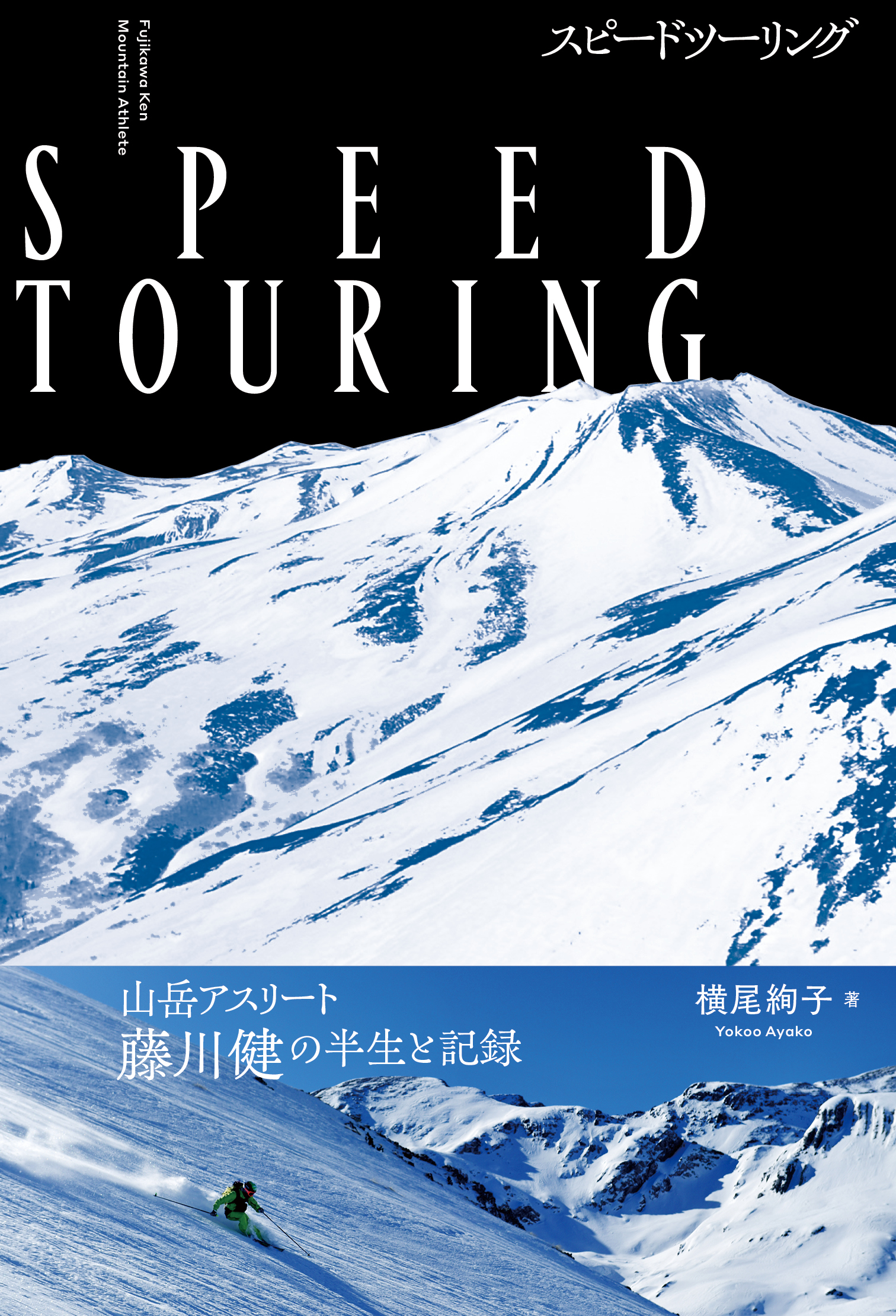
"SPEED TOURING: The Life and Records of Mountain Athlete Takeshi Fujikawa" (by Ayako Yokoo / Rokka Editorial Office)
Price: 2,530 yen (tax included) 200 pages
Available to purchase on Amazon → https://www.amazon.co.jp/dp/499137300X
"From the idea for the book to the time it came to me, I've been working on the contents with my editor for about four years. My vision, or rather the thing that is at the top of my mind, is speed touring.
Both the 100 famous mountains of Japan that I climbed in 33 days in 2014 and the SKIMO that I participate in every year are training for speed touring. I suggested that we summarize all of that and put it all together in one book. There were some twists and turns, but I think that in the end it turned out to be the interesting book that I intended."
This book was not written by Fujikawa Takeshi himself. It was transcribed based on Fujikawa's stories by Yokoo Ayako, an editor at the publishing company who has a long relationship with Fujikawa. Yokoo is a former editor of the mountaineering magazine "Yama to Keikoku," a qualified weather forecaster, and a true Yamaya fan who enjoys mountain climbing, skiing, and telemark skiing.
In other words, this book was completed in close collaboration with Yokoo, who is well aware of Fujikawa's achievements and the background behind them.

"It might have been easier to have it published by a major publisher, and sales figures might have been more certain. But I think the quality of the finished book depends on the editor in charge. It all depends on
how much close communication you have with your editor and how much you share your goals. But a large organization alone won't produce something good. In that sense, I've known Yokoo for a long time, and he's been watching over my work from afar, if only from afar. I'm glad I was able to leave my work in book form at the right time when Yokoo was starting his own small publishing label."
A cutting-edge book that will remain for generations to come
Rather than simply entrusting the production of the book to an editor, Fujikawa himself had an objective view of his ideal finished product
"If it sells a lot, it might bring in some income. But even if it doesn't sell in large numbers, I wanted it to be a cutting-edge book that will remain in the hands of future generations.
Even if only a few people find it interesting, I think the content will be quite appealing to those who are receptive to it."
No matter how good a writer or listener you are, this is not something that anyone could write.
Only someone who has experienced the harshness of mountaineering and the vastness of the mountains firsthand, and who understands the passion and effort that Fujikawa puts into it, could write this.
"I used to work a lot for skiing magazines, so there are a lot of editors who only look at the skiing aspect of it, but there are few editors who look at my activities as a whole, including my time in the mountains.
In that sense, it's easy for me to explain. It's not too far away, but not too close either. I think that just the right distance helped it achieve the style I envisioned."
Fujikawa is also an avid reader, especially of philosophical books. His writing, including his http://telemark.fujiken.boy.jp
"It sounds like a boastful story, so I couldn't have written it myself. I think it was good that Yokoo-san wrote it from a third-party perspective."
What is speed touring anyway?
What exactly is the "speed touring" mentioned in the title? Is it something that pushes people to their physical, mental, and geographical limits, like "Beyond the Mountain Ridges: Speed Touring from the Tokachi Mountain Range to Mount Daisetsuzan," which aired on NHK Hokkaido in November 2024?
"The style of that show is the most challenging part of me. But to me, speed touring is a bit more relaxed. It's
something I've incorporated into regular touring, seeking elements of 'lightness' and 'speed.' It's not the 'skiing-focused' backcountry ski tours that are popular in Japan, but rather a European-style ski tour that focuses on 'movement.'
For me, the latter is the ideal ski style."

When talking about mountain athlete Takeshi Fujikawa, one achievement that cannot be left out is his seven consecutive national championships in SKIMO (ski mountaineering). What position does SKIMO hold for Fujikawa?
"SKIMO is the highest level of speed touring training. It's like everyday jogging."
Winning seven consecutive championships with just everyday training is impressive. SKIMO is a record-breaking event, and the organizers prepare the snowy mountains for the event. The harsh yet beautiful, untouched wilderness of the snowy mountains is exactly where Fujikawa should be
"I would like more people to try SKIMO on a wider scale,
but in a more casual way. It's fine if people just want to have fun, or maybe there's a competition coming up, so they'll give it a try. They don't have to aim to win. In fact, even if they're not competing, if the mountain isn't looking good today, they might think, 'Why not go up the slopes SKIMO-style and ski down?' I'd like
SKIMO to spread in Japan as a form of exercise, similar to jogging. This is something I've been thinking about ever since I started working with SKIMO."
In Europe, where SKIMO originated, it is a familiar pastime that anyone can enjoy, and a form of training.
In Japan, ski resorts generally prohibit climbing the slopes, but is it OK in Europe?
"Europe is basically a free place that values personal responsibility. Even in resorts like Zermatt, there are many people who climb the slopes and ski.
The lifts are running and they have lift tickets, but they just want to climb as a form of exercise."
Climbing next to a working lift is a sight that would be unthinkable in Japan.
Even if you were to encounter such a sight, you would probably be amazed at the feat of a stoic top athlete.
"Japanese skiing focuses too much on the top level. That's not the case at all in Europe. Serious skiers do it at a high level, of course, but the bottom line is thicker.
If you go to a small ski resort in Europe, you'll see mothers with babies on their backs climbing up the slopes on skimo. When you say to them, 'It must be hard carrying a baby,' they say, 'No, it's refreshing and feels great.'
not just skiing, they're climbing, which helps them to stay mentally in shape. Of course, going up a mountain with a baby on your back is a bad idea. But if you're on the side of the slope, you can just climb a little and ski. This is a great way to get involved in skiing and touring, and anyone can do it.
I think this is what skimo should be like."
When you hear the word "SKIMO," you might imagine athletes in tight dresses and helmets, panting and shaking their shoulders, and looking a little intimidating
"The Olympics may be exciting for the most elite SKIMO athletes, but I don't think that's the core of the sport. Japan has misunderstood this important aspect, which is why it's not spreading."
The birth of a ski resort where you can climb and ski
So Fujikawa decided to take action on his own, making it possible to ski up the slopes at the ski resort where he works as an instructor
"I wanted to change the common sense that you shouldn't climb the slopes, so I made it possible to hike up Sapporo Bankei Ski Resort, my home slope.
First, I spoke to the principal of the ski school I belong to and he agreed. He acted as a go-between for me and the ski resort, and we've been trying out all sorts of things.
We've held a series of skiing competitions on the slopes, and we've used the ski resort's budget to rent out around 20 sets of skis and boots."

Seal walking on the detour route of Sapporo Bankei Ski Resort. Walking while balancing on skis will also help you improve your skiing skills
What an innovative idea it is to not only agree to climb the slopes but also to rent ski equipment
"In any case, I don't ski in the backcountry, I climb the slopes with skins and ski down them.
Even if you're starting out in backcountry, I think the first thing you should do is to climb the slopes and ski down
them. We work with the ski resort to create courses, print leaflets, and open up the courses to let people know they can climb up. Because we're a small ski resort, it hasn't become a big movement yet, but it's become established and has been going well for over 10 years."
Why do ski resorts oppose climbing on the slopes in the first place? Is it because it's dangerous? Or is it because it doesn't generate lift ticket sales?
"The simple thing that people think about is the risk of skiers and climbers coming into contact,
but that's just a misconception, and so far there have been zero accidents. In terms of money, there's always the lift ticket, the lift ticket thing. Ordinary people come to ski resorts and enjoy skiing. Ski resorts provide the venue for that. I think this is
a good opportunity to develop business models other than lift ticket purchases, and also an opportunity for people other than skiers to take an interest in ski resorts."
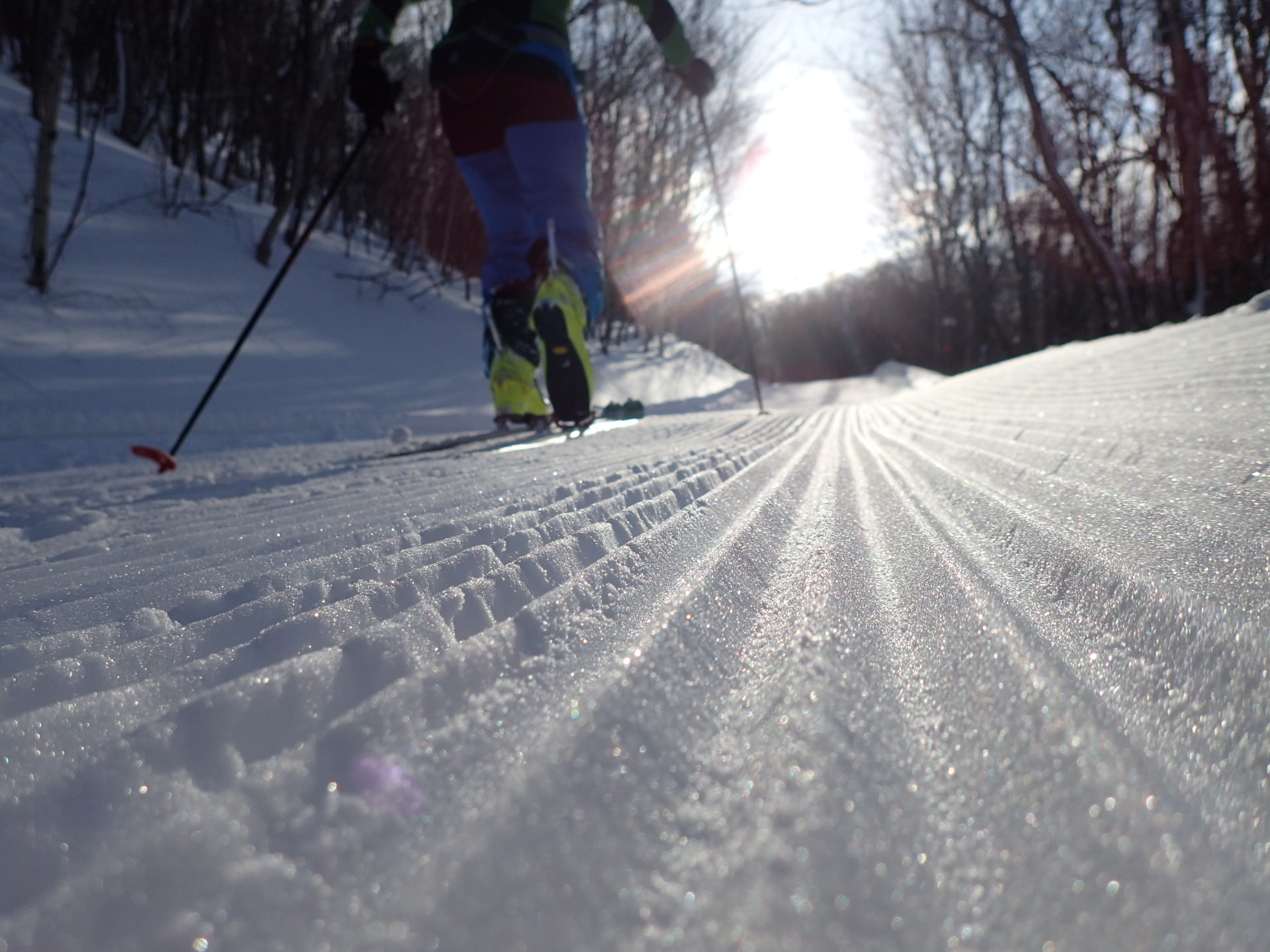
First thing in the morning, you'll be running rhythmically up the well-maintained slopes. Even in bad weather, as long as the ski resorts are open, you can enjoy this as a form of daily exercise. You'll get a sense of accomplishment and exhilaration that's a little different from backcountry skiing
A new pastime called seal walking
Climbing and sliding down the slopes of a ski resort. It's a relaxed activity that's part fun, part training, and part daily exercise. It's quite different from SKIMO.
That's why Fujikawa came up with the name "Seal Walking."
"We stick climbing stickers on the slopes and walk instead of racing. Skis are not just equipment for sliding down the slopes.
They are a multifunctional and excellent means of transportation that can also be used for walking and climbing. Beginners should not head straight to the snowy mountains.
I want the slopes to be a place where all kinds of skiers can practice, whether they are aiming for backcountry skiing or a Grade 1 certification."
For ordinary people like us, ski resorts, which are the most familiar snow surfaces, will not be able to spread unless they open up their ski resorts to beginners. This
was a major move by Fujikawa, who has felt frustrated that skiing and speed touring have not taken root in Japan like they have in Europe.
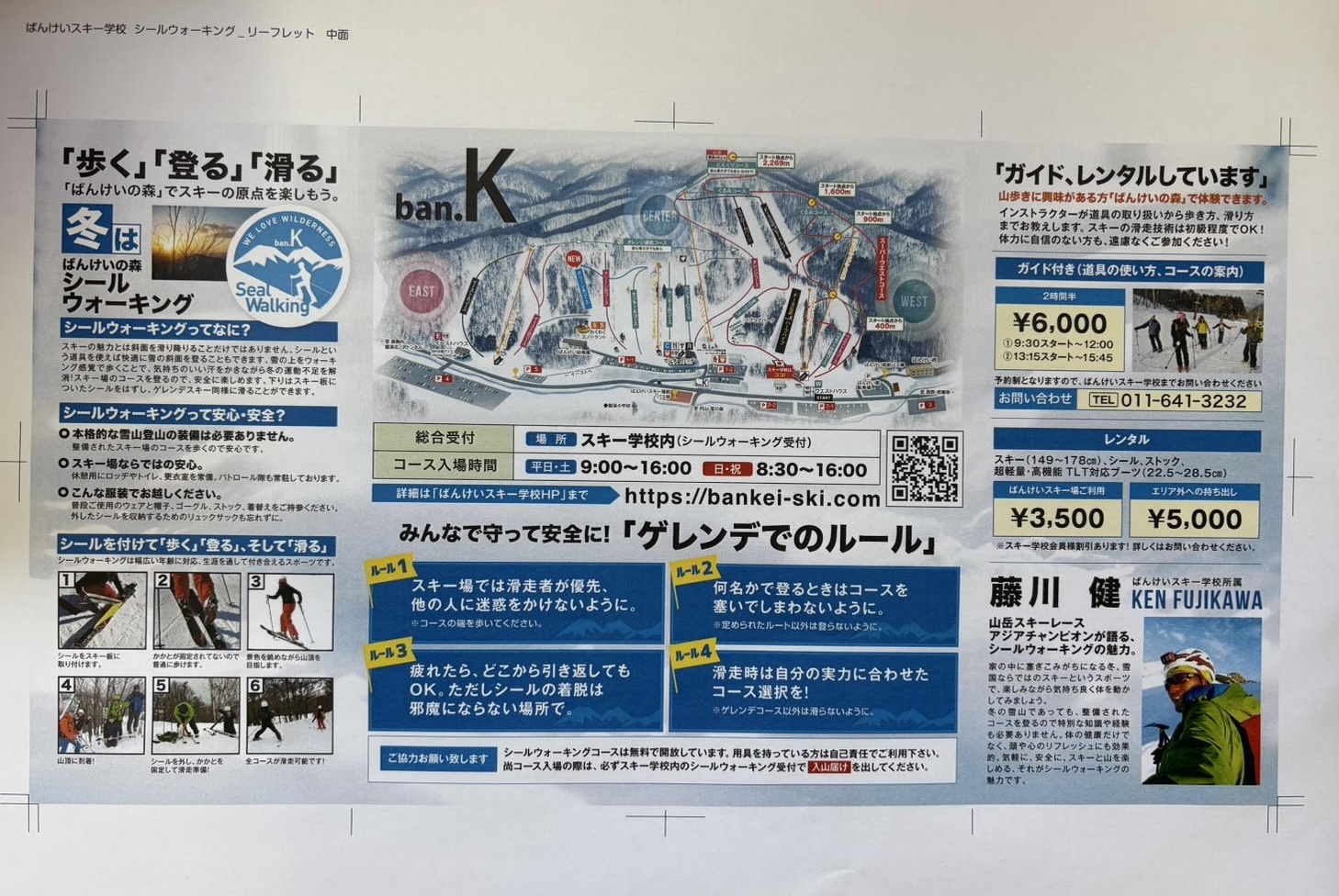
Here is the seal walking leaflet for Sapporo Bankei Ski Resort.
A two-and-a-half-hour guided tour costs 6,000 yen.
Renting a three-piece set consisting of skis, seals, and poles costs 3,500 yen (5,000 yen for taking skis outside the area)
. There are four rules for the slopes:
1) At the ski resort, skiers have priority and should not cause trouble for others. (Please walk on the edge of the trail.)
2) When climbing with several people, do not block the trail. (Do not climb outside of the designated route.)
3) If you get tired, it is okay to turn back at any point. However, you should put on and take off your seals in a place that will not get in the way.
4) When skiing, choose a trail that suits your ability! (Do not ski outside of the slope trails.)
"So no equipment is needed. All
you need are skins and a drink. We wanted to increase the number of beginners, so we had instructors with ski school knowledge act as guides and got a variety of people involved. Skiers on the slopes wouldn't be able to do it if they were suddenly handed just the equipment. We
don't need someone specialized like a guide; we just need someone who can teach them how to use the equipment and the basics of walking. An instructor can even ski down the slopes with beginners. If more ski resorts like this open up, I think the appeal of SKIMO will spread to a wider base."
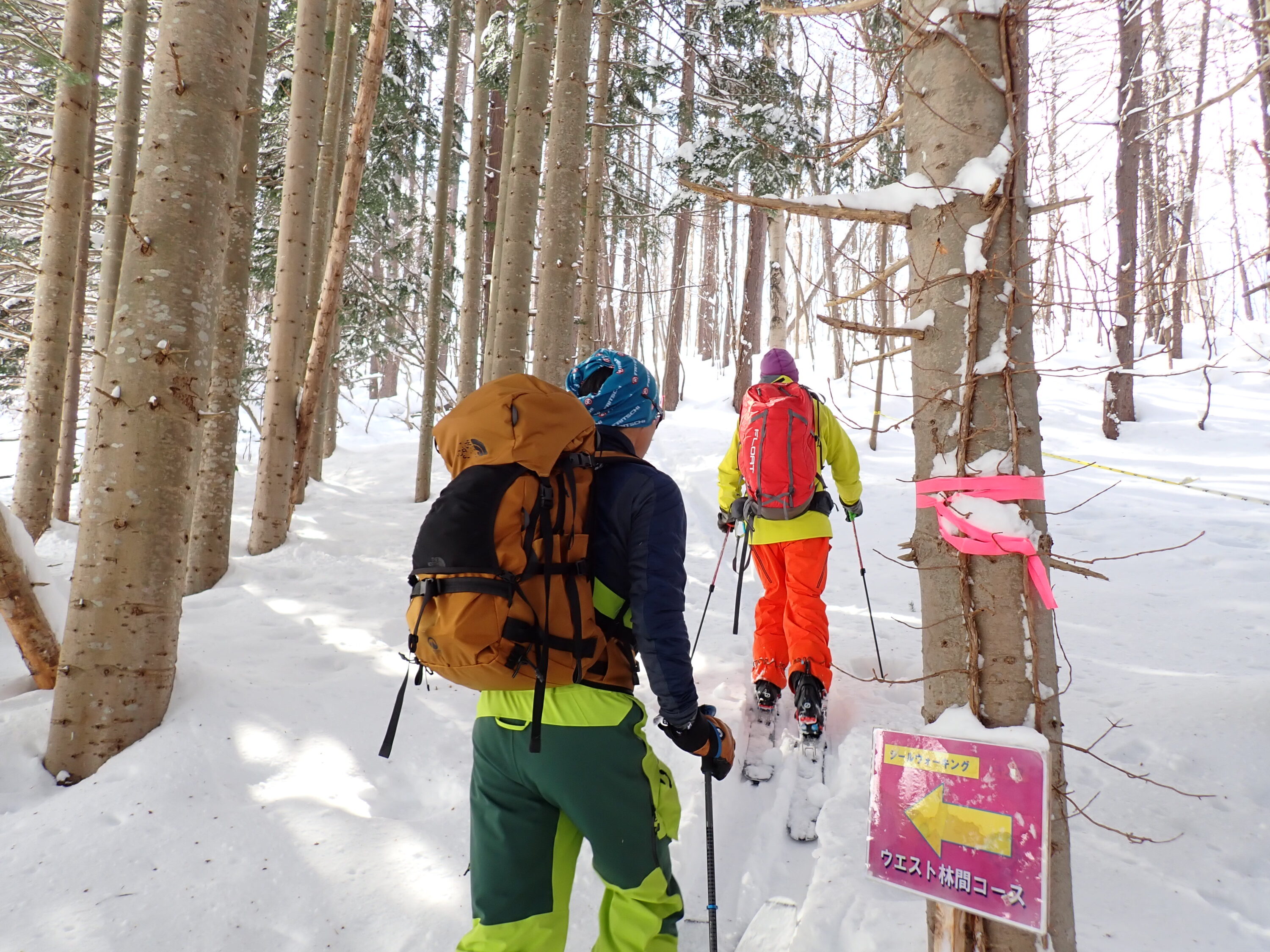

When Fujikawa spoke about SKIMO, I sensed a hint of loneliness in every word he said, a sense of frustration that, even though backcountry skiing was booming in the ski and snowboard world, SKIMO was not well known among the average skier
Having mastered skiing and climbing techniques and confronted the snowy mountains, mountain athletes are now taking the next step. The spectacle of a mother with a baby on her back skiing up the slopes at a Japanese ski resort. This is the dream of Fujikawa Ken for SKIMO
Interview date: Saturday, February 1, 2025
Interview cooperation: Lost Arrow