

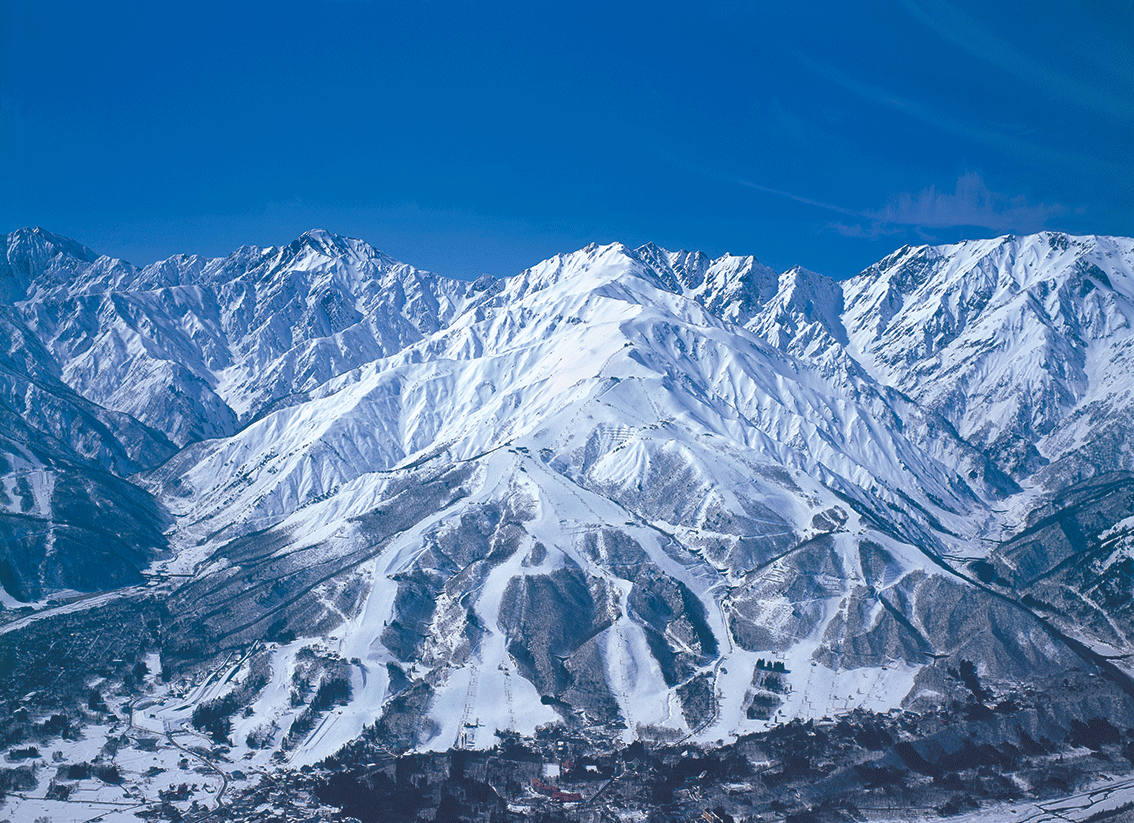

Hakuba Happo is one of Japan's leading snow resorts, and the beauty of the Hakuba mountain range and the huge slopes make it a popular field that never ceases to attract skiers and snowboarders. Happo One Development Co., Ltd., which operates 13 lifts and four facilities at Hakuba Happo One Ski Resort, established the "SDGs Marketing Department" in June 2020, the first dedicated SDGs department at a ski resort in Japan. With efforts on a global scale now spreading, what is the background and spirit behind this pioneering initiative by a Japanese snow resort? What are the actual SDG efforts?
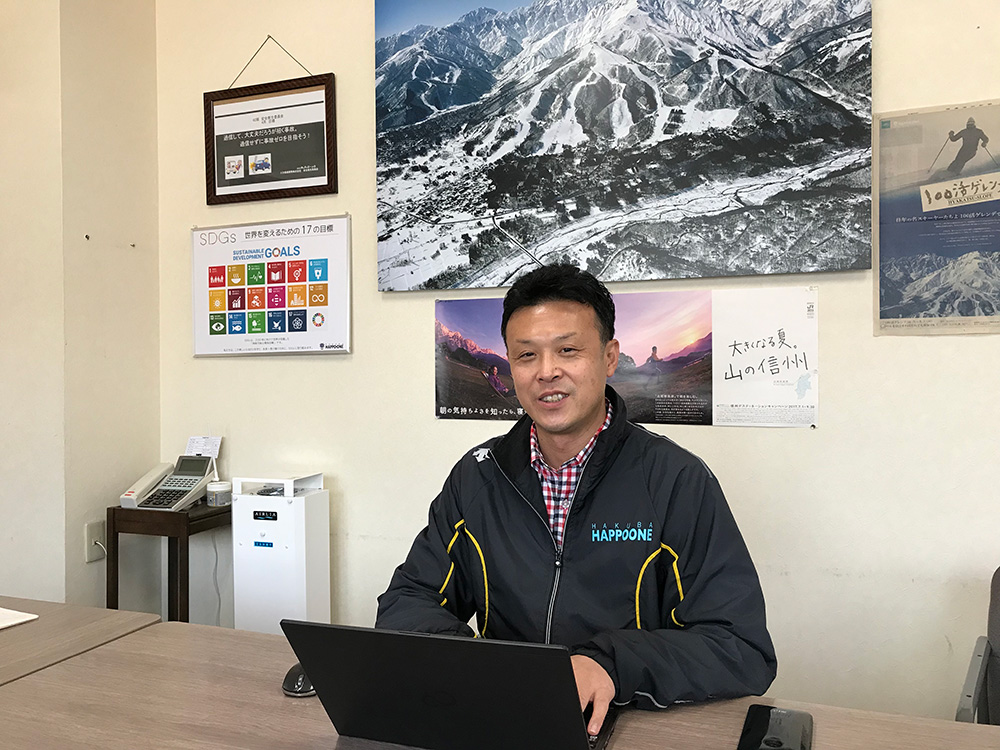
In April 2022, when the Hakuba Alps were still completely covered in snow, the STEEP editorial team visited Happo-One Development Co., Ltd. The company's head office is located right in front of the bus terminal for Happo-One Ski Resort. We were greeted by Akimoto Hideki, head of the sales and management division, who oversees the highly-regarded SDGs marketing department
Background of SDG initiatives
- Why did Happo-One Development decide to start working on the SDGs? Was there a particular reason?
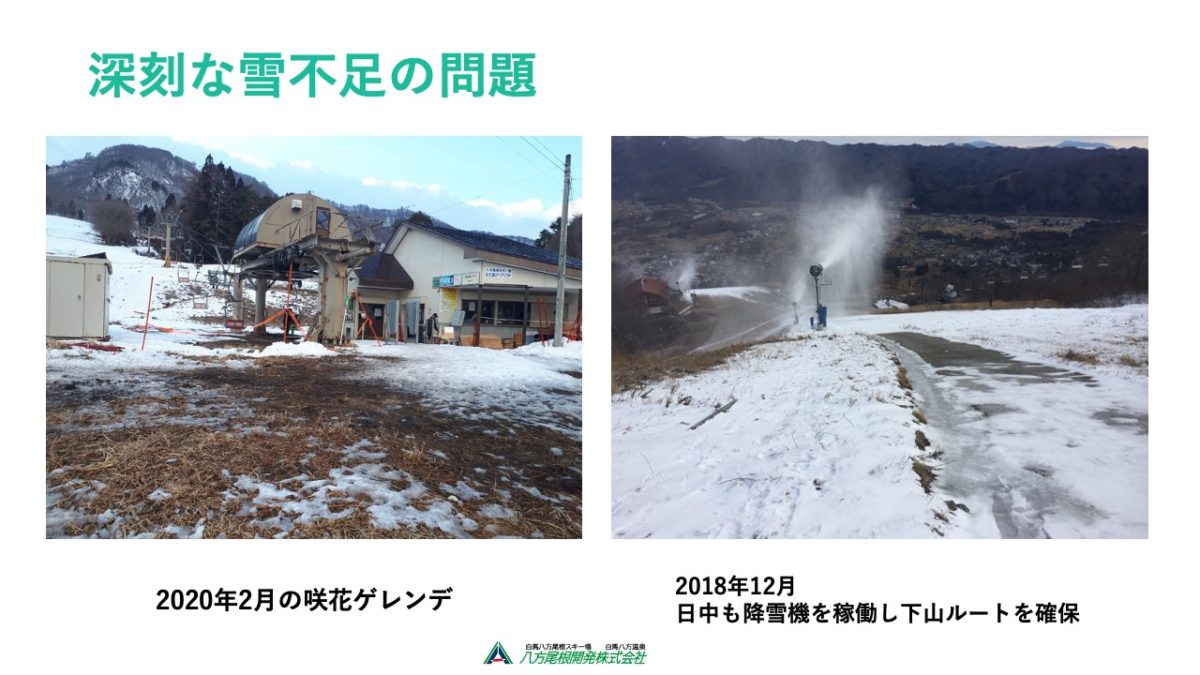
Akimoto-san: We've been feeling the light snowfall for the past few years, and Hakuba has also experienced years without snow. In 2015-16, we had a once-in-a-century light snowfall, and the lack of snow continued until January 14th, making it impossible to ski down to the foot of the mountain. We were saying, "This is a once-in-a-century thing! It definitely can't last two years," and the following season, there was no snow until January 14th either...
*We will proceed with the presentation materials for our efforts towards the SDGs
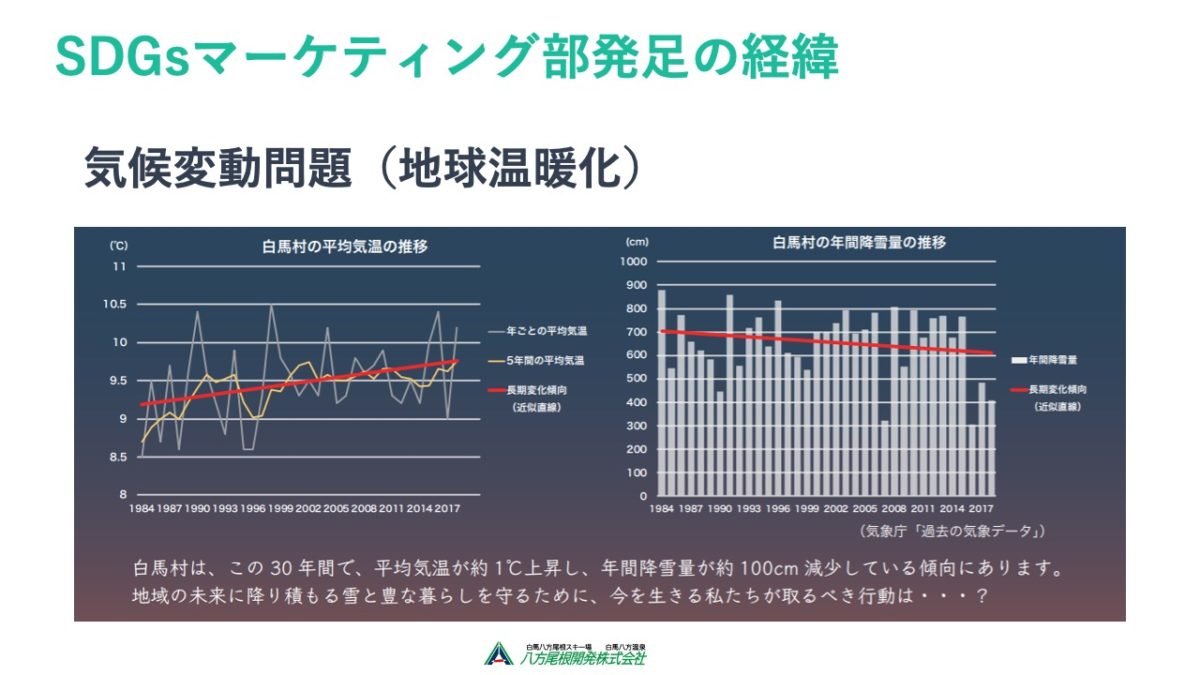
This is truly unusual, but if you look at climate statistics going back about 100 years, temperatures have been rising steadily, and snow has been falling less, so you can really feel that it's not accumulating. Walls of snow no longer form all the way into town, as they used to, and this phenomenon has become more apparent over the past 10 years. This is also clearly reflected in data on the trends in average temperature and annual snowfall in Hakuba Village, which shows that over the past 30 years, the average temperature in Hakuba Village has risen by about 1°C, and annual snowfall has decreased by about 100cm
At that time, in March 2020, our company's president POW Japan , and we hit it off immediately, leading to the decision to join POW. I immediately began the process of setting up an SDGs department. I have been interested in climate change for some time, and I believe it is an issue that companies will have to face as a matter of responsibility in the future, so I wanted to take advantage of this positive trend. What was then the sales department, no longer followed the usual sales style, but rather wanted to start by branding Happo-One itself. So, in June 2020, we launched the "SDGs Marketing Department."
Japan's first ski resort launches "SDGs Marketing Department"
-This was the first time that a Japanese ski resort had an "SDGs Marketing Department," wasn't it?
Akimoto-san: We thought about incorporating digital marketing into our SDG activities. Currently, Hakuba Happo-One Ski Resort has an online lift ticket sales system, and we thought about collecting customer information at the time of sale and sending out information about our efforts to those users via newsletter. We currently have over 10,000 registered users, and it has been two years since we started communicating our SDG efforts
Introducing a digital system requires a considerable amount of money, so we had some difficulties getting started, but we were able to utilize government subsidies to reduce the cost of installing the equipment, and in return, we were able to raise funds for the activities of our marketing department staff.We were able to create a system that would produce results one by one
-What were some of the challenges you faced in the early stages of your efforts?
Akimoto-san: First of all, it was difficult to get understanding within the company. We held something like a promotional meeting and asked, "Do you know about the SDGs?" and everyone replied, "What's that?" (laughs bitterly). At the time, no one had even heard of the term SDGs. However, over the past year, the term has suddenly started to be featured in the media, and I think it has become more widely accepted
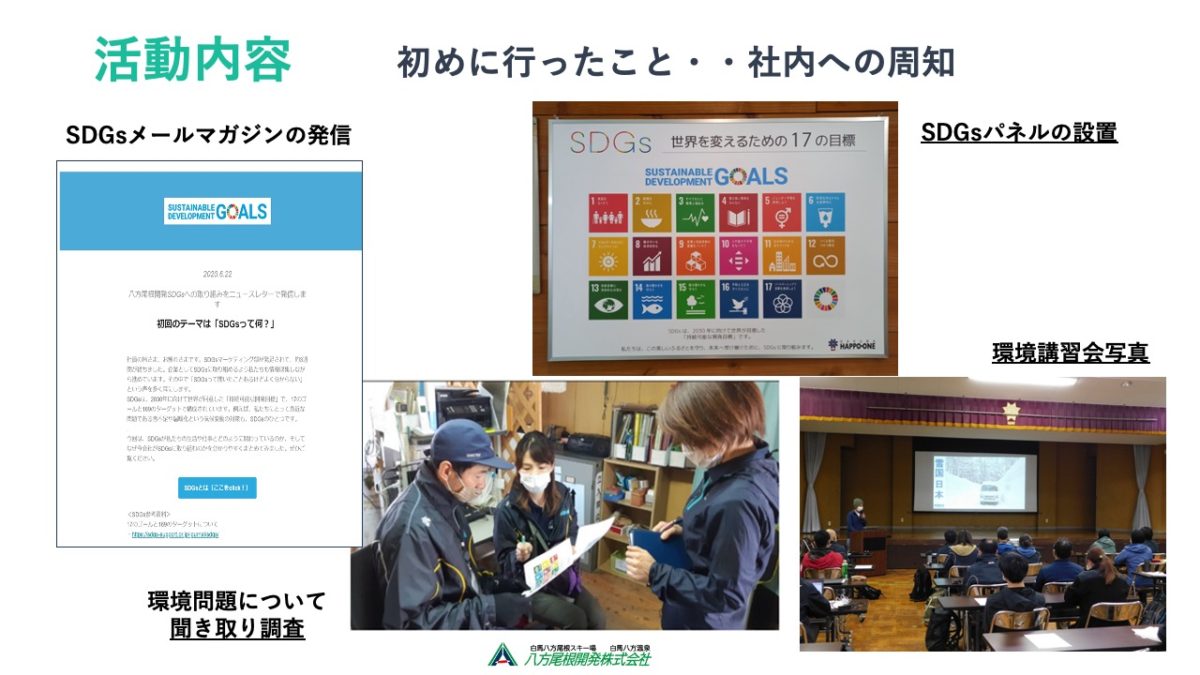
As part of our internal initiatives, we first had a lecture from POW on what the SDGs are, how climate change is discussed in easy-to-understand terms, and what global warming is. To spread awareness, we need to make it visible, so we put up SDG panels in each department, put up renewable energy stickers, sent out information through email newsletters, and conducted interviews about the environment
The first thing we considered in terms of environmental issues was what source of electricity we should use. Because thermal power generation has a major impact on climate change, we thought that the first thing we needed to do was to switch from thermal power generation to other forms of electricity
Therefore, starting with the 2020-21 winter season, we will be switching to renewable energy for our lifts. In the first year, SDG initiatives had not yet progressed nationwide, so we were able to make the switch while keeping electricity procurement costs down, but in the second year, social conditions have changed and we are facing difficulties. The balance between supply and demand has already shifted, making it difficult to achieve this without increasing costs, and we were finally able to switch all of our lifts (13 that we operate) to renewable energy this April

Achieving 100% renewable energy lift operation in unprecedented speed
-That's amazing! The lifts run on 100% renewable energy!
Akimoto-san: This only applies to the portion of Hakuba Happo-One Ski Resort that our company operates... In our first year, switching to renewable energy was just one of the topics of the year, with a plethora of other topics, including the opening of new areas, the introduction of snow machines, online ticket sales, and reservation-only parking. We had the opportunity to announce it on radio and television, and the topic that received the biggest response from viewers was the renewable energy switch. We were a little surprised at the level of interest, thinking, "It's so impressive!" We were encouraged by the many comments we received, such as, "It's very significant that a large ski resort like Happo-One is taking the lead in switching to renewable energy, and we support it!" We feel that we received such support, and we are extremely grateful for it
-User evaluations and support give a sense of accomplishment and encouragement to your efforts
Akimoto-san: That just shows how much people are paying attention to the SDGs, and I could really feel the expectations they have for Happo-One. Light snow is a matter of life and death for ski resort management. If there's no snow, you have to make it, and that's where snow machines come in. This requires using a huge amount of energy to make snow, which is a contradiction in that it "destroys the environment," so to speak, but we thought we could at least switch to renewable energy, so we switched all the electricity used to run our artificial snow machines to renewable energy. The electricity used to pump water for snowmaking is still conventional, so that's our next challenge
Additionally, for snow compaction work on the slopes, we are working on a trial basis to link the driving system with sensors that detect variations in the amount of artificial snowfall, in order to improve the efficiency of the work and prevent unnecessary CO₂ emissions
We also run a hot spring business, and are switching to renewable energy there as well, with over 80% of the electricity used by the entire company, including offices, now coming from renewable sources. If we continue at this pace, we believe we will be able to achieve 100% by 2030
-This is a very pioneering move, starting in 2019 and achieving 100% renewable energy in just three years is astonishingly fast. What made it possible to achieve this speed?
Akimoto-san: I think the hardest part is getting people to accept our efforts. We need to make what we're doing visible and have stakeholders, or teams of people who will work with us, both inside and outside the company
In that sense, the Hakuba area's ski resorts are united under the name HAKUBA VALLEY, forming a DMO called "HAKUBA VALLEY TOURISM," which has established an organization called the SDGs Subcommittee. We have been involved in this organization since its early days. Its members include government and local representatives, so we are able to share our respective activities and gain their understanding and support, which is also a driving force behind our activities
It's also true that the SDGs have become a hot topic of discussion over the past year, which has given us a boost. We've started using Slack as an information tool within the company, and since we share information across the entire company, it's become natural for everyone to not remain indifferent. Now, people from other departments feel free to share ideas like, "We're thinking about this, do you think it's possible?" or share their questions and opinions like, "How does this fit into the SDGs? Isn't that a bit wasteful?" When we first launched, no matter what we said, they were met with a "...???" response, so it's become a lot more reliable (laughs)
Individual departments have begun to review fixed costs, and I can really feel that the chemicals of the SDGs are bringing about change within the company. Internal communication has also become more active and open. I think this kind of environment is also very important in quickly making progress on initiatives. Right now, it feels like things are running very smoothly
I feel like it's going really well now
-What is the current structure of the SDGs Marketing Department?
Akimoto-san: I oversee all marketing, and the SDGs Marketing Department has three female staff members, one of whom is from Australia. Before the COVID-19 pandemic, 40% of our users were inbound tourists, so responding to diversity is also an important theme
Recently, we've been expanding our efforts beyond just renewable energy. We held workshops with local students to think about environmental issues, and this winter we created a large snow sculpture of a whale. We wanted to give them a firsthand experience of the problem of light snow by providing an opportunity to realize that the snow we take for granted is not something to be taken for granted
Happo-one has always been involved in vegetation restoration projects to protect alpine plants in the summer, so the local community has an interest in nature conservation. The area also hosts many school trips, and has begun offering products that incorporate SDGs experiences in collaboration with the local community
-There are concerns that SDG initiatives will not directly lead to increased business or sales, and in fact will be costly. Was there any opposition or resistance to this?
Akimoto-san: Due to the nature of my job, I have often visited overseas resorts for inspections. In the United States, the first department to consider the SDGs (there were no SDGs at the time) and the global environment was established at a ski resort in 1998, and it has been 20 years since then. Now, there is not a single resort in the United States that is not working on environmental issues. As a result, customers support the ski resort's efforts, become loyal customers, and become loyal customers
Another benefit is that it will create a demand for employees who want to work for companies that are properly addressing environmental issues, and it will be possible to attract highly conscious, high-quality human resources. This kind of beneficial trend is certainly beginning to take hold overseas
We also felt that we lacked the ability to fulfill social significance while running the ski business, and that this was why people were unable to commit to their jobs and stay put, and why we were unable to attract young people who were motivated to work here. We felt that we should give back to society and the local community what we have gained from the natural blessings of the mountains and snow, and that this was a major reason why we started working on the SDGs
-It's about creating an environment where people who love snow mountains and nature can work with pride
Akimoto-san: In fact, in the first year, a young person came to us saying, "There's a department that's partnering with POW to work on the SDGs, right? I'd like to work part-time here!" He had high skills and a strong sense of responsibility, and he worked really hard. When we work on the SDGs, people are able to commit and do a good job even for a short period like this, so we're starting to hope that we'll naturally be able to attract talent from both within Japan and overseas. Furthermore, if people with disabilities can play an active role, it will also help to establish diversity
Also, it will definitely raise awareness of waste, which will have the benefit of allowing us to effectively cut out excesses that we may have had up until now. Our company has been around for about 60 years, and until now, most of our staff were from the local area. Now, 20-30% are local, and the rest are people who came from outside and have settled in Hakuba. I think we need to create a company where many different people can commit in many different ways
What can be given back to users?
-Have you been able to directly give back to your customers through your SDG initiatives?
Akimoto-san: I think that's an area where we still need to work harder. Take parking, for example. In America, if people share a car, it's more efficient, they use less gasoline, and they reduce CO₂ emissions, so they offer discounts on parking fees
However, we are still not very diverse in our efforts, so it may not feel like we are directly benefiting our customers. If we talk about the details, we are reducing costs by preventing disposable items and promoting secondary use, such as not using disposable chopsticks in restaurants and collecting and reusing IC chips, and we are thinking about returning the accumulated savings to our customers
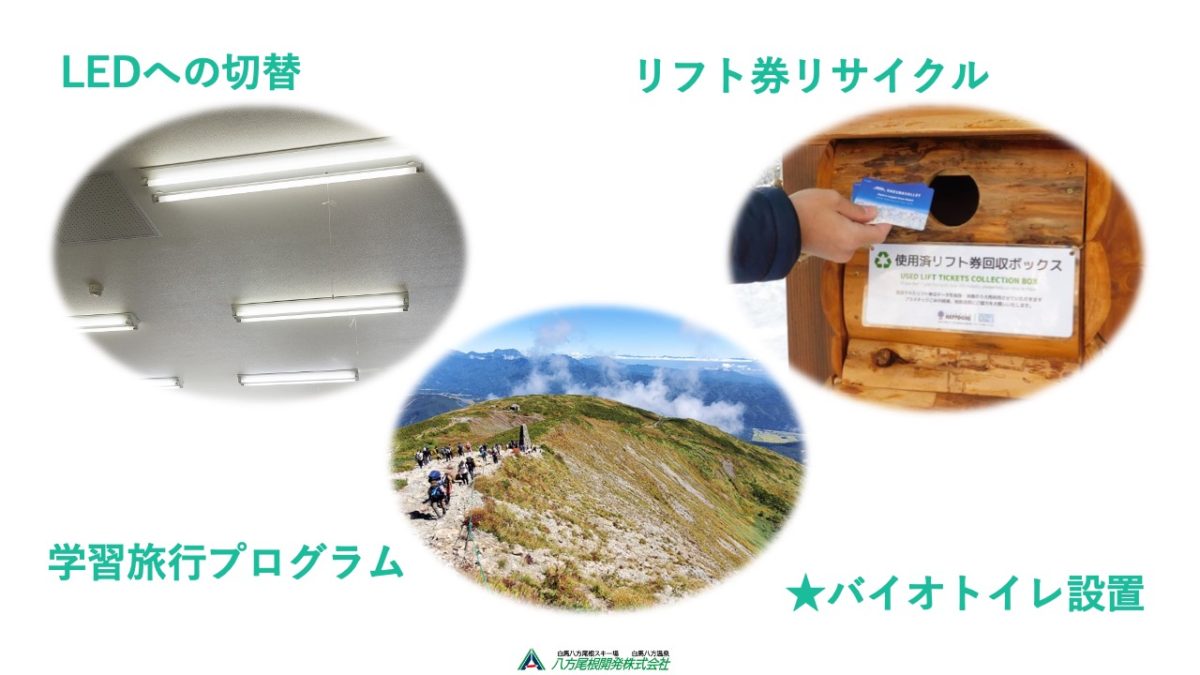
This year we tried our hand at biomass toilets, which are rare in cold regions. I think it's important to find partners who are interested in such things and want to work with us, and to proactively tackle what we can do "now." In a sense, I think that by walking together with our customers, we can see how we can give back in the form of SDGs
Have you noticed any positive reactions from customers?
Akimoto: I still don't know if users think, "I want to go to Happo-one because Happo-one is doing these kinds of initiatives," but at the very least, I don't think there are any critical voices asking, "Why are you doing that?" If they hadn't done anything, I'm sure there would have been voices asking, "Why aren't you doing anything?"
―I don't think there will be any complaints unless the lift fees go up
Akimoto-san: It's a bit of a reverse idea, but if there's a program that resonates with customers from the perspective of protecting the natural environment, I feel like the combination of lift fees and additional fees could also lead to support. I'd like to say, " the SDGs initiative!" A mechanism that allows customers to feel that they are making an added value by contributing would be a new initiative in itself, so I would like to hear from customers through a questionnaire survey.
-You are aiming to achieve 100% renewable energy by 2030, but how quickly do you expect these efforts to change the snow industry?
Akimoto-san: I feel like the ski industry as a whole isn't on the same page when it comes to initiatives. Half of the ski resorts in Japan are privately run and the other half are publicly run, so considering the issue of Japan's declining population, I think they won't be able to survive unless they shift from products aimed at the masses to products aimed at the upper classes. This will make such movements increasingly important, and the number of ski resorts that can focus on them will be somewhat limited
Considering differentiation and customer needs, ski resorts of a certain size will likely take the lead in this effort. However, realistically, it would be difficult to get the entire industry on the same page due to individual circumstances
However, ski resorts are artificially created by cutting down forests, so considering the nature of our livelihood, I strongly feel that we need to be proactive in protecting the environment and contributing to society
-In addition to renewable energy, you are also working on other SDGs。
Akimoto-san: the SDGs . In recent years, our auberge-style accommodations, which offer hospitality using ingredients from Hakuba and Nagano Prefecture, have become extremely popular. Even the more expensive types, which cost around 100,000 yen, tend to sell out in no time.
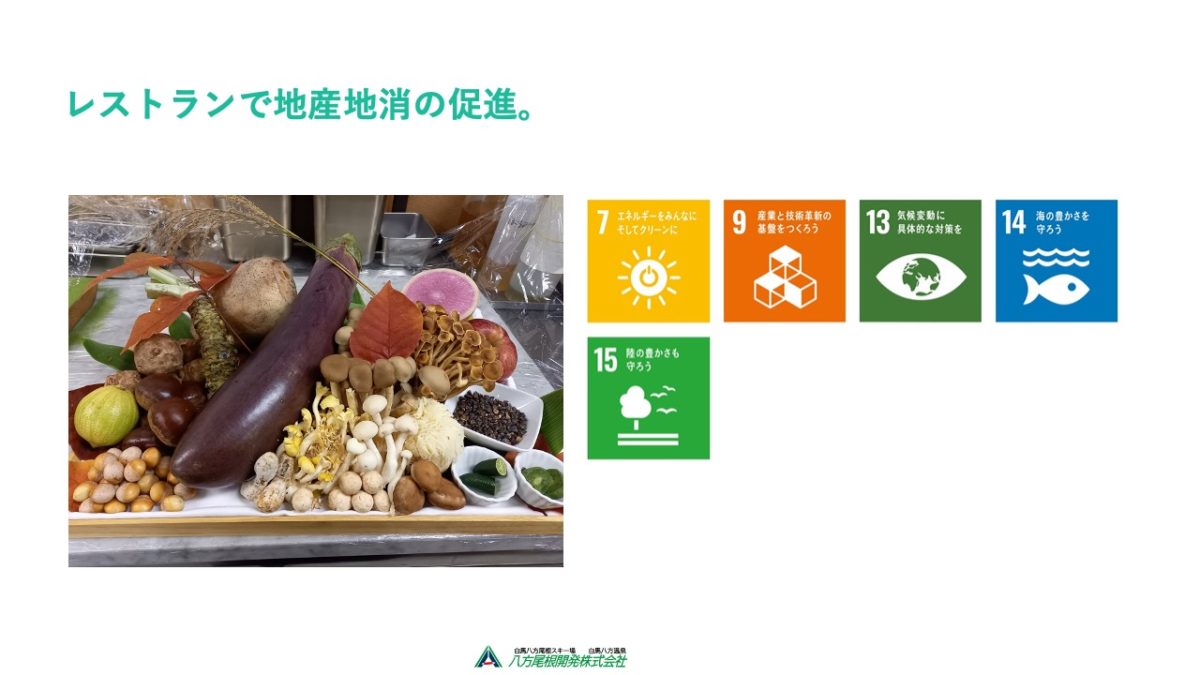
There are also cases where gender issues, such as LGBT, need to be considered. There are a certain number of LGBT people living in Hakuba. It's not a goal that can be achieved today or tomorrow, but just getting into the ring is the first step, and I think that attitude is important
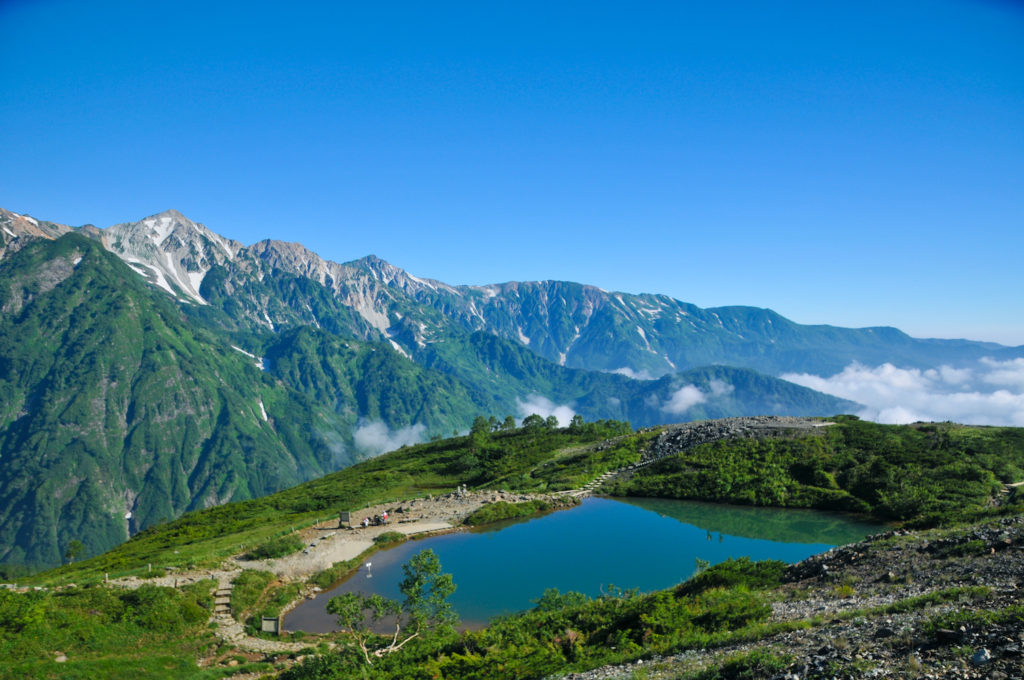
Happo-one has many themes that can contribute to the SDGs throughout the year, such as the natural environment, snow-capped mountains, and alpine plants. We would like to work together with local people to make Hakuba a more sustainable and prosperous place, so that we can steadily move forward with what we can do, one by one
-Is there any memorable episode that made you feel glad that you worked on the SDGs?
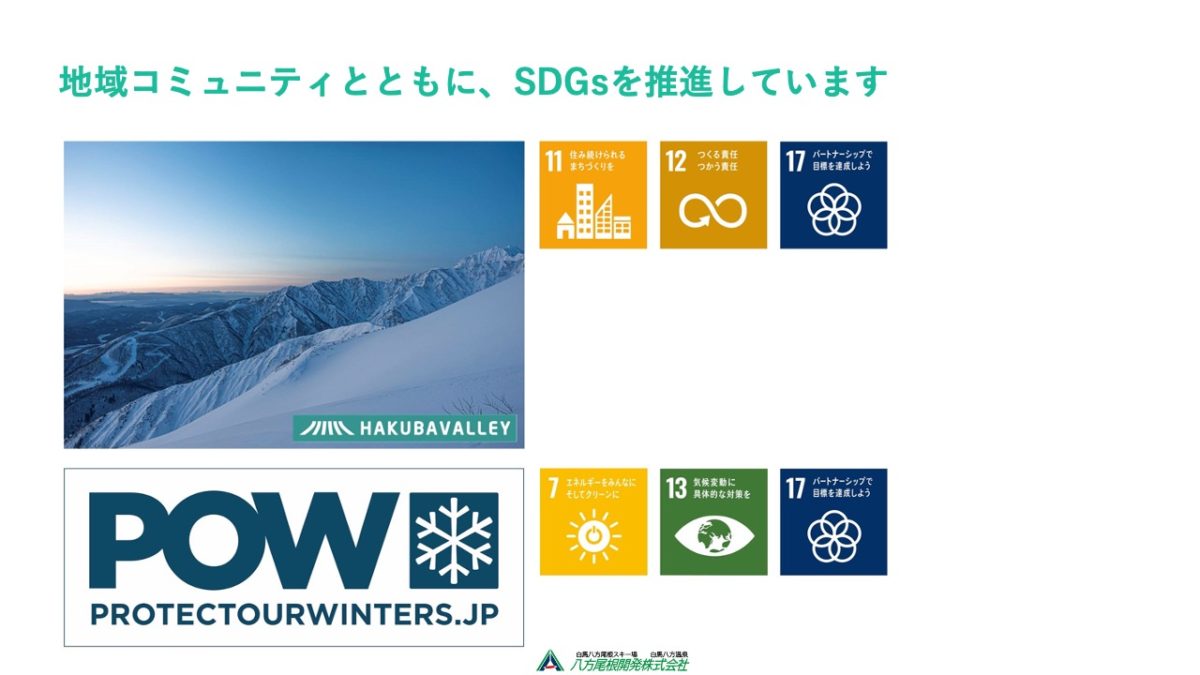
Akimoto-san: Because we were the first to start working on the SDGs, people around me have started reaching out to me in various ways. I've expanded my network, not only with POW Japan, but also with new contacts, and I'm now communicating with industries and people I'd never had any contact with before. This is very encouraging, and I think it represents great potential for the snow industry, which has been relatively "closed" up until now. When I think of this as one of SDG Goal 17, "Partnerships for the goals," I can't help but feel that the SDGs are profound
-Finally, please give a message to skiers and snowboarders who are "thinking about the future of snow"
Akimoto-san: Environmental problems cannot be solved by the efforts of only certain regions or companies. Change can come from each individual starting to do what they can now, even if it's just a little. Hakuba Happo-One Ski Resort will continue to tackle environmental issues so that everyone can enjoy winter sports for many years to come. Let's work hard together toward the SDGs!
the person who taught me
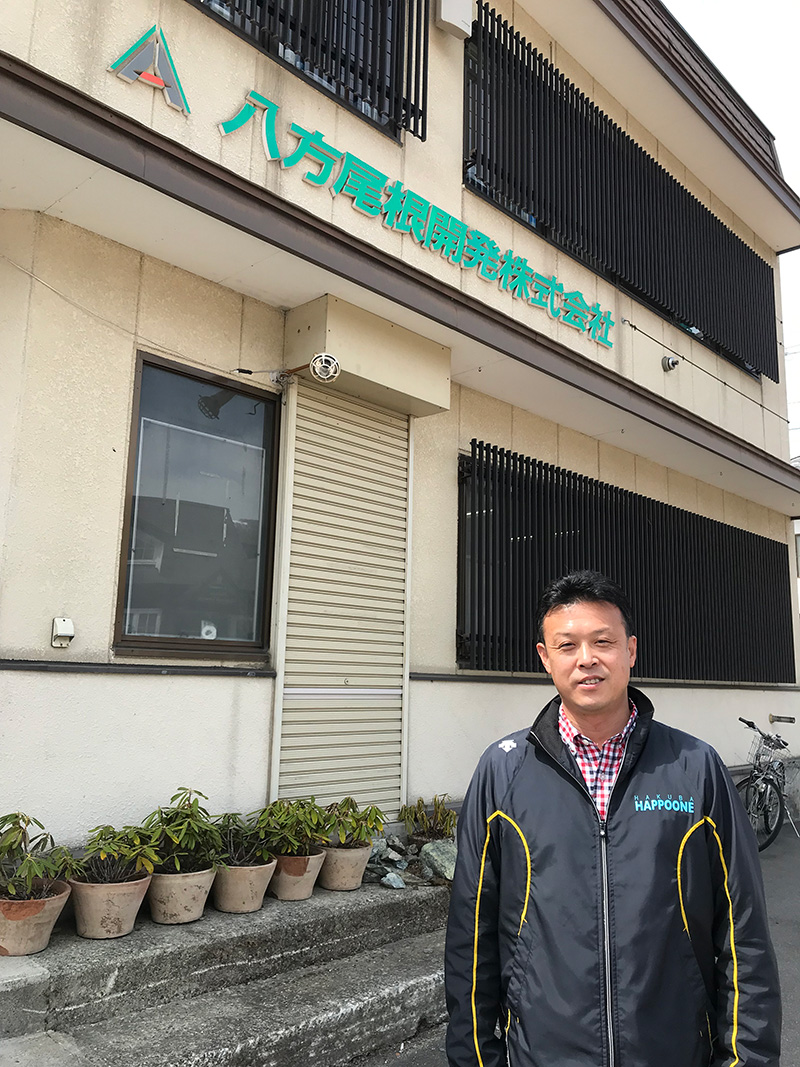
Hideki
Akimoto
Executive Officer, Head of Sales and Management Division, Happo-one Development Co., Ltd.
Born in Tokyo, he has worked in the food and beverage industry and trade before moving to Hakuba in 1998.
He moved here in 2005
and became the head of sales in 2015.
In 2016, he became an executive officer, overseeing the management and sales departments. He currently serves as vice president of the Happo-One Tourism Association, working to revitalize the region.
Interview cooperation: Happo-one Development Co., Ltd. Interviewed in April 2022 by STEEP Editorial Department