

It's been about three years since ski boots equipped with the BOA Fit System first appeared. While the high level of fit and precise control have been widely praised, there's still a strong preference for the traditional buckle type. What are users feeling now, and what choices are they making? And how do pro shops, which interact with real skiers on a daily basis, view the situation? We asked nine pro shops that carry BOA boots about the current state of affairs
BoA's current position, three years after her debut
It's been about three years since the BOA Fit System was fully adopted for alpine ski boots. When it first appeared, there was a mix of excitement and anxiety, with people wondering, "Is BOA really necessary for ski boots?" and "Can it be trusted as a replacement for buckles?"
However, nowadays, major brands are successively releasing models equipped with BOA, expanding their lineups, and awareness has greatly increased, especially among intermediate and advanced skiers. The number of skiers who actually try them on at demo events or in stores to experience the fit and evaluate their hold and fine-tuning capabilities is steadily increasing
On the other hand, looking at the market as a whole, BOA has not yet completely replaced the traditional four-buckle system. Many users are still carefully considering their purchase due to factors such as price range, the number of models available, perceptions of durability, and the trust they have in the buckle structure they have been familiar with for many years. Furthermore, some users say they want to get a four-buckle watch while they still have the option, indicating that user values are still polarized
The background behind the existence of both supporters and cautious individuals
So, what are the images and evaluations held by these polarized users? Our editorial team has heard comments like these at test drives and user events
Voices of support for BOA
- The entire foot is evenly compressed, providing a high level of fit
- It has a snug fit that envelops the entire foot, with almost no pressure points
- The dial allows for easy fine-tuning and easy retightening
- Easy to put on and take off
- They have excellent after-sales support
Voices of people considering the purchase carefully
- I'm worried about whether it will break easily, its durability, and whether it will last a long time
- Models using BOA technology are expensive
- The traditional four-buckle design provides a sense of security because it allows for partial tightening
- I'm more used to and prefer the direct feel of a buckle
- I'm hesitant to use it in competitions
How do pro shops, which interact with users on a daily basis, view the changes over the past three years? Let's hear their real opinions
Reviews by professional shops
While awareness is established, many are cautious about purchasing
. I feel that boots with BOA are quite well-known among intermediate and advanced skiers. However, beyond that, only a small number of people are absolutely set on buying BOA boots for their next purchase. Many people try them on and consider them if they are better than boots with only buckles, or they are cautious about purchasing them because they see them as still not mature in terms of price and performance. Some people also have a need to buy 4-buckle boots while they are still available.

User reviews are overwhelmingly positive, and the key to future success lies
in reaching out to inexperienced users. There are virtually no negative reviews from current users. The ability to fine-tune the tightness and the even tightening are highly praised. On the other hand, it seems there are still a certain number of people who have never used BOA boots. Many skiers still seem to prefer buckles.

Customer satisfaction is high, and there have been no requests to switch back to buckles
. More users are choosing BOA, and I think its recognition is increasing. While the number of pairs sold is increasing, I thought that the number of repairs would also increase, but this season we have only had one exchange at our store.
Conversely, the reasons for not choosing them or deciding against purchasing them remained the same as when they were first released: "They don't have narrow-last boots" and "I like the unique feeling of being held down from above by the buckle."
If we can offer narrow-last boots, I think we can better engage customers who are more active and demand precise control. User feedback has been overwhelmingly positive, with no one expressing a desire to switch back to buckle boots. It seems many are convinced of the appeal of BOA

The number of users who specifically request BOA boots is steadily
increasing. They are gaining popularity year after year, and more and more people are specifically asking for BOA boots. Many customers say that they can be easily tightened and loosened, and that they don't have the "partial tightening" problem that can occur with buckle boots, making them very comfortable to wear.

Junichi Sato, Staff member
at outdoor shop Permark
The snug, enveloping fit is very popular.We hope to see an expansion of tighter lasts in the future.
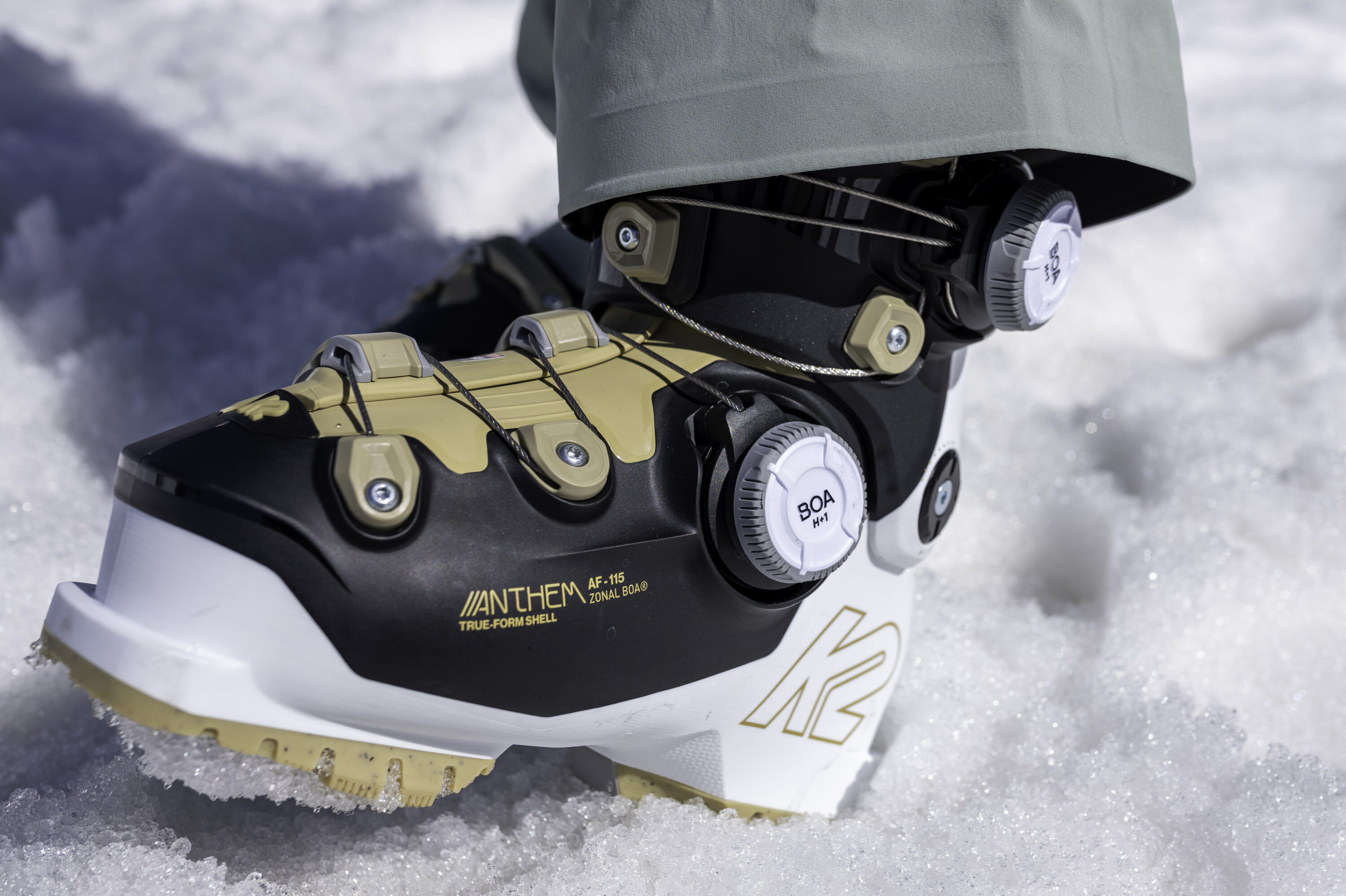
While we mainly handle K2 boots with the BOA system, the overall snug, enveloping fit is extremely well-regarded.
Personally, I hope that more brands will offer models with narrower last widths and tighter fit, even for backcountry models with tech holes.

The lower BOA is highly regarded, while the upper BOA is still under consideration.
Regarding the lower shell BOA, I think it could be the default setting except for racing and demo models. There are almost no complaints from users who use it, and on the contrary, it seems that many people around them are becoming interested in the BOA.
As for the upper BOA system, it hasn't become widespread yet, and to be honest, we're still waiting to see how things develop

the essence of BOA, which is a good fit rather than just ease of putting on, is
starting to become more widely understood. In fact, we're receiving more requests for BOA boots from users. However, there are still many skiers who think that "BOA boots are easy to put on (to slip your feet into)."
The BOA system is not simply a replacement for buckle systems, or a way to make boots easier to put on and take off. I think this misunderstanding needs to be corrected. At our store, we provide thorough explanations before customers make a purchase, and we have received positive feedback from those who have actually bought them. Ultimately, I believe that you need to choose a shape that fits you well before wearing BOA boots

Initial concerns have now turned into trust. The failure rate is the same as or less than that of buckles.
In the first year, I think there were a certain number of shop staff like us who were apprehensive. While fit preferences vary, the level of adoption has increased considerably, regardless of the type of skiing.
We often receive inquiries about malfunctions, but based on my experience so far, it's the same as or even less than that of buckles. The support is also excellent, so the level of trust is high.

With few malfunctions and excellent support,
we haven't yet received any complaints in stores saying "I regret switching to BOA boots." Moreover, the number of models featuring this system is increasing year by year from various manufacturers, and it's starting to be incorporated not only into backcountry models but also into boots for groomed slopes, so it seems to be a system that's well-suited for ski boots.
When choosing a product for the first time, some users worry about things like, "Will the wire break?" or "It seems like it might break." I actually use it for about three seasons myself, and I also listen to examples of malfunctions I've heard at manufacturer training sessions, and then I guide them accordingly
At our store, we rarely see customers bringing in products because they've "broken down." BOA offers a solid warranty, and customers can order replacement parts themselves free of charge via their website. Personally, I think it's a system with many advantages

What we learned from the voices of professional shops
What we've learned from these shop comments isn't simply whether "BOA is popular," but rather that the phase of user evaluation has shifted
When BOA ski boots were first released, the main topic of discussion was likely concerns about the unknown technology, such as "Will it be durable enough?" and "Will it really replace buckles?" However, now, three years later, many shops are saying in unison that actual malfunctions are less frequent than expected, and that users have given them very high ratings. In particular, the comfortable fit due to the uniform tightening and the ease of fine adjustments were universally praised by many shops
On the other hand, BOA has not become the "norm" or "first choice" for all skiers. A significant number of users prefer the secure fit of traditional four-buckle systems, and some refrain from purchasing BOA due to its price and limited range of last widths. Furthermore, the misconception that "BOA = easy to put on and take off" persists, making proper fitting and careful explanation of the system's characteristics crucial for customer satisfaction in shops
From a broader perspective, it could be said that BOA is steadily progressing from a "new mechanism" to a "strong option." In the future, as more evidence of its durability is accumulated and the variety of compatible models and last widths expands, the number of users choosing BOA may increase even further