

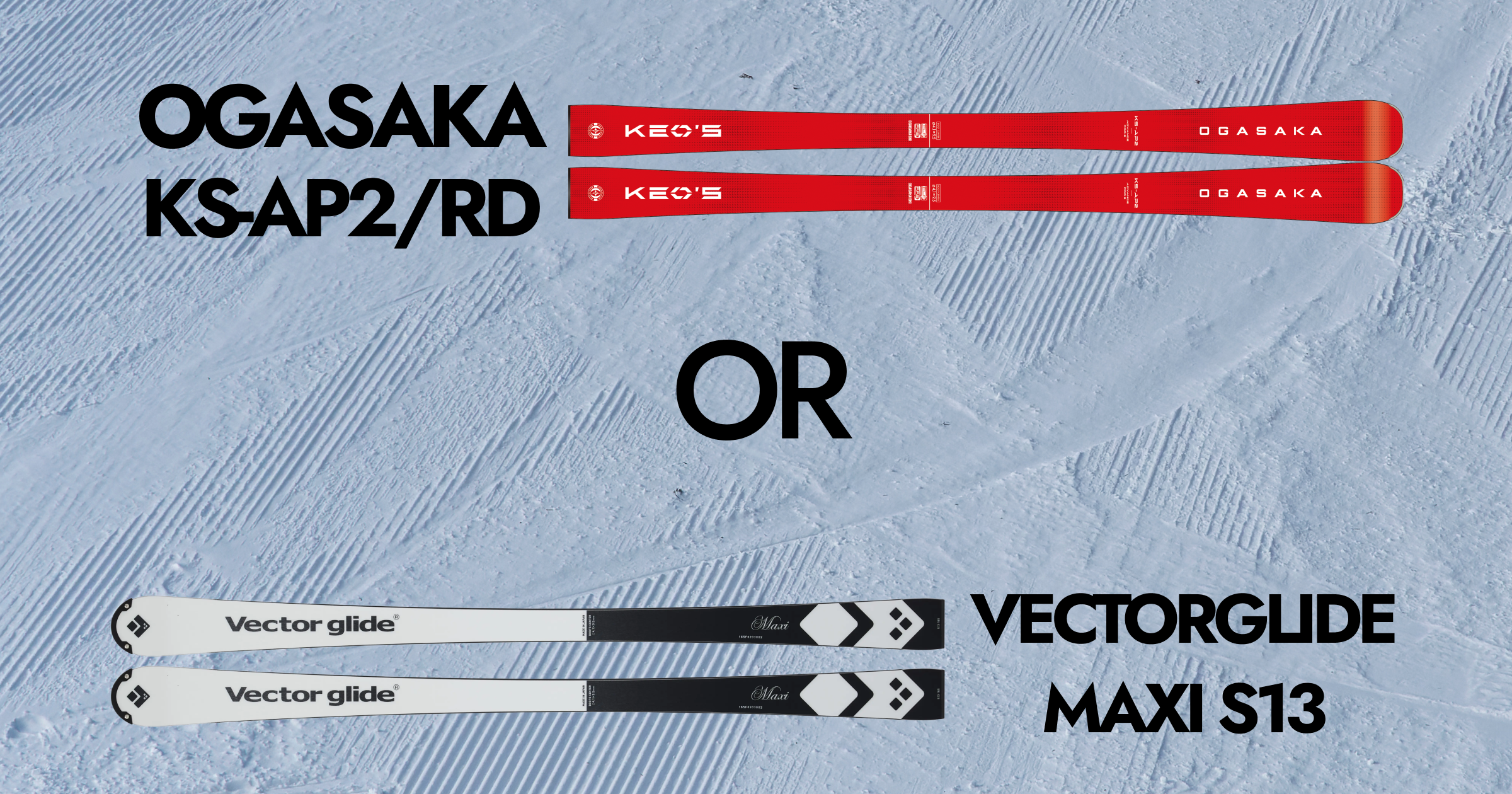
The differences in the "feel" and "character" of skis cannot be fully understood from the spec numbers alone. This is the depth and enjoyment of choosing skis. Therefore, we've picked out two similar 26-27 model skis to highlight. Let's explore their individual characteristics based on user test ride reviews. Which one will you choose?
OGASAKA "KS-AP2/RD" or VECTORGLIDE "MAXI S13"?
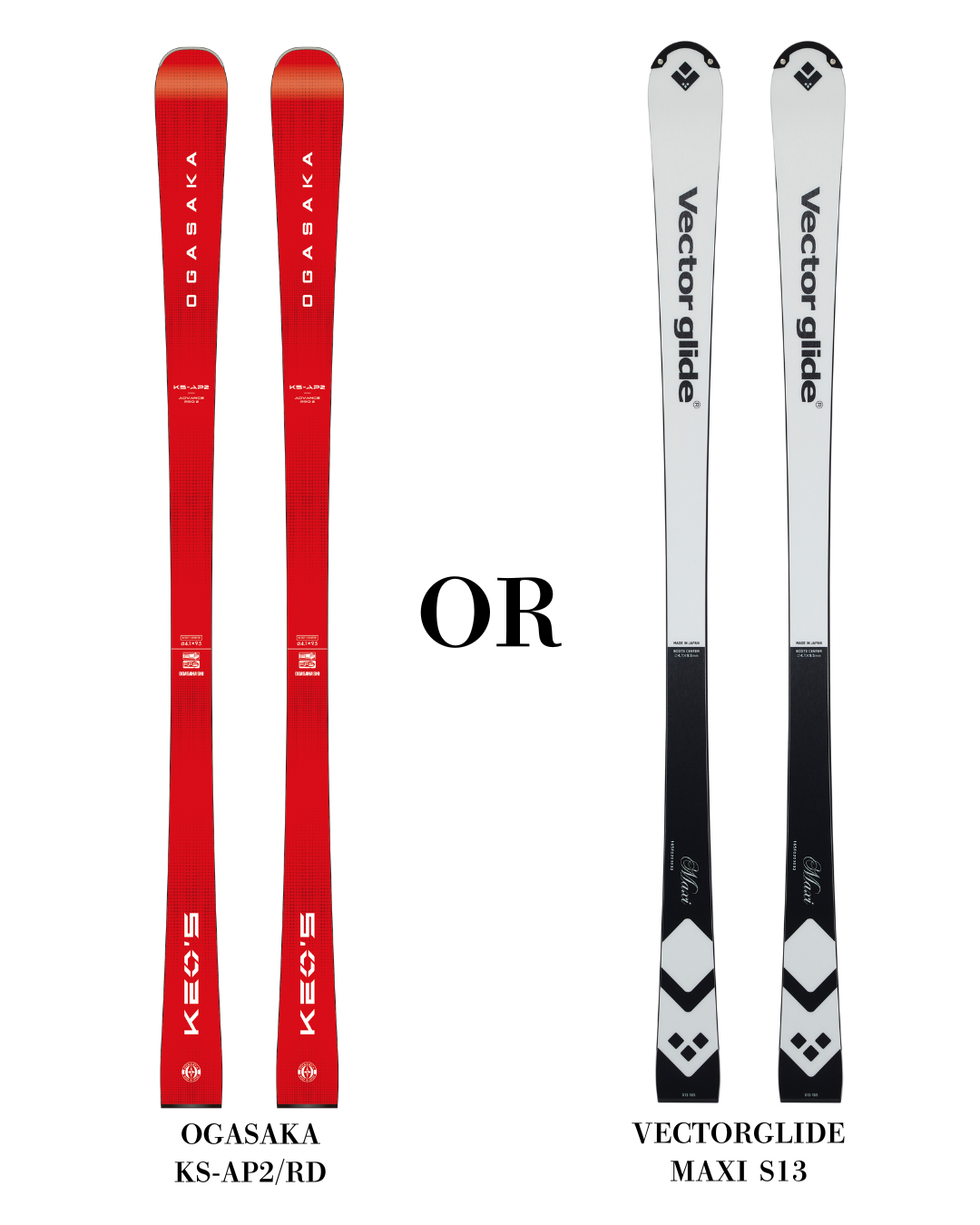
They both have the same 67mm waist width. Their R-values are also almost identical at approximately 13m (165cm). These two models, both described as technical all-around models, are quite similar in terms of specifications, but...?
| Model | D (Dimension) | R (radius) |
| KS-AP2/RD | D=120-67-102mm | R = 12.7m (165cm) |
| MAXI S13 | D=121-67-105mm | R = 13m (165cm) |
"KS-AP2/RD" is this kind of ski

The "KS-AP2," an evolution of the pioneering "Keo's" series of carving skis, is a refined model based on the original "KS-AP." While the TC series is geared towards competition, the KS-AP2 is positioned as an all-around technical model. Unlike the KS-UP, which prioritizes ease of use, this model focuses on short to medium turns and achieves smooth and precise skiing even at high speeds. Based on a race-derived structure, it suppresses excessive rigidity to accommodate a wide range of skiers. This ski embodies the essence of basic skiing: "skiing precisely."
Katsumi Noda of "NODA Ski Workshop" test-rode the KS-AP2/RD. What were the reasons for his all-5-star evaluation...?
This is a basic model that combines quick turn initiation with all-around performance. While inheriting the mild rigidity and maneuverability of the previous model, the tip grip has become much easier to understand, and the carving performance has been further improved. It
is not as demanding as the TC series for technical competitions, but it is ideal for those who find ordinary all-around models insufficient. I think it is suitable for those who want a clean turn arc and quick initiation for certification and prize competitions, those who want to ski comfortably with one ski not only for short turns but also for medium turns and groomed freestyle, and those who want to improve the quality of their transitions and the first half of their turns in prize competitions. I think it will be
most enjoyable in situations such as groomed medium to slightly steep slopes, packed snow, and slopes with rhythmic changes. What is needed is "early edge setting, consistent front-to-back balance, and the technique of shifting weight to the outside foot from the first half of the turn." For length, 160cm is recommended for short turns, and 165cm for all-around performance, and the SRED plate is highly recommended.
[Reviewer Profile]
Annual skiing days: Approximately 15 days
Height: 170cm / Weight: 72kg
Skiing style: Basic/Alpine
Self-proclaimed level: Expert
Home resort: Sugadaira Ski Resort
My Gear: Ski: OGASAKA / TRIUN (165cm) | Binding: MARKER / COMP 12 | Boots: LANGE / WORLD CUP RS
[Review]
Light □□□■□ Heavy (5 levels)
Soft □□□■□ Hard (5 levels)
Stability: ★★★★★
Maneuverability: ★★★★★
Carving: ★★★★★
Versatility: ★★★★★
Buoyancy: ★★★★★
Playfulness: ★★★★★
"MAXI S13" is this kind of ski

While the brand primarily focuses on powder/freeride skis, the MAXI series takes on a more on-piste focus. Unlike the playful "OMNNY" and the comfort-oriented "Gran Turismo Mark2," this model is positioned in the race/technical category, pursuing turning precision and designed for technical competitions with tight turns. Its supple flex and composite radius enable smooth and sharp turns. It is heavier than the "S13 LIGHT," which has the same 67mm center width, and also enhances stability at high speeds
Koichi Tachimi of the pro shop "Mt.Peaks" shared the appeal of this model and even recommended setups
While Vector Glide is often associated with wide skis, their "Maxi S13" is also a fantastic ski for recreational skiing. Its soft tip makes initiating turns easy, and the responsive tail guides you into the next turn. The soft tip allows for excellent flex on mogul slopes, providing precise control and speed.
In addition to its high maneuverability and turning ability, it also boasts excellent stability, making it a ski you can enjoy from the start to the end of the season, even as snow conditions change. Its versatility on Japanese snow-covered mountains is a testament to its Japanese origins!
For skiers with SAJ Level 1 or higher, we recommend adding the Marker WC PC Interface Plate. The plate improves quick turns and stability at high speeds. This is a ski we recommend for skiers looking to take their game to the next level.
[Reviewer Profile]
Annual skiing days: Approximately 15 days
Height: 168cm / Weight: 60kg
Skiing style: Freeride (powder, backcountry) / Telemark
Self-proclaimed level: Expert
Home resort: Itoigawa Seaside Valley Ski Resort
My Gear: Ski: ICELANTIC/PIONEER 86 (174cm) | Binding: INWILD/MEIDJO 3 SR | Boots: SCARPA/XT PRO
[Review]
Light □□□■□Heavy (5 levels)
Soft □□■□□Hard (5 levels)
Stability: ★★★★★
Maneuverability:★★★★★
Turning ability: ★★★★★
Versatility: ★★★★★
Edge grip: ★★★★☆
Responsiveness: ★★★★☆
Furthermore, Yui Ohno from "Ishii Sports Yodobashi Shinjuku West Exit Store" also commented as follows
This ski always responds to the rider's intentions, from turn initiation to maximum power, and from the latter half to the transition. It has solid rigidity, but the rebound is not too strong, and it has the strength to create a stable footing and support even when aiming for aggressive turns. Another strength is that it allows the rider to easily decide how long to hold on in the latter half of the turn.
It has stability and grip at high speeds, and you can attack with dynamic movements even on hard slopes, terrain, and rough snow surfaces. The acceleration is also powerful. It has a certain weight, so fine swing control with your feet is a little difficult, but I think the key to fully enjoying the charm of this ski is to firmly put your weight on it with each turn and be mindful of shifting your center of gravity so that the ski does not lift off the snow surface.
The ability to change the balance to your liking by selecting plates and bindings is the key to bringing out the individuality of this ski.
[Reviewer Profile]
Annual skiing days: Approximately 20 days
Height: 181cm / Weight: 61kg
Skiing style: Freeride (powder, backcountry) and basic
Self-proclaimed level: Expert
Home resort: HAKUBA VALLEY, Katashina Kogen Ski Resort
My Gear: Ski: SALOMON / S/RACE PRIME (165cm), SALOMON / QST 106 (189cm) | Binding: SALOMON / STRIVE 16 MN, SALOMON / SHIFT 13 MN | Boots: SALOMON / S/PRO RACE 140
[Review]
Light □□□■□Heavy (5 levels)
Soft □□□■□ Hard (5 levels)
Stability: ★★★★★
Maneuverability: ★★★★★
Turning ability: ★★★★☆
Versatility: ★★★★☆
Edge grip: ★★★★☆
Responsiveness: ★★★★★
What we learned from the comparison
Will you refine your turning precision, or enjoy the feeling of skiing beyond that? If you want to improve your turning technique at a brisk pace, choose the KS-AP2; if you want to fully utilize your refined skills and enjoy smooth, high-speed cruising, choose the MAXI S13. Both are high-quality skis that will elevate the enjoyment of skiing on the slopes to a whole new level