

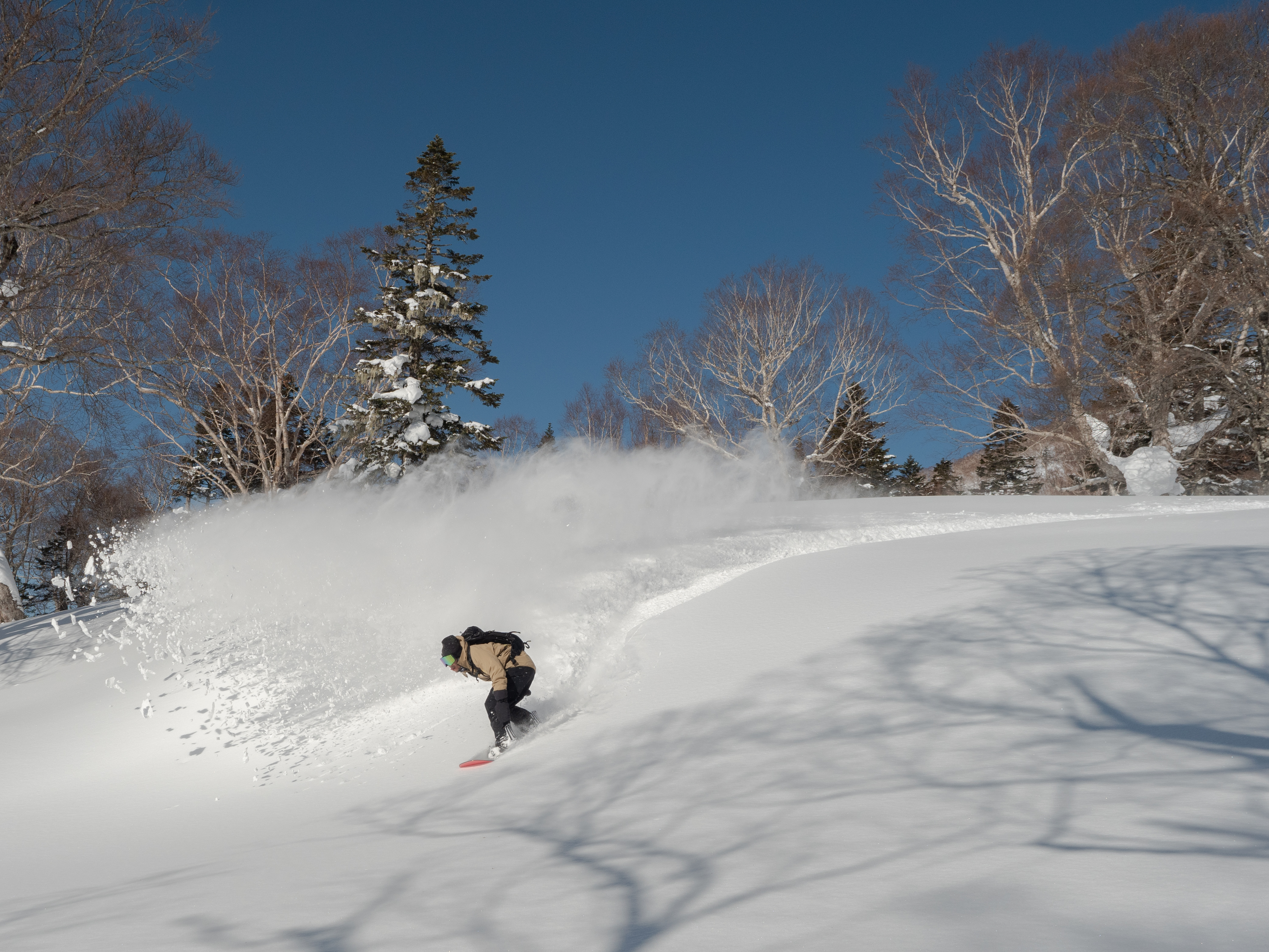
If you want to improve your snowboarding skills and ride more freely, choosing the right board for you is incredibly effective. To do this, it's important to understand the factors that determine a board's performance, such as its specifications, construction, and materials. How do these various elements work together? What kind of riding is possible as a result? What styles does it suit? Let's take an interest in the physical mechanisms and build a foundation of knowledge for choosing the right board
Introduction
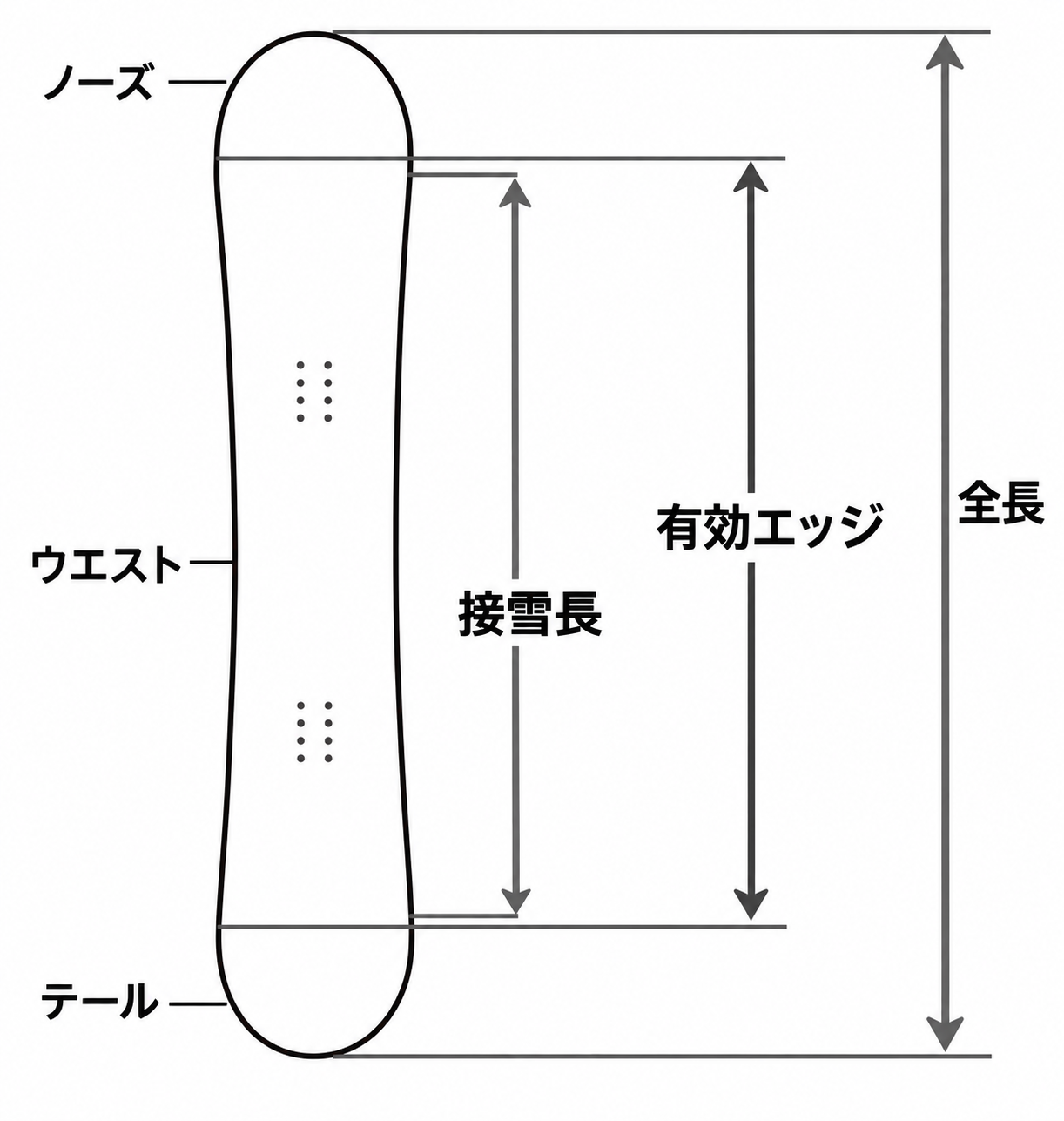
The first step in acquiring basic knowledge is to first understand the elements and parts that make up a snowboard. These include the nose (tip), tail (rear end), waist (width in the middle), and the effective edge that actually grips the snow surface—these are words that always appear when explaining the shape and specifications of a snowboard. When choosing a board, you need to check the condition of these elements
Bottom shape
When you place a snowboard on a flat surface and look at it from the side, the shape of the bottom varies. This is the most important factor in determining how pressure is distributed or concentrated on the snow surface. The most common shapes of bottom curvature are camber, flat, rocker, and double camber. Let's look at them in order
Camber
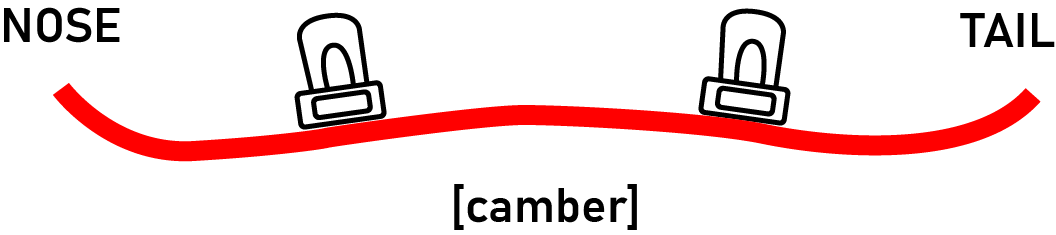
Camber is the most traditional and fundamental snowboard shape, developed by applying the shapes used in skiing to snowboarding
- The physical mechanism
involves a bow-shaped design where the center of the board is raised above the snow surface. When pressure is applied to the center of the board, a force acts to flatten the board (the principle of a leaf spring). In reaction to this, the entire edge from nose to tail is pressed evenly and powerfully against the snow surface. - The performance characteristics of a board with
a camber shape include strong grip on the snow surface when pressed down and a strong "rebound force (pop)" that causes the board to return to its original shape. As a result, it is effective in situations where strong force and speed are required, such as high-speed freeriding, carving that withstands centrifugal force, jumps on kickers, and halfpipe, and can be said to excel in these situations.
On the other hand, because the edges are constantly trying to bite into the snow, loose maneuvers can be difficult. Also, active action is required for recovery at low speeds. In deep powder, the nose tends to sink into the snow, so it is a good idea to set the bindings further back, not slow down too much, and avoid sudden changes in turn
. The degree to which these characteristics are pronounced differs depending on whether the camber is large (deep) or small (shallow).
Locker: Rocker
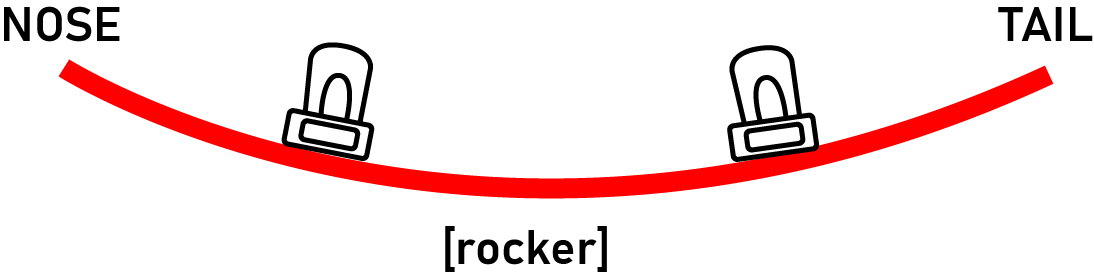
Inspired by the rocker structure of surfboards that float on water, the "rocker" shape revolutionized the snowboarding world in the late 2000s, becoming known for its ability to "float in powder" and "prevent catching edges."
- The physical mechanism
involves the center (between the feet) making contact with the ground, and the board curves upward in a U-shape towards the nose and tail. Because the pivot point is in the center and the nose and tail are less likely to touch the snow surface, it is possible to pivot around the center, making it easy to rotate the board. - The board's performance characteristics
include excellent buoyancy in deep powder and ungroomed snow because the nose does not interfere with the snow surface. It also prevents nose drop. Furthermore, because the edges have very little catch, it is exceptionally easy for beginners to handle when learning the basics of turns (such as leaf drops).
On the other hand, because the contact area with the snow is small and pressure is not easily applied to both ends even when the edges are engaged, the board may lack stability at high speeds, such as nose flutter, and may not be suitable for strong edge grip like carving.
Flat (Flat camber): Flat (Flat camber)
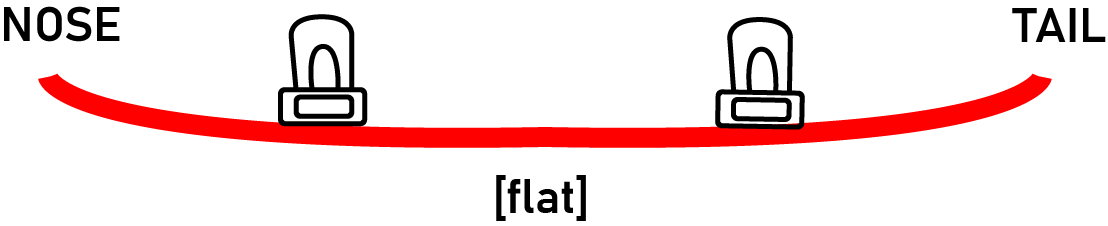
The "flat" shape was developed to strike a balance between the "stability" of camber and the "grip-resistant" of rocker. It is sometimes called "zero camber" or "flat camber." (Note that definitions of names vary by manufacturer, so check the manufacturer's official shape diagrams and explanations.)
- The physical mechanism
eliminates the camber arch, resulting in a nearly flat design from the center of the board to the snow contact points at the nose and tail, creating a larger contact area with the snow surface. - of this board
offers a good balance between stability in gripping the snow surface and ease of handling. The entire board grips the snow surface easily, resulting in a relatively smooth ride.
On the other hand, it lacks the sharp rebound of a camber board or the overwhelming buoyancy of a rocker board. Because it doesn't have any outstanding performance features, it's sometimes said that those seeking a highly purposeful riding style may find it a little lacking.
Double camber (Hybrid / Gullwing)
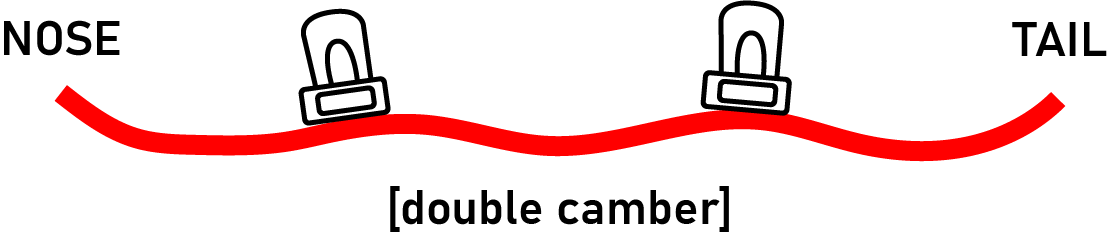
This hybrid shape was developed to meet rider demands, combining the rebound and edge grip of camber with the buoyancy and looseness of rocker
- The physical mechanism
involves two small, independent camber sections under the feet (below the bindings), and the center of the board has a rocker shape. The outline appears M-shaped. - The board's performance characteristics
include a camber that provides edge grip when you press down, and a rocker in the center that makes it easy to float in powder. Its advantage is its all-around capability, allowing it to handle a wide range of conditions from the park to powder.
On the other hand, due to its complex structure, the force tends to be dispersed, and it falls slightly short of the strong rebound force and carving sharpness of a pure camber board, or the overwhelming buoyancy of a pure rocker board.
Flat Rocker
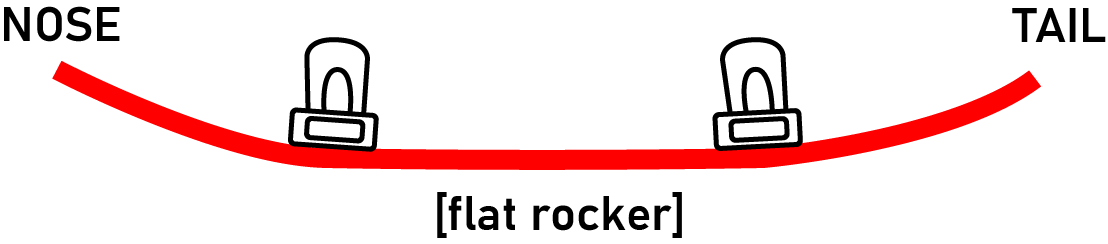
A flat rocker is a type of surfboard where the center section is flat, and the rocker gradually develops from near the feet towards the nose and tail
- The physical mechanism involves
a flat section between the feet that grips the snow surface broadly, distributing weight evenly, while the nose and tail curve upward from the outside of the feet, physically reducing the resistance (friction) of the edges against the snow surface. - Theboard's performance characteristics
include a flat center shape that enhances stability when riding on rails or boxes, and when performing pressing maneuvers. Furthermore, the rocker shape at both ends generates buoyancy in powder and reduces catching during spins. However,
because the ends are raised, the contact surface with the snow is shorter, and it does not have the same bow-like rebound force as a camber board, making it more difficult to achieve height on ollies (jumps). Also, it is slightly lacking in edge grip and straight-line stability during high-speed carving.
Other shapes include this one -3D shape (convex)
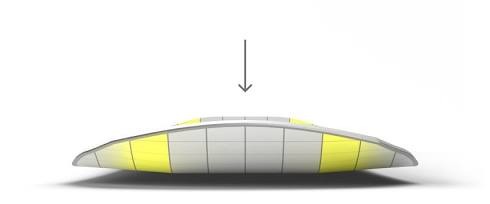
In addition to standard shapes like camber, rocker, and flat, "3D shapes" have been increasing in popularity in recent years. As you can see in this illustration of a board placed on a flat surface and viewed from the front, the base (running surface) of the nose and tail is rounded like a spoon
This results in an advanced design that three-dimensionally fuses the advantages of camber and rocker, where the edges are floating when on flat ground and don't catch, and only engage when the board is tilted
Typicaloutlines (shapes)and features
The outline is a crucial element that determines the degree of specialization in the direction of skiing and the size of the arc during turns
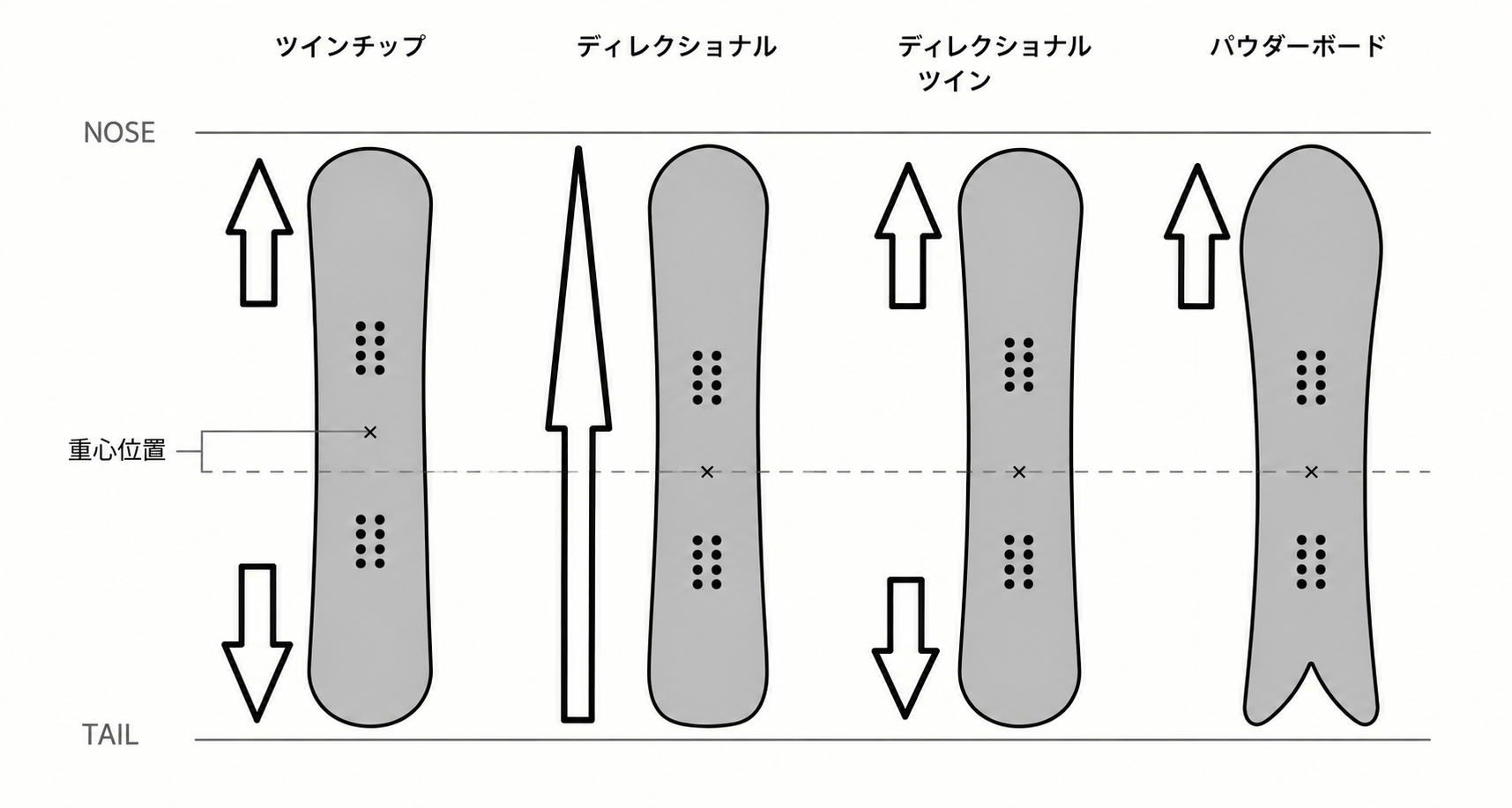
| item | Twin Tip | Directional | Directional Twin | Powder Board |
|---|---|---|---|---|
| Nose and tail shape | The nose and tail are the same length, shape, and stiffness, making it perfectly symmetrical. The stance position is also set in the middle of the board | It has a long nose and a short tail. The binding mounting position is set back towards the rear | While the nose and tail shapes are almost identical, the setback and other features enhance suitability for different skiing directions | They often have a wide nose and a narrow, tapered tail. There are also models with a large setback and swallowtail designs |
| My favorite way to ski | Switch Jib Ground Tricks | Carving Powder | All-around | Powder, tree runs, and skiing that utilizes buoyancy |
| Main uses | Park, freestyle, and play-focused | Freeride carving | All-around | Powder backcountry |
Twin Tip
- Outline features:
The length, shape, and stiffness (flex distribution) of the nose and tail are perfectly symmetrical, and the stance position is set in the middle of the board. It was developed for freestyle riding, influenced by skateboard culture. - you prefer regular
(facing forward) or switch (facing backward), you can ride, jump, and land with the exact same feel. It's essential for trick-focused freestyle riding, such as ground tricks that make frequent use of spins, and
park riding (kickers and jibs). On the other hand, because the center of gravity is in the middle of the board, in powder, you have to consciously lean back (shift your weight to the tail) or the nose will dig into the snow. Also, its stability when riding in a straight line is inferior to directional boards.
A board with a twin-tip shape is, for example, this model
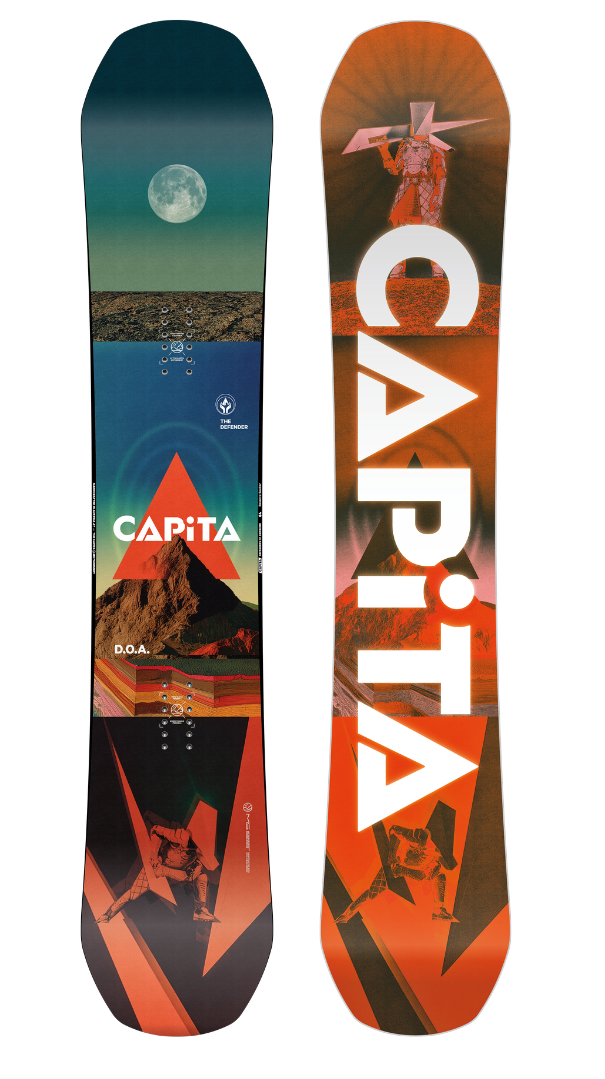
CAPiTA|DOA
Directional
- Outline Characteristics:
The nose is made longer than the tail, and the binding mounting position (insert holes) is set further back (setback). Also, the nose is often softer than the tail. - This board's preferred style
naturally places the center of gravity towards the rear, making it easier to generate forward propulsion. Its long nose also helps the board lift off rough snow and powder. It offers excellent straight-line stability, making it the most advantageous shape for high-speed freeriding and carving.
However, when riding switch, the short, stiff tail feels awkward in the direction of travel, making control difficult.
A directional shaped board is, for example, this model
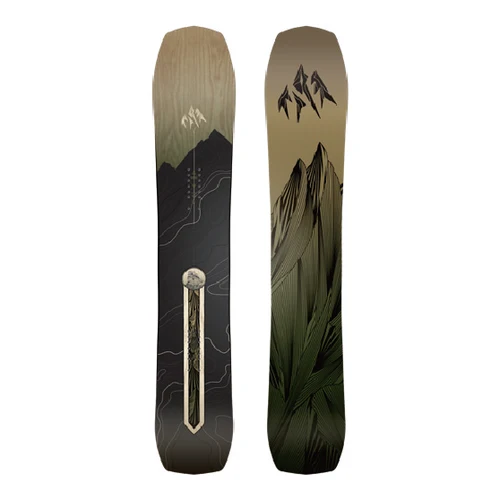
JONES|FLAGSHIP
Directional Twin
- Outline features:
A symmetrical twin-tip design, but with the binding positioned slightly further back, or the tail being slightly stiffer than the nose. - Its strengths lie
in its twin-tip design, which offers ease of switching and turning, and its directional design, which provides excellent stability for forward freeriding. This makes it highly versatile and is frequently used in all-mountain freestyle boards designed for riding across the entire slope.
However, like directional boards, it can be difficult to control when riding switch.
A directional twin-shaped board is, for example, a model like this
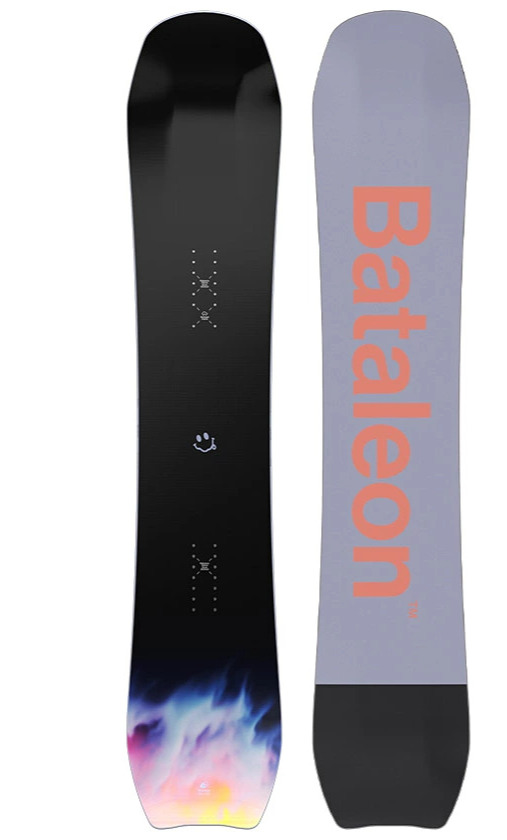
BATALEON | WHATEVER
Powder board
- Typical outlines
include a wide nose and a narrow, tapered tail, as well as a design with the tail set back. The large nose area ensures buoyancy, and the tapered tail encourages the tail to sink in deep snow, making it easier to keep the nose afloat. Some models also feature unique tail shapes, such as swallowtails. - Its preferred style
excels at smoothly skiing through deep powder by utilizing its buoyancy. Because the nose doesn't easily dig into the snow and it's easy to ski without needing to lean back too much, it's easy to maneuver smoothly in tree runs and on uneven terrain. Depending on the model, it may also feature good maneuverability due to its shorter overall length and excellent turning performance thanks to its tail shape.
Powder boards are like this model, for example

STORCH BRUSHED
Overall length and effective edge
The length of the board (overall length) and the resulting effective edge length have a significant impact on how easily it glides
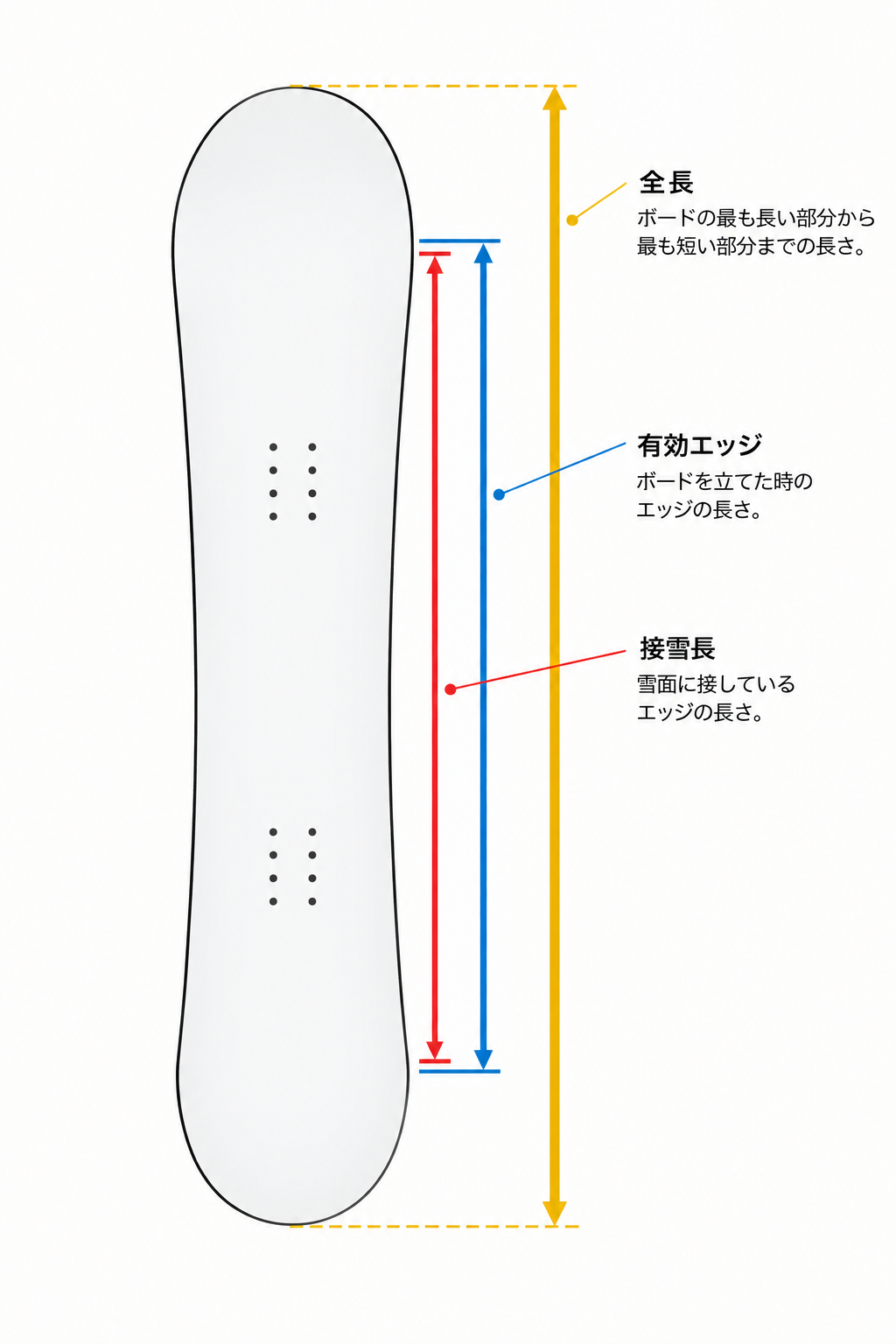
The effective edge refers to the length of the edge of the ski that actually contacts the snow surface and contributes to turning, out of the total length of the ski. The curved sections of the nose and tail are not included in the effective edge
Snow contact length refers to the length of the part of the board that is in direct contact with the snow surface (floor) when the board is placed on a flat surface
- This board features a long effective edge
that firmly grips the snow surface, resulting in high straight-line stability. It's less prone to chattering even at high speeds, and carving turns are stable. However, it requires a little more force to control. - This board features a short effective edge
, making it easy to maneuver and turn in tight spaces. It's lightweight and easy to handle, and easy to control even at low speeds. On the other hand, it can feel a little unstable at high speeds.
- Longer boards
have a longer effective edge, increasing friction and grip with the snow surface. They offer stability even at high speeds, are less prone to wobbling, and have outstanding grip to withstand centrifugal force during carving, as well as superior buoyancy in deep powder.
On the other hand, they are heavier and have a heavier swing weight, making quick changes of direction and precise maneuvers more difficult. - Shorter boards
have a lighter swing weight, allowing them to rotate with less effort, which is advantageous for high-speed spins and delicate balance adjustments on jib features. However, because the effective edge is shorter, the board is more prone to chattering at high speeds, increasing the risk of losing grip during turns.
Waist width (thickness)
- A wide waist
allows for deep carving by tilting the board to its limit. The increased surface area also increases buoyancy in powder. It's perfect for carving and powder riding.
On the other hand, it can take time to switch edges from the toe side to the heel side, resulting in a sluggish ride. Also, if the width is too narrow for your boot size, "drag" will occur when you tilt the board deeply, causing your toes or heels to contact the snow surface, which can lead to falls or stalls, so be careful. - A board with a narrow waist
allows for instantaneous weight transfer from toe to heel to the edge, enabling extremely quick and sharp maneuvers. It's ideal for people with small feet or those seeking delicate control. On the other hand, for those with large feet, the risk of drag increases.
Flex (vertical bending)
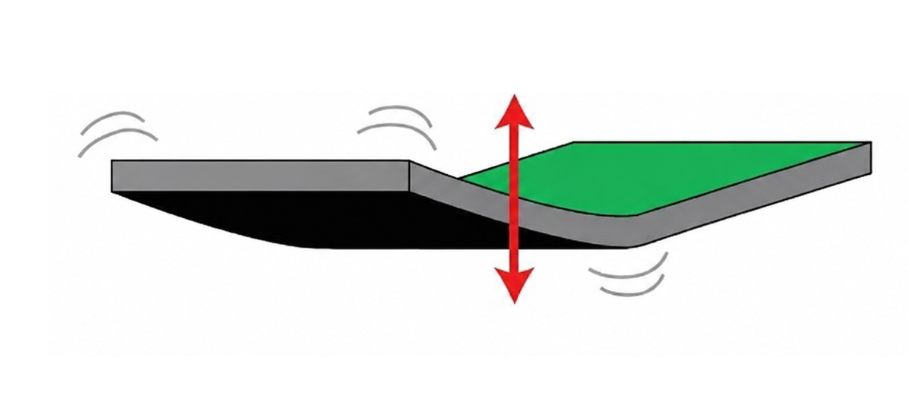
Flex = the stiffness of the board in relation to its vertical "bend". The board bends under load, and this rebound force is used to support turns. Softer boards are easier to handle, while stiffer boards provide greater stability and stronger rebound at high speeds
- Soft flex boards
allow you to flex the board even with less leg strength. Because the board flexes, it's easier to create turns, making them suitable for low speeds and beginners. They are also essential for freestyle tricks like ollies and nollies, and for pressing the board flat against jib features. - Hard flex (stiff) means
the board won't bend even under strong force, generating powerful rebound. This is necessary to withstand the impact of landing on huge kickers and to counteract the strong centrifugal force generated during high-speed carving. However, without sufficient leg strength, it becomes difficult to flex the board, making turns challenging.
Torsion (torsional rigidity)
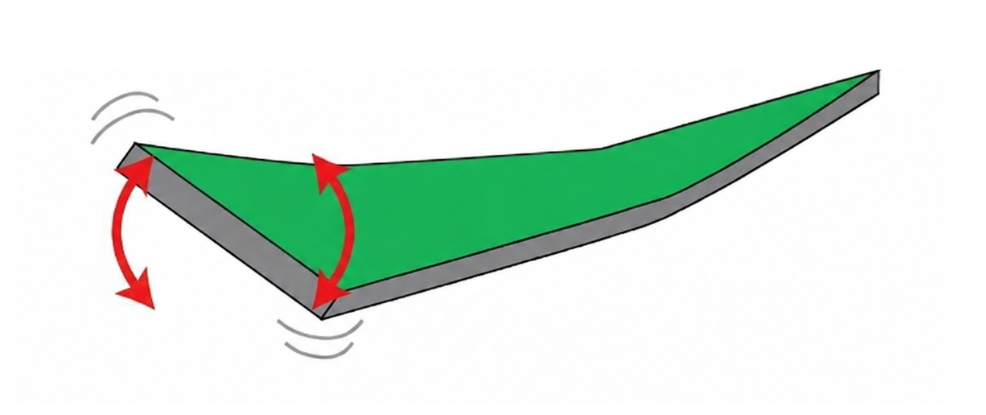
The stiffness of the board against diagonal twisting. When initiating a turn, if you start loading from the toes or heel of your front foot, the board will twist (torsion will engage), allowing the edges to quickly grip the snow surface and enabling a smooth turn initiation
- its soft torsion
, it's easy to make fine adjustments to turns at low speeds and recover from errors (catching an edge). - the torsion is stiff
and has strong resistance to twisting, it enables powerful power transfer from edge to edge, resulting in intense edge grip even on hard snow surfaces such as ice.
Radius = radius of rotation
Radius (R) refers to the size of the board's sidecut, which determines the arc of a turn. It is directly related to the board's width. It not only determines the size of the turn but also the ease of turning. The riding feel varies greatly depending on the size of the R
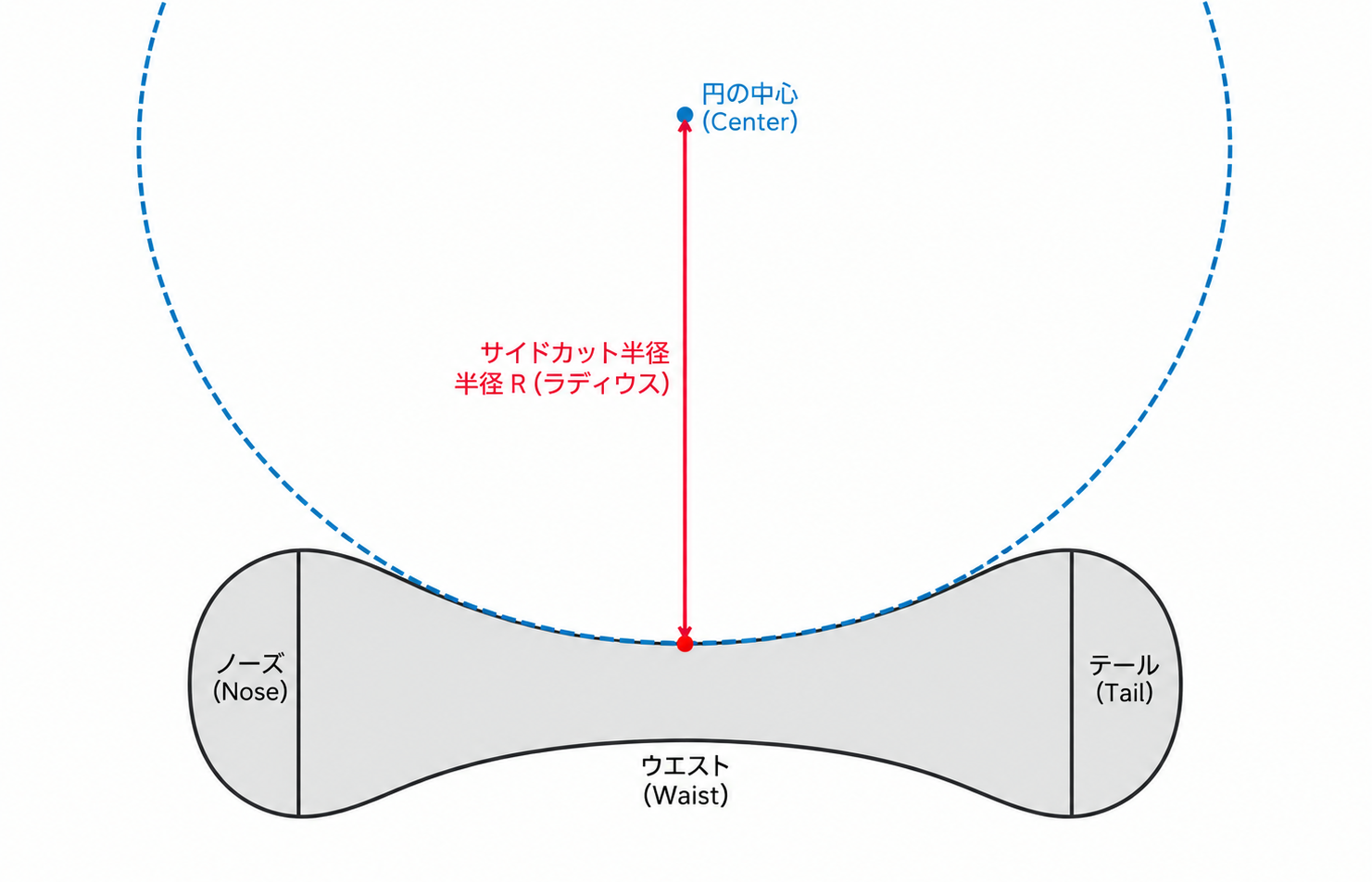
- This board
excels at making large, arcing turns and boasts high stability at high speeds. It's easy to carve at speed, making it a favorite among advanced riders. Tight turns require a bit more power, so beginners might find it slightly difficult. The choice depends on whether you want to "turn easily" or "enjoy high speeds." - Its small radius
makes it easy to turn in tight spaces, and it requires minimal effort to maneuver. It's easy to handle even at low speeds, making it ideal for beginners. Its ability to make tight turns makes it easy to use on narrow courses, crowded slopes, and in tree runs.
Internal structure and materials
Snowboards are not simply wooden planks; they are made with a "sandwich structure" that layers various cutting-edge materials. This combination of materials determines the lifespan and riding feel of the board
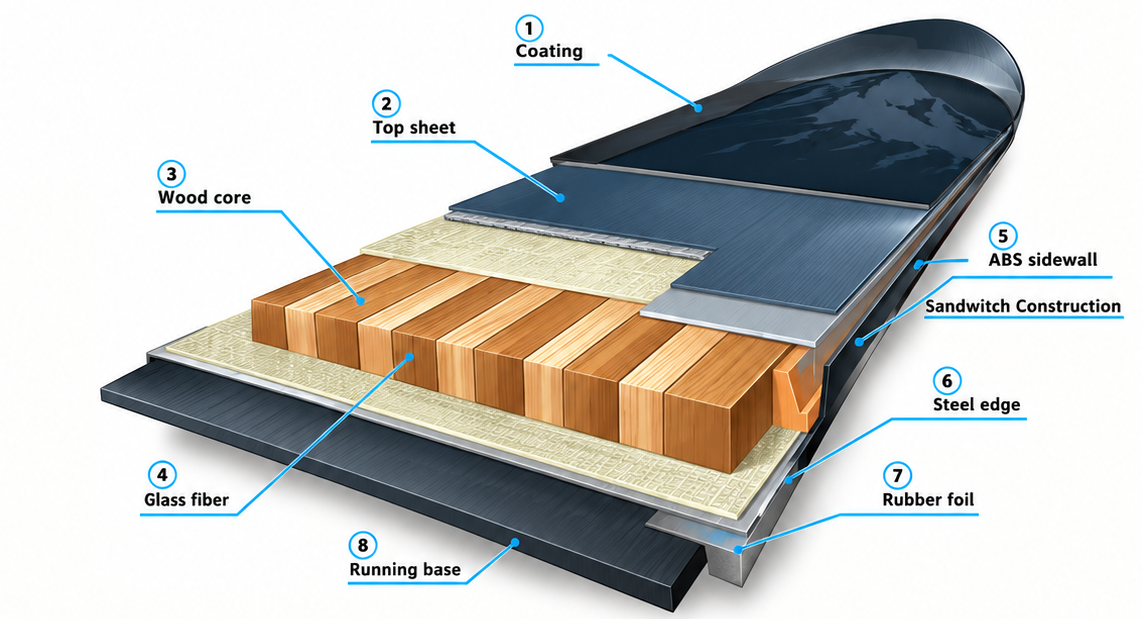
Core material
The largest volume portion at the center of the board
- Wood cores form the base of almost all snowboards. By carefully considering the grain of different types of wood, such as poplar, bamboo, and paulownia (aspen), and gluing them together, a natural balance of flex and rebound is created. Paulownia is used where lightness is desired, and bamboo where rebound is needed, and so on
. - Honeycomb Structure/Synthetic Materials:
There are technologies that aim to reduce weight to the absolute minimum by using honeycomb-shaped paper cores, which are also used in aircraft parts, or by placing aluminum cores in the nose and tail.
Reinforcement
The fibrous material sandwiching the wood core from above and below acts as a reinforcement. Depending on the material used, it plays a role in enhancing the performance of the board, and fiberglass and carbon are commonly used
- fiberglass
, the "bi-axle," in which the fiberglass is woven vertically and horizontally at 90-degree angles, provides a soft and loose ride, while the "tri-axle," which adds diagonal weaving, strengthens torsion and provides quicker response. - the carbon /Kevlar fiberboard
thick and heavy, it is possible to precisely enhance rebound force and rigidity to suppress fluttering during high-speed skiing.
Board weight
In snowboarding, "weight" isn't simply a matter of good or bad; there's a clear trade-off depending on your riding style
- The advantage of lightweight
gear: The lighter the gear worn under your feet, the less energy is lost. Models using carbon fiber or ultra-light wood cores have reduced swing weight, making grabs in the air and the initial stages of spins much easier. They also reduce strain on your feet during long rides or while on the lift, resulting in less fatigue. - The advantages of having weight:
Boards that are too light tend to bounce off rough snow surfaces (snow that has been trampled and broken up, or heavy snow in early spring). Boards that are intentionally given a certain amount of weight (mass) have superior "overcoming ability" that allows them to powerfully break through the unevenness of the snow surface due to the law of inertia. In high-speed freeriding and carving, this "solid weight" enhances stability and becomes a powerful weapon that suppresses chatter.
Summary | Choose your next item by working backward from your current needs
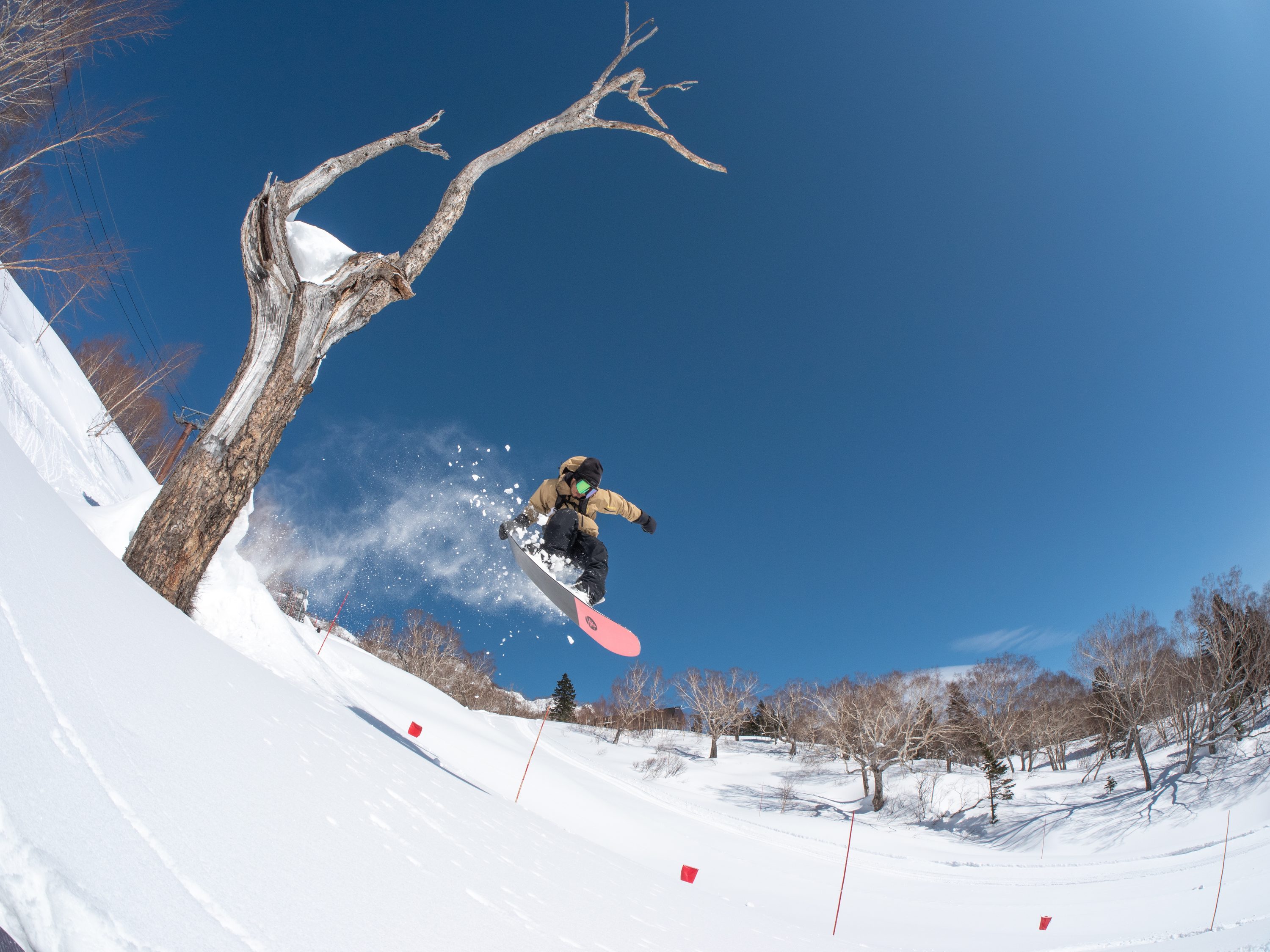
The spec numbers and elements like camber and directional listed in snowboard catalogs can all be considered blueprints that show "what kind of physical phenomena this board will exhibit on the snow." A simple approach when you're unsure which board to choose is to articulate "what is difficult to do with your current board" and then work backward to find the physical specifications that would solve that problem
- If you're afraid of speed during turns or your board is unstable
, the recommended choice is a "camber" or "directional" board with a longer effective edge and a hard flex. This is because the strong grip and weight provide stability against centrifugal force and on rough snow surfaces. - If your board sinks in deep snow or your back foot gets tired
, we recommend choosing a powder board with a "rocker shape" that generates buoyancy, or a "tapered shape" with a narrow tail that sinks naturally. Choosing a wide waist increases the surface area, giving you a surf-like floating sensation. - If you have trouble with stable landings or can't withstand the impact of jumps
, a recommended choice is a medium to hard flex "twin tip (camber type)" board. A board with strong rebound force due to reinforcement materials such as carbon will be more resistant to the impact of landings, and its perfectly symmetrical shape will help with switch landings.
Choosing a board with specifications that address what you feel is lacking will allow the board's performance to support your skills, accelerating your progress and enhancing your enjoyment of snowboarding. For the 26-27 season, keep these points in mind when choosing a board and find the perfect one for you