

Ski brand catalogs are filled with various pieces of information: waist width 95mm, radius 18m, rocker, twin tip, and so on. Just looking at the specs doesn't really tell you much, but if you could understand how those detailed specs actually affect your skiing, reading test ride reviews and choosing skis would surely become much more interesting. So, let's acquire the basic knowledge needed to interpret those specs
The performance of skis cannot be determined by a single number
You often hear explanations like, "The wider the ski, the more buoyant it is and the better it is for powder," "A 95mm waist makes it versatile for all-mountain skiing," or "A full rocker makes it suitable for freestyle skiing." Of course, these aren't wrong. However, these explanations alone are nowhere near enough to describe the unique characteristics of a ski
For example, even with the same 95mm waist width, some models allow you to freely explore different terrains, while others offer superior straight-line stability at high speeds. A ski's character isn't determined by a single specification, but rather by a combination of many design elements
- Waist width
- Bottom shape (rocker, camber, etc.)
- Flex and Torsion
- Radius
- Shape (directional, twin tip, etc.)
- length
- weight
- structure
- material
These elements are key to understanding the character of a ski. Let's explore how each one affects your skiing and how it manifests in the riding feel. If you follow this to the end, you should be able to predict the characteristics of a ski yourself without having to ask for an explanation at a ski shop
KEY 1 |What are the consequences of different waist widths?
It wouldn't be entirely wrong to say that the most important factor in determining the characteristics of skis is their waist width. The range is remarkably wide, from approximately 60mm to 12mm
The wider the waist, the more buoyancy you get from under your feet, and the narrower the waist, the easier it is to maneuver, resulting in faster edge changes. In short, the wider the waist, the better suited you are for powder, and the narrower the waist, the better your turning performance. That's the basic understanding to start with
This is a rough guideline
- Suitable for racing ~65mm
- Suitable for on-piste running, 65-85mm
- All-mountain 85-100mm
- Fat (suitable for powder) 105-120mm
- Big Fat (suitable for deep snow) 120mm~
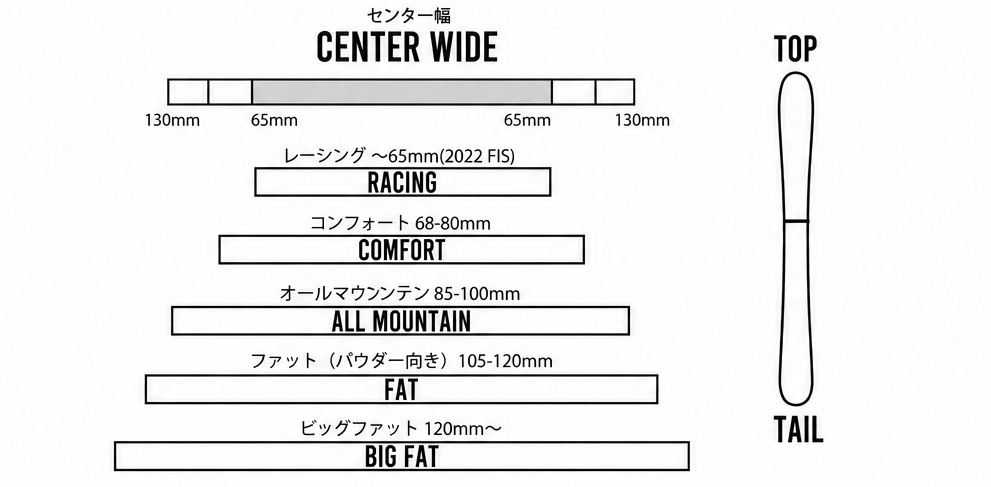
However, you can't judge a board's character based on that alone. When you add design elements such as rocker, flex, weight, structure, and materials, each board develops its own unique character
KEY 2 | Bottom Design - Rocker & Camber
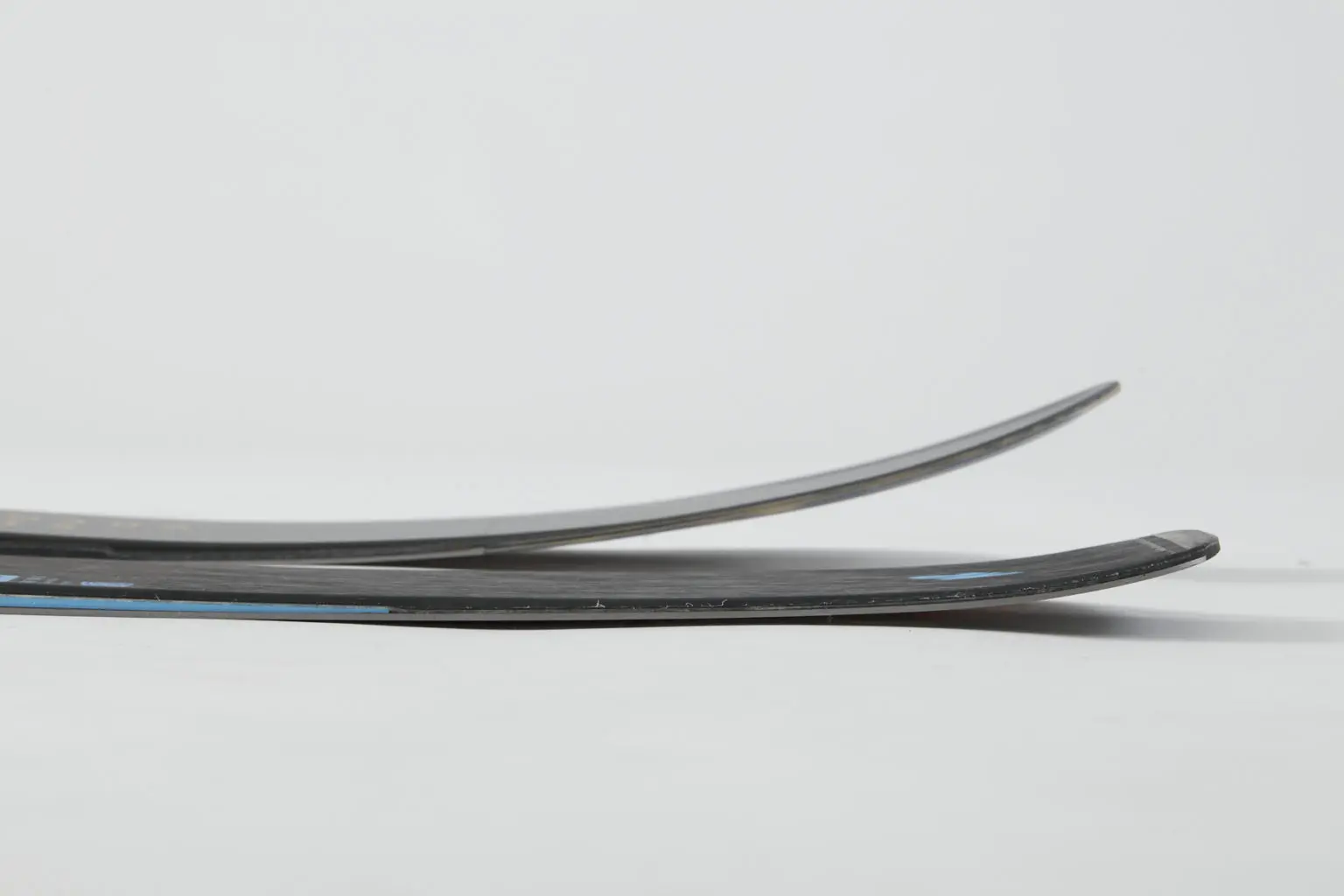
When you look at skis from the side, imagine the tips and tails are lifted above the snow surface, with the central part touching the snow. This curved-up section is called a "rocker."
On the other hand, a "camber" is a shape where the central part of the ski curves upward, pushing back against the snow surface when weight is applied. The design itself—where the rocker starts, how much it lifts, and how much of the camber remains—creates the character of that ski
Differences in bottom design affect the ease of initiating turns, edge grip, ease of sliding, and maneuverability on rough snow, ultimately influencing the ski's handling and feel, and thus greatly influencing what is known as the ski's character
There are several combinations of rocker and camber, and they are adopted depending on the intended use of the ski
[Camber Model]
A classic bottom design without rocker. The long contact edge and camber provide agility and stability in turns, but in powder, techniques such as flexing the board and directing its rebound will be required.
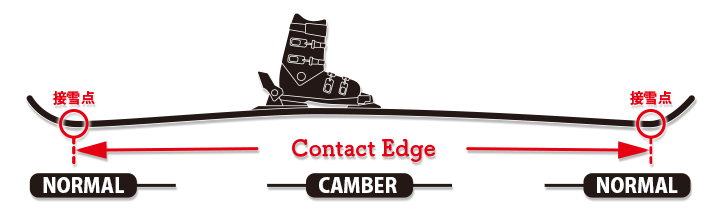
[Nose Rocker + Camber Model]
This bottom design is adopted by most directional models in recent years. The nose rocker promotes buoyancy in powder, and the relatively straight tail provides stability in the latter half of turns.
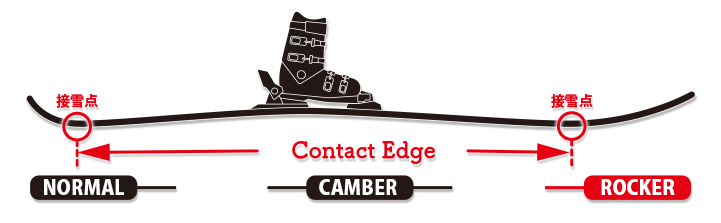
[Nose Rocker + Camber + Tail Rocker Model]
The relatively short effective edge compared to the overall length allows for greater freedom of riding, and the tail rocker enables effortless sliding and gliding. This style is common in wider freestyle models.
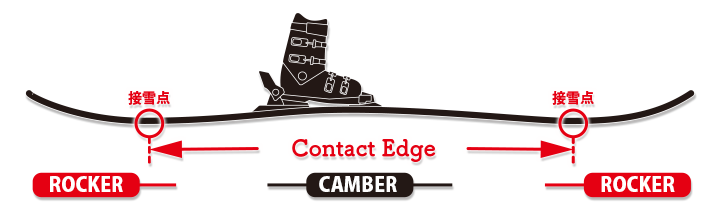
[Full Rocker Model]
The entire bottom features a full rocker that creates a smooth arc. The nearly flat surface underfoot makes sliding maneuvers easy. Enjoy exhilarating and free riding on banks, natural terrain, and deep snow.
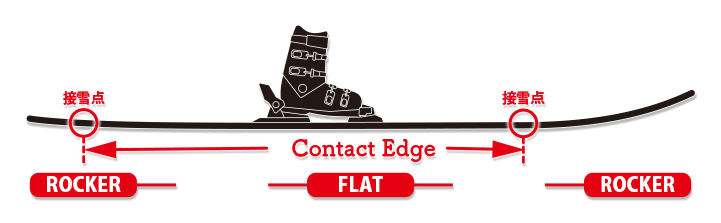
The nose rocker affects how the ski enters the snow surface, initiates turns, and maneuverability in rough snow, while the tail rocker relates to turn release, pivoting, and the feeling of freely moving the skis. The amount of camber left in the center changes the balance between edge grip and rebound, and this is strongly reflected in the ski's performance and riding feel
One of the key points to understanding ski specs is knowing that rocker isn't just for lifting the board in powder
KEY 3 |Flex and torsionintuitively affect the feeling of skiing.
"This board is stiff," "It's flexible and easy to ride"—these are phrases that frequently appear in test ride reviews, but "flex" and "torsion" are related to how the edges interact with the snow surface. Just understanding this will make the meaning of the phrase "stiff board" much clearer
Flex (flexural stiffness/bending stiffness) is the property of bending or flexing in the longitudinal direction, while torsion (torsional stiffness) is the resistance to twisting around the long axis. These "twisting" movements are different from the "bending" movement in a turn
[Flex]
Softer boards flex easily bend even with relatively little force. Therefore, it is easier to get the board to respond even at low speeds, making it easier to move the board in accordance with the undulations of the terrain and to perform pressing movements.
On the other hand, stiffer boards do not easily lose their shape even when heavily loaded. Therefore, the board can withstand increased speed and heavy loads, making it easier to maintain a stable posture.
[Torsion]
Torsion stiffness is particularly related to edge grip on hard snow surfaces, how the tip and tail act on the snow surface under load, and the precision of control.
If the torsion is firm, even if the flex is not very stiff, you may feel a stronger grip on the snow surface when you engage the edge. Conversely, if the torsion is soft, even if the flex is quite stiff, the tip and tail may twist when edging, making it difficult for the edge to work evenly on the snow surface.
KEY 4| Shape – Directional or Twin Tip (Freestyle)?
Ski shapes are broadly divided into freestyle and directional. The red arrows indicate the recommended mounting position for the bindings
【Freestyle】
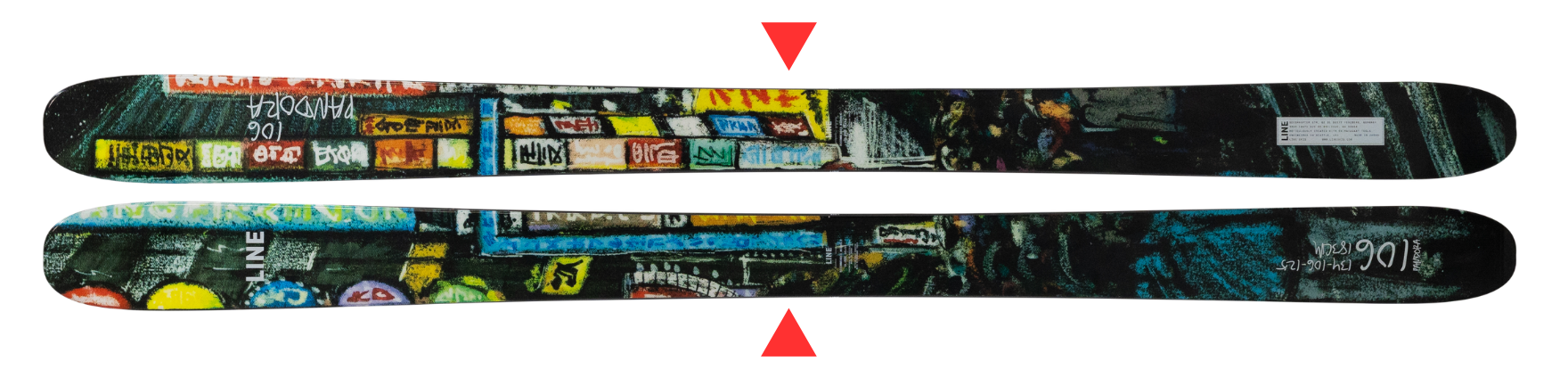
These twin-tip or twin-rocker models are "skis that do more than just go forward," featuring a distinctive shape with upward-curving tails at both ends. Because the tails easily lift off the snow surface, they can be used for freestyle tricks such as jumps, scrapes, sliding, and switch landings. The binding mounting position is set near the center of the ski, resulting in excellent swing balance and superior maneuverability and stability for jumps, ground tricks, and switch riding
【Directional】
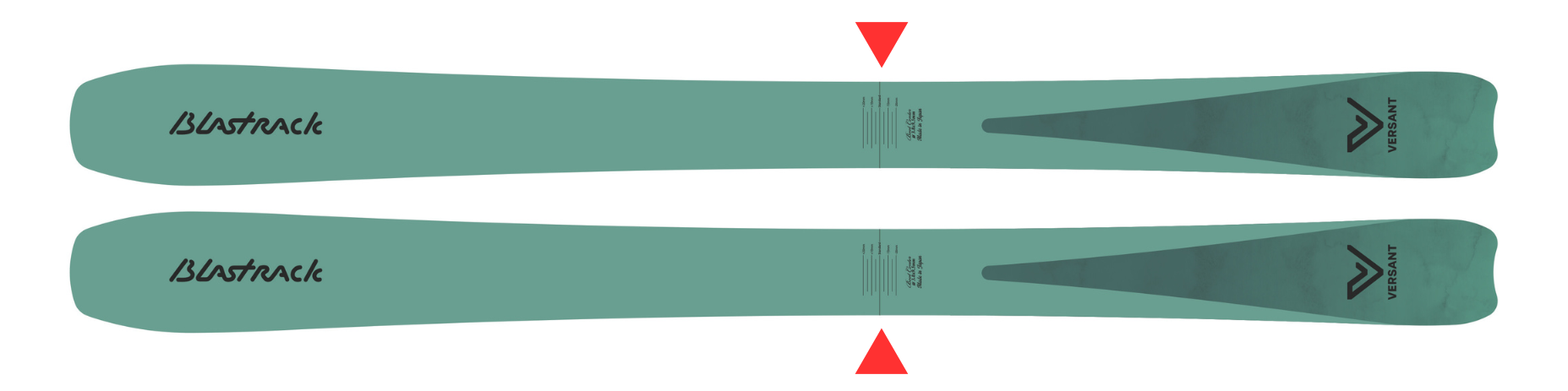
The name comes from "Direction," meaning orientation or direction, and it is designed with forward-sliding in mind. Therefore, it excels in turning and high-speed stability, allowing you to enjoy stable high-speed turns even on hard-packed snow. The form is long and wide at the top, with a large rocker. The tail is low, stiff, nearly flat, and has a small rocker
KEY5|R (Radius)allowsyou to read how skis "turn".
Radius (R) is a design value derived from the ski's sidecut that indicates the size of the turn arc that the ski can easily draw. For example, if R = 18m is displayed, the ski's sidecut is designed to ideally draw a curve close to a circle with a radius of 18m
Generally speaking, a smaller radius (R) makes it easier to make smaller turns, while a larger radius (R) makes it easier to make larger turns
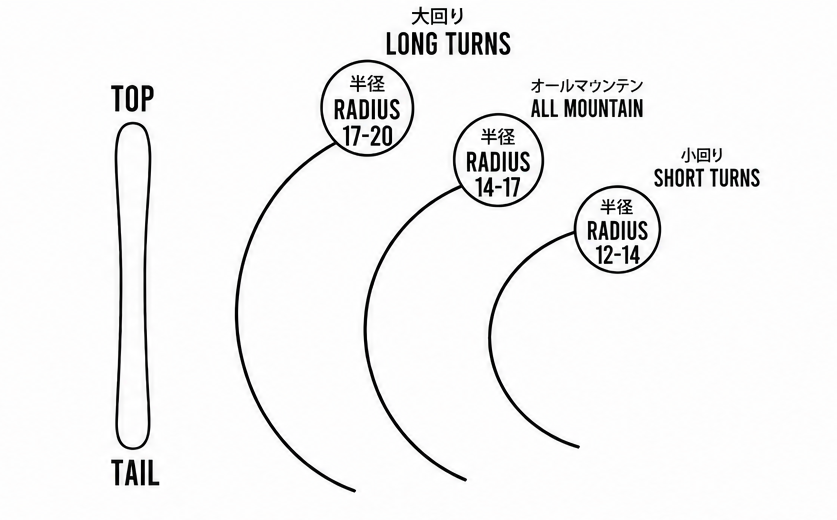
For example, consider skis with a radius of R=12-14m. Because of the strong sidecut, when you engage the edge, the skis will enter the turn direction relatively strongly. In terms of feel, they excel at short turns, quick transitions, and rhythmic turns. They are also easy to handle in situations where you want to keep the size of your turns compact, such as tree runs, moguls, and narrow courses
So, what happens when the radius (R) is large? When R = 20-25m or larger, it becomes easier to draw larger turn arcs. Rather than focusing on the turning transition itself, it becomes more compatible with high-speed vertical downhill skiing, drawing long lines, and making full use of the slope
[Skis with multiple radii]
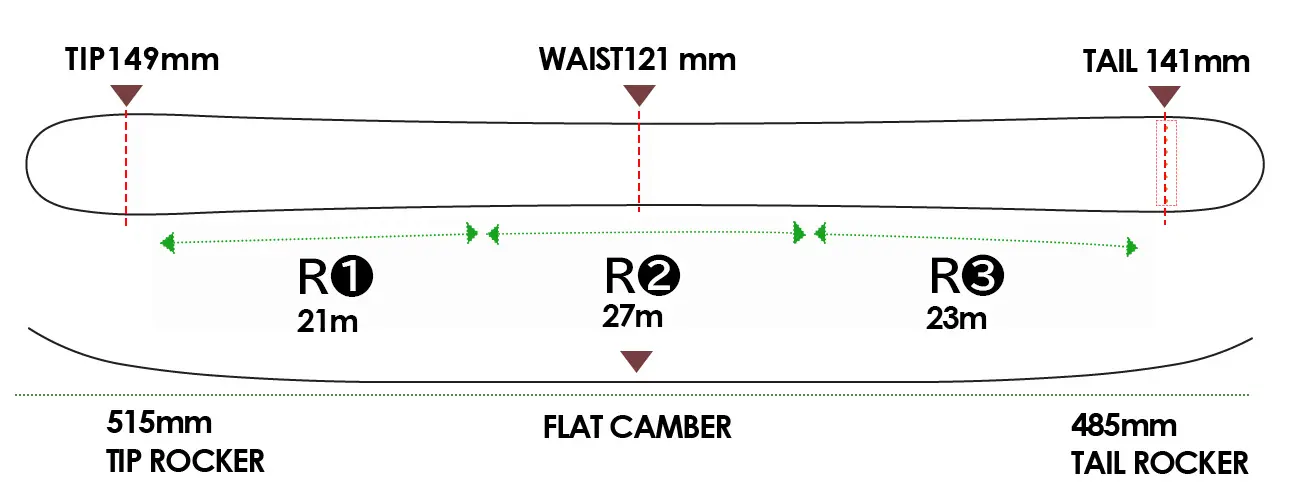
While typical skis use one or two radii at the front and rear, some models intentionally incorporate multiple radii, such as three or four, to enhance turning performance
These designs are becoming increasingly popular, especially in models for freeride skis and on-piste carving skis, because they can accommodate a wide range of slope conditions, including groomed, ungroomed, and varied terrain, as well as the desired turn size
KEY 6 Basic Structure – Sandwich, Cap, or Semi-Cap?
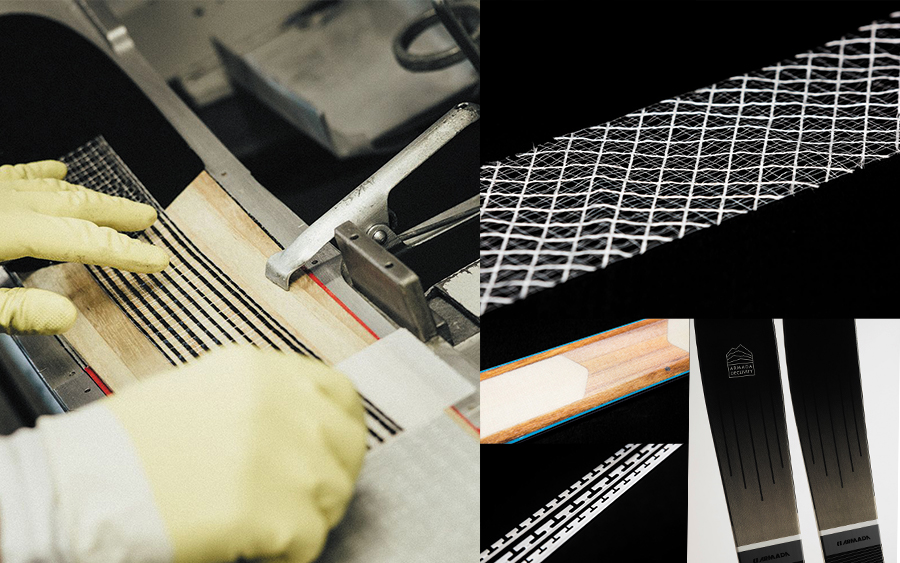
Skis are made by layering various materials. The core is the main material. Reinforcements such as fiberglass, resin, and metal are placed around it, and the ski base is made up of edges, base material, sidewalls, and topsheet. This is the basic structure of a ski
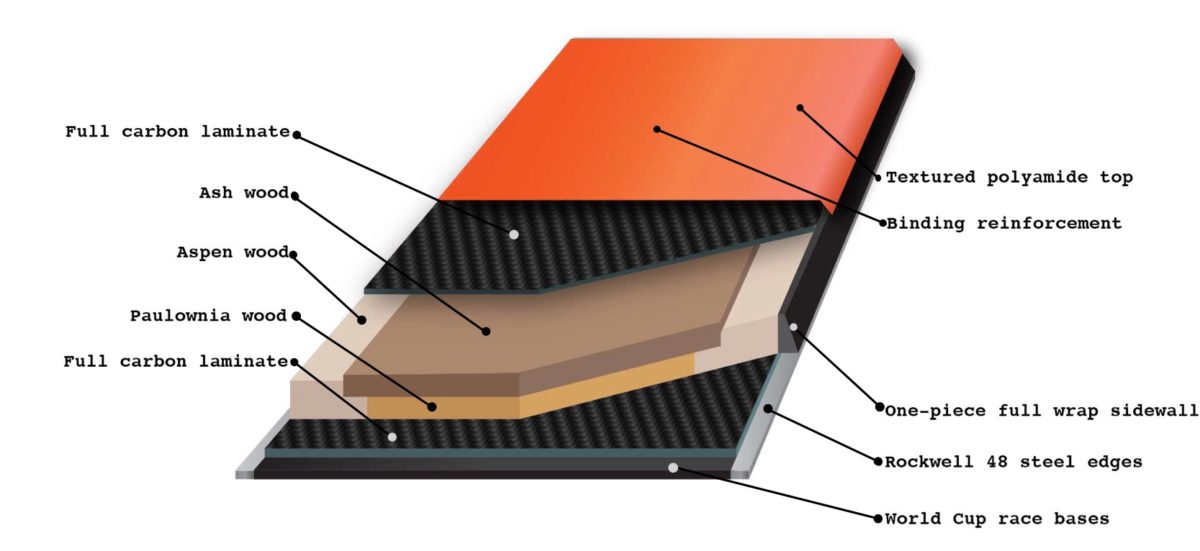
Each part is glued together and then pressed into place using a press. The types and combinations of core and reinforcing materials are endless, and this is what creates the performance differences between models. The feel and performance of skis are heavily influenced by the materials themselves and the combinations of materials used
Two of the most common ski constructions are the sandwich construction and the cap construction
[Sandwich Structure]
Its characteristic feature is that it makes it easy to arrange materials according to their respective roles. Reinforcement materials are stacked around the core, creating a solid structure that extends close to the edges. As a result, it is easy to obtain performance characteristics such as edge grip, power transmission, and a sense of unity with the snow surface.
[Cap Structure]
The upper material is molded to cover the sides of the ski. This difference affects the feel of power transfer to the edges, the overall rigidity of the ski, and how vibrations are transmitted. The cap structure is relatively easy to make lightweight and is considered to allow for more flexible movement of the entire ski.
Currently, many products feature a semi-cap structure, which can be described as a hybrid combining the concepts of a cap and a sandwich design, and the terminology and design philosophy vary from manufacturer to manufacturer
KEY8 | Materials
[Core (Core Material)]
The primary material used for the core (core material) of skis is wood.
Why wood? Because wood possesses a very good balance of properties necessary for skiing, such as lightness, flexibility, rebound, and vibration absorption. Nothing beats a wood core for producing the flexible rebound and smooth flexing necessary for skiing. Different types of wood, such as poplar, ash, beech, and paulownia, have different properties. Naturally, the type of wood, the part of the tree, and the quality affect the specifications of the skis.
However, the hardness and lightness of the wood do not directly reflect the performance of the skis; it depends on how the layers are combined. Most wood cores are made of laminated wood, not single-ply wood. By combining multiple different materials, the flexibility and strength are adjusted.


[Reinforcement Material]
Fiberglass is the most commonly used reinforcement material for wood cores. It is a flexible reinforcement material that is easy to process.
Another commonly heard material is Titanal. It is an alloy of titanium and aluminum, and because it is a metal, it is often thought that "Titanal = hard". Of course, it plays a role in increasing rigidity. However, that is not all. One of the main reasons why Titanal is used in skis is that it suppresses vibrations and provides stability on the snow surface. When skiing down rough slopes at high speeds, the skis do not become unstable and have high maneuverability.
For this reason, it is not uncommon for it to be incorporated into models that pursue carving at high speeds.

Meanwhile, carbon fiber has also been gaining prominence, similar to titanal. Because carbon fiber has a very high specific strength (strength per unit weight), it is well-suited to designs that require both lightness and the necessary rigidity.
This is especially advantageous for touring skis, as it can provide both lightness for uphill climbs and the necessary rigidity for downhill skiing. However, this is not determined solely by the material.
Even with the same Titanal or carbon fiber, changes in placement and direction will alter how it affects flex and torsion. Therefore, when looking at the specifications, try to imagine not only "what's in it," but also "where and how it's used."
KEY 9 | Choosing the right length isn't always "height + 10cm"
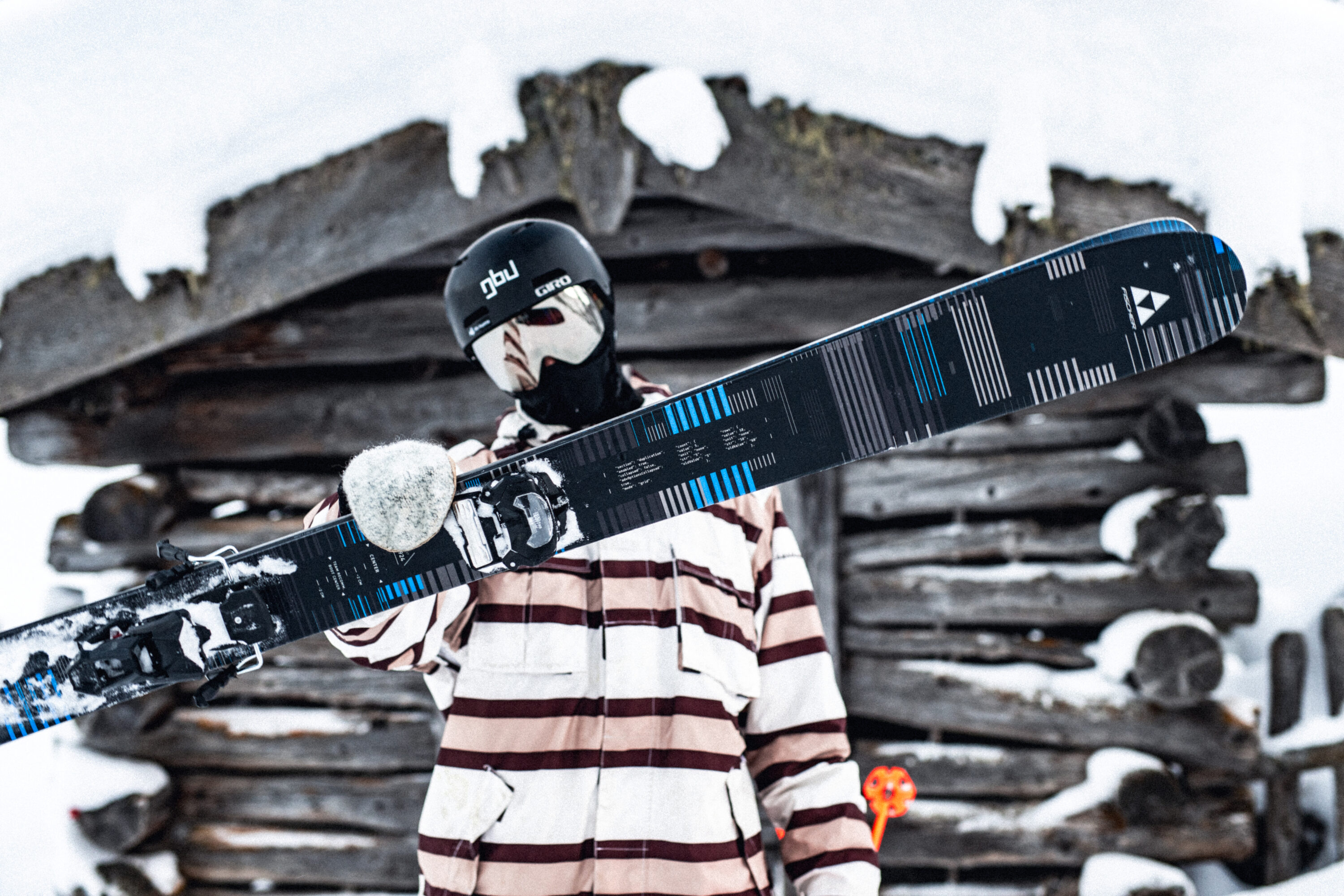
Many people have probably heard that a good guideline for choosing ski length is "height + 10cm." This is an easy way to start when choosing skis. However, once your skiing skills reach an intermediate level and you want to improve further or choose skis that better suit your preferences, simply basing the length on your body size is insufficient. This is because even skis the same length, 180cm, can feel very different depending on these factors
- Effective edge is long or short
- Large or small lockers
- Twin-tip or directional
- Light or heavy
- Twin-tip or directional
Furthermore, you should consider not only your height, but also your weight, skiing speed, skill level, the type of terrain you'll be skiing on, turn size, and how you want to maneuver your skis. For example, even among skiers who are both 170cm tall, there's no reason to recommend the same length to someone who wants to "maneuver their skis nimbly in trees" and someone who wants to "make big, high-speed turns on steep slopes." So, instead of thinking "how many centimeters should I add to my height?", you should think "what will I use that length for?"
KEY10 | Which is more important: lightness or weight?
When you pick up a pair of lightweight skis, you might think, "They're so light! They seem easy to handle." However, the weight you feel in your hands and the feel of handling them while skiing are not the same. A prime example of this is "swing weight." Even with the same total weight, skis where the weight is concentrated near the center will feel different when swung from side to side compared to skis where the weight is distributed to the tip and tail. "Lightness of swing weight" is a frequently discussed checkpoint in ski test reviews
Lighter weight doesn't necessarily mean easier to swing. While lightness is one factor in maneuverability, lighter isn't always better. It's common to hear complaints that because a board is light, it reacts to even slight bumps, causing it to flap around and lacking stability
Weight is one factor that contributes to stability and damping (vibration absorption). Having weight can make it easier to maintain a stable line when skiing at high speeds on rough snow surfaces, as it can withstand the unevenness of the snow surface without being overwhelmed
Summary –Reading Specifications and the Final Check Before Choosing Skis
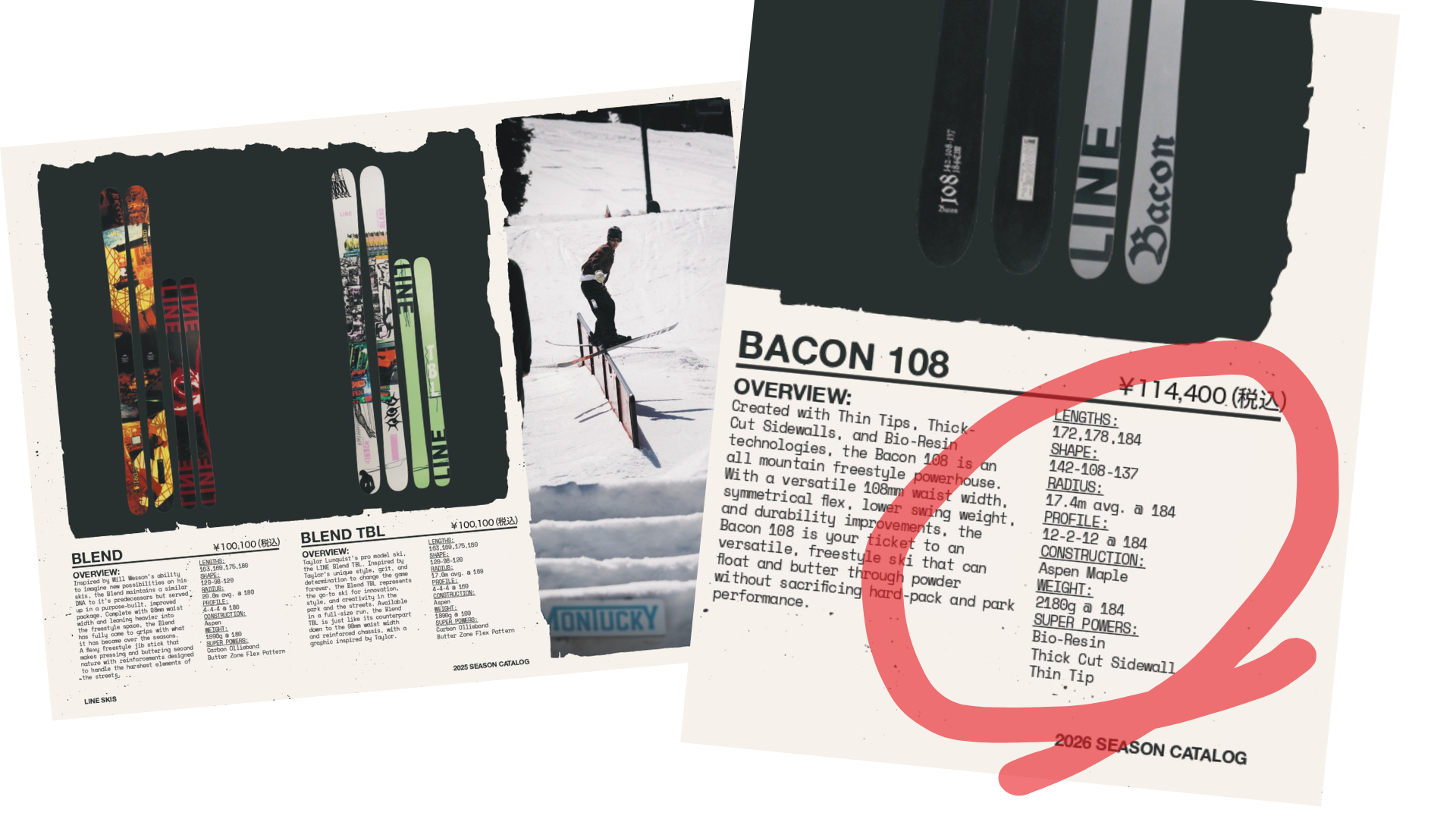
There isn't one single "best" ski when it comes to choosing skis. The important thing is to read the specifications from the perspective of, "What kind of skiing is this model trying to achieve?" When you do that, the specifications sheet will start to look more like a blueprint for the skis than just a list of numbers and technical terms
Now, ask yourself these seven questions
Q1: Is the waist width suitable for the type of snow you want to ski on?
Q2: What types of snow surfaces do rocker/camber work best on?
Q3: Are the flex and torsion suitable for the intensity of your skiing?
Q4: Is the radius close to the turn size you want to make?
Q5: What aspects are the structure and materials aiming for: lightness, stiffness, or damping?
Q6: Does the shape make the skis run, or do they make them move?
Q7: Are the length and weight appropriate for their purpose?
"What do I want this ski to do?" That's the first thing to consider. Once you've decided that, the specifications will help you choose the ideal skis for yourself. And when your desired style of skiing aligns with the design philosophy of the skis, the numbers in the specifications will finally become "useful information for you."