
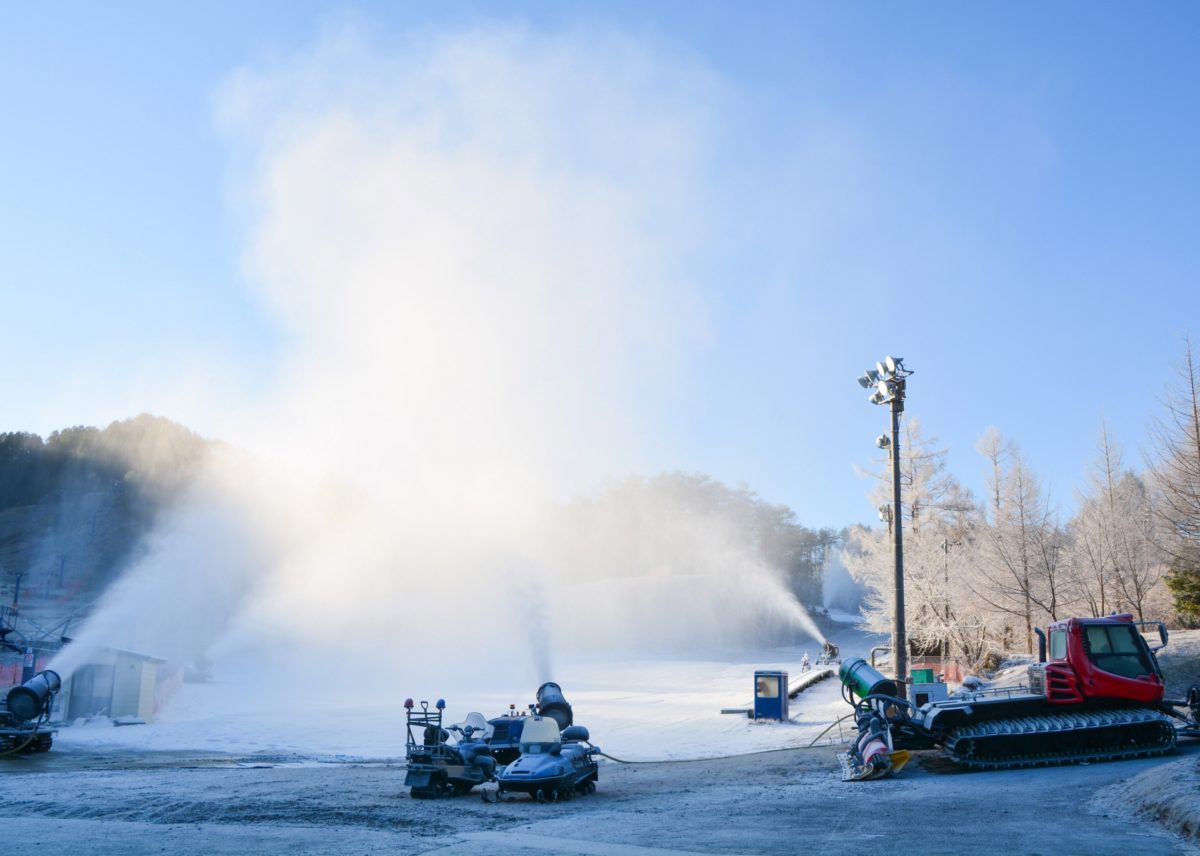
This series will provide a variety of insights to help you get to know Japanese ski resorts in more detail and with a more enthusiastic perspective. The third installment will focus on snow machines and snowmaking machines, which help to get the season started early and address the issue of lack of snow. Ski resorts, known for their early start to the season, are now in full operation in preparation for opening at the end of October or early November. But what exactly are these snow machines and snowmaking machines?

Artificial snow was first put to practical use in the United States, but its origins lie in Japan!
The history of humans artificially creating snow is long. The first recorded instance was in 1936 (Showa 11) in Japan, before World War II. At the time, physicist Ukichiro Nakaya, a professor in the Faculty of Science at Hokkaido Imperial University (now Hokkaido University), was devoted to snow research. He succeeded in creating the world's first artificial snow in the university's low-temperature laboratory, elucidating the process by which snow crystals form and the relationship between snow and weather conditions
Nakatani made great achievements as an authority on low-temperature science, and later became involved in the production of scientific films on snow and ice, and even attempted to study the Greenland ice cap (a huge block of ice). However, Nakatani's artificial snow was not primarily intended for commercial use. In other words, it is not directly related to the artificial snow that covers ski slopes today
Artificial snow was first put to practical use at the end of the 1940s. It is said that this was at an American ski resort, where artificial snow made from crushed ice was used. Later, snow machines modified from paint spray guns were invented, and a snow-making machine called an "ice shrinker" was developed that crushed ice. The latter was also introduced at Sayama Ski Resort, an indoor ski resort that opened in Saitama Prefecture in 1959
Artificial snow machines, which use a method similar to that used today, first became widespread in the 1960s. The first outdoor ski resort in Japan to use them was Karuizawa (now Karuizawa Prince Hotel Ski Resort) in 1961. Artificial snow machines became widespread in Japan in the late 1970s, as ski resorts began opening one after another all over the country
During the economic bubble from the end of the 1980s to the early 1990s, people flocked to ski resorts wherever they had slopes and lifts. As a result, ski resorts were built in areas with low temperatures but no permanent snowfall. This led to a sudden surge in the use of snow machines
After the ski boom ended, demand for snow machines increased for a different reason. Global warming forced ski resorts, which had previously relied on natural snow, to rely on artificial snow. Meanwhile, snowmaking machines became widespread, primarily to ensure ski resorts could open on certain days and maintain snow levels until temperatures dropped below freezing
This is especially useful for ski resorts that are looking to open early. Notable examples include Snow Town Yeti, Karuizawa Prince Hotel Ski Resort, and ski resorts in the Okumino area of Gifu Prefecture
Kashiyama Kogyo is a pioneer in the development of snowmaking and snowmaking machines in Japan, releasing the first Japanese-made machine in 1978

"Snow machines" and "snow making machines" that make artificial snow - What is the principle behind how snow is made?
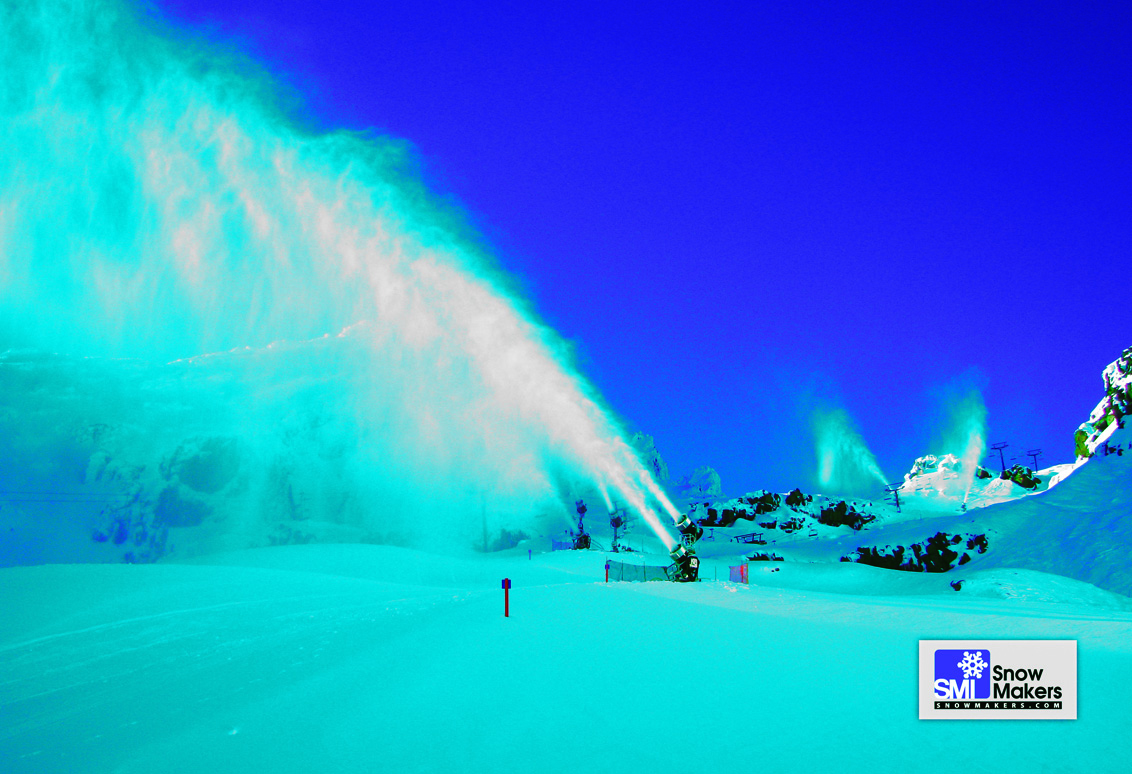
Machines that produce artificial snow include
: artificial snow
and artificial making machines
Did you know that there are two main types of snow machines? Snow machines are further divided into these two types:
A. Fan type (snow machine) that spreads snow by rotating a fan
B. Gun type (snow gun) that sprays snow from the tip of a long, thin pipe
Regardless of the type, the principle behind how snow machines make snow is the same: They supply water from a base area, break it into particles, and disperse them into the air. These tiny water particles are called "nuclei," which turn into ice (snow) as they fall through the air
However, even if water is sprayed with a spray bottle at a ski resort where the temperature is -1°C, it will not turn into snow by the time it hits the ground. So why does water sprayed by a snow machine turn into snow?
Snowmakers compress air and release it at the same time as the "core," using the adiabatic expansion effect to instantly create an extremely cold space. The key to this is "adiabatic expansion," a phenomenon in which the temperature of water or air rises when it is compressed and drops when it expands. When the compressed, heated air is released with force, it expands all at once, making it cold.
Let's take a look at the features of each of the two types of snowmakers: "fan type" and "gun type."
A "fan-type" snow machine that can produce large amounts of snow in low temperatures
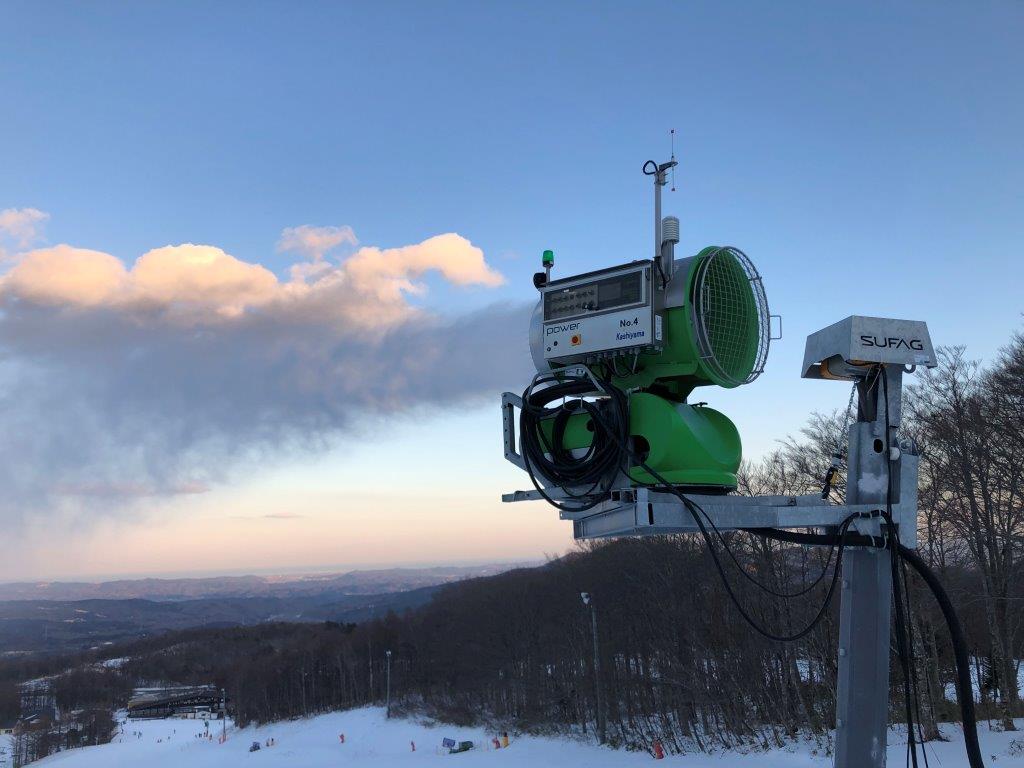
The fan type is equipped with a compressor (a machine for compressing). It has a large fan, which is used to increase the flight time of the ejected "core." By increasing the flight time, the ice (snow) crystals will grow larger before landing
It uses less air and has low running costs. Another advantage is that it can easily produce large amounts of snow at low temperatures. Conversely, in principle, it is not possible to produce much snow at high temperatures (-1 to -3°C)
[Snow Machine] Fan Type (Snow Machine)
・They can make large amounts of snow in low temperatures
. ・They are broadly divided into electric and hydraulic types.
・The new model does not lose power even in high temperatures.
▼ How a fan-type snow blower works
The evolved "gun-type" snow machine has overcome its weaknesses
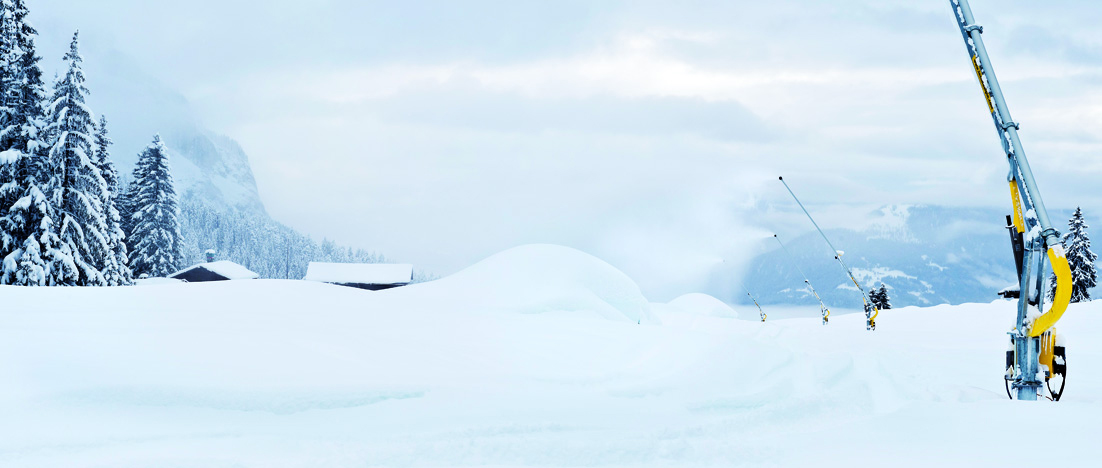
On the other hand, the older gun type snow maker uses compressed air supplied through pipes from the base area, just like water, and creates snow by utilizing the adiabatic expansion effect and the effect of increasing the airborne time of the "core." Because it uses a large amount of air, it has the disadvantage of consuming a lot of energy. On the other hand, it is said to be excellent for making snow in high temperatures
However, recently, a new type of gun known as a "low air gun" or "stick type" has appeared, which consumes less air than the traditional gun type. This type uses the adiabatic expansion effect of a compressor to form the "nucleus", but does not use the air pressure to increase the hang time. The hang time is achieved by "dropping from a high place". In principle, it consumes less air, so running costs can be significantly reduced. It seems that most of the European and American models have switched to this type
What they all have in common is that snow machines cannot produce the amount of snow that ski resorts need unless the temperature drops below -1°C. Of course, the lower the temperature, the more snow they can produce. Automation has also been developed that senses the temperature, automatically starts making snow when the set temperature is reached, and increases the amount of water as the temperature drops
[Snow Machine] Gun Type (Snow Gun)
・Strong even at high temperatures
・Consumes a lot of energy
・Recently, there has been a shift to energy-saving models
Snowmaking machines operate on a completely different principle than snow machines

On the other hand, snowmaking machines create ice in a plant located in the base area. They then crush it into a shape that is as close to snow as possible and spread it over the slopes. They are often called "ice crushers." This is similar to how shaved ice can be made in the summer, and the process of making snow (crushing the ice) is not affected by the temperature. Just as shaved ice does not melt for a certain period of time even at room temperature, the snow that is created will maintain its appearance for a while even when the temperature is not below freezing
Snow machines can make snow at any time, making them essential for ensuring a good start for ski resorts when they open, and they are also handy for ensuring a stable supply of snow at the beginning of the season. This is because it is highly unlikely that a snow machine would suddenly spread snow on a completely snowless surface when the temperature is not below zero.
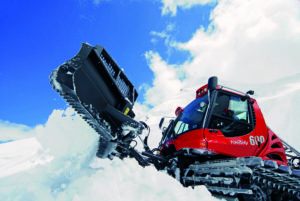
Ski resorts that open using artificial snow usually have a scene like the one in the photo (below) before opening. Ice is made in a plant and crushed into snow. To reduce the area exposed to sunlight and rain, it is first stored in a mountain shape. Before opening, it is spread out with a snow roller and laid out on the runs.
Although they are much more expensive than snow machines, their overwhelming advantage is that they can make snow even when temperatures are not below freezing

[Snow making machine]
・A machine that makes snow-like ice from scratch
・Can make snow regardless of temperature
・Costs more than a snow machine
Who are the manufacturers of snow machines and snowmaking machines?
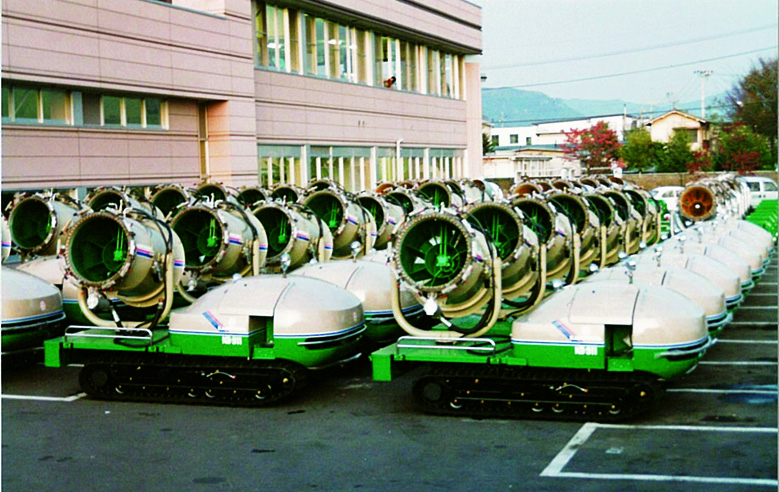
There are major manufacturers of snow machines and snowmakers in both Europe and the United States. A representative American manufacturer is SMI, founded in 1965, which has delivered over 12,000 machines to date, 90% of which are still in use. The European manufacturer with the largest market share is Italy's Technoalpin, which was founded in 1990 and has grown rapidly into a global manufacturer in a short period of time. These two brands are sold in Japan by Snow Systems, a company that also handles snow groomers and snowmobiles
Meanwhile, original development continues in Japan as well. Kashiyama Kogyo, based in Nagano Prefecture, was the first to manufacture domestically produced snowmaking and snowmaking machines in Japan in 1978, and has since boasted the largest market share among domestic manufacturers
Since 1979, they have delivered a total of 3,000 units. They also supported the Nagano Olympics. Incidentally, Kashiyama Kogyo's snowmaking machines were installed at Snow Town Yeti, the first to open in Japan, and Karuizawa Prince Hotel Ski Resort, the second to open
Among Kashiyama Kogyo's snow machine lineup, the KB-911 is a powerful model with an unprecedented style. It is self-propelled by a diesel engine and does not require an external power supply. It is a formidable machine that can instantly make snow wherever you want with just a water supply. What's more, it is equipped with a powerful engine and snow crawlers that can climb slopes of up to 30 degrees. It is amazing that it can even run while making snow
The third category
Snow made by freezing superabsorbent polymers (absorbent polymers), the same type of absorbent material found in disposable diapers and sanitary napkins, soaked in water is generally found on indoor slopes. The original ski resort was Skiing in Tsudanuma, which was open in the 1990s. Today, Snowva resorts across the country use this type of artificial snow

*Continued in Part 2 (Part 2 will be released on October 27th)
Interview cooperation and photo provided by Kashiyama Kogyo Co. , Snow Systems Co., Ltd. (in alphabetical order).
It is based in the most indoor position in the outdoor world and the most outdoor position in the indoor world.
https://www.d-mizorogi.com/
*Also recommended: "The Road to Becoming a Ski Resort Maniac" series