

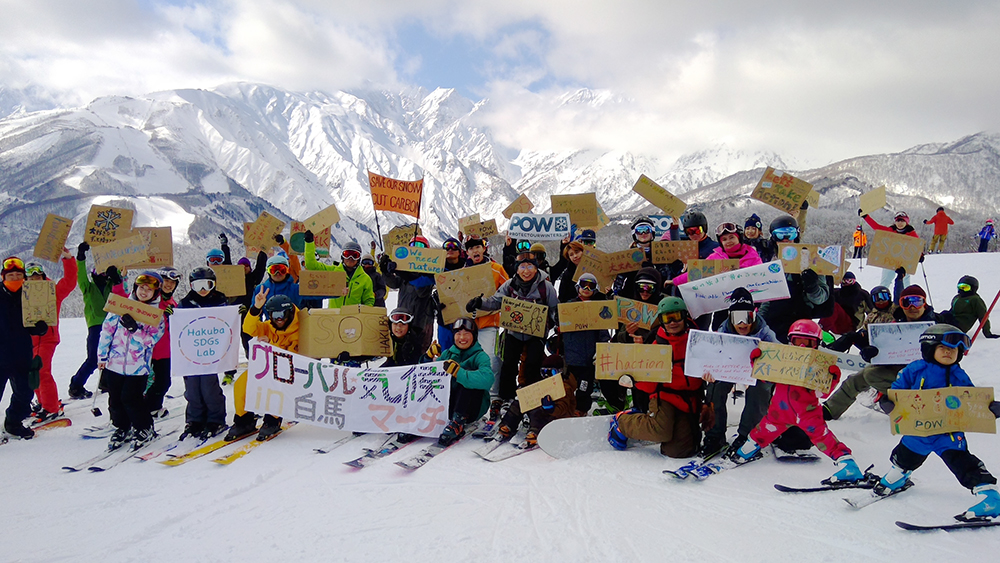
*The photo above is from the slope climate march held at Iwatake Snow Resort in 2020
Protect Our Winters (POW) is a movement that takes decisions and actions with a focus on a decarbonized society in order to protect natural environments from the threat of climate change. We spoke with representative Goro Komatsu and secretariat staff member Hitomi Suzuki about the background to the establishment of POW JAPAN in Japan, as well as their ideas, actions, and vision
Looking at the situation from a broader perspective, it is clear that there is no time to wait
--Looking back on the '21-22 season, how do you feel?
Komatsu: It was a season where I enjoyed powder to the fullest. The amount of snow this year was incredible, but the quality of the snow was also great. It was often cold and I couldn't warm up
--It was the first time I saw Lake Aoki completely freeze over. (STEEP's editor-in-chief has been living in Omachi City for two years.)
Komatsu: Me too! I've been living here for 16 or 17 years now, but this was the first time. When I came here, there was a year called 2006, when there was a heavy snowfall, but it seems like it's been getting gradually warmer since I moved to Omachi (laughs). Since then, I feel like no one is surprised even if it rains in January
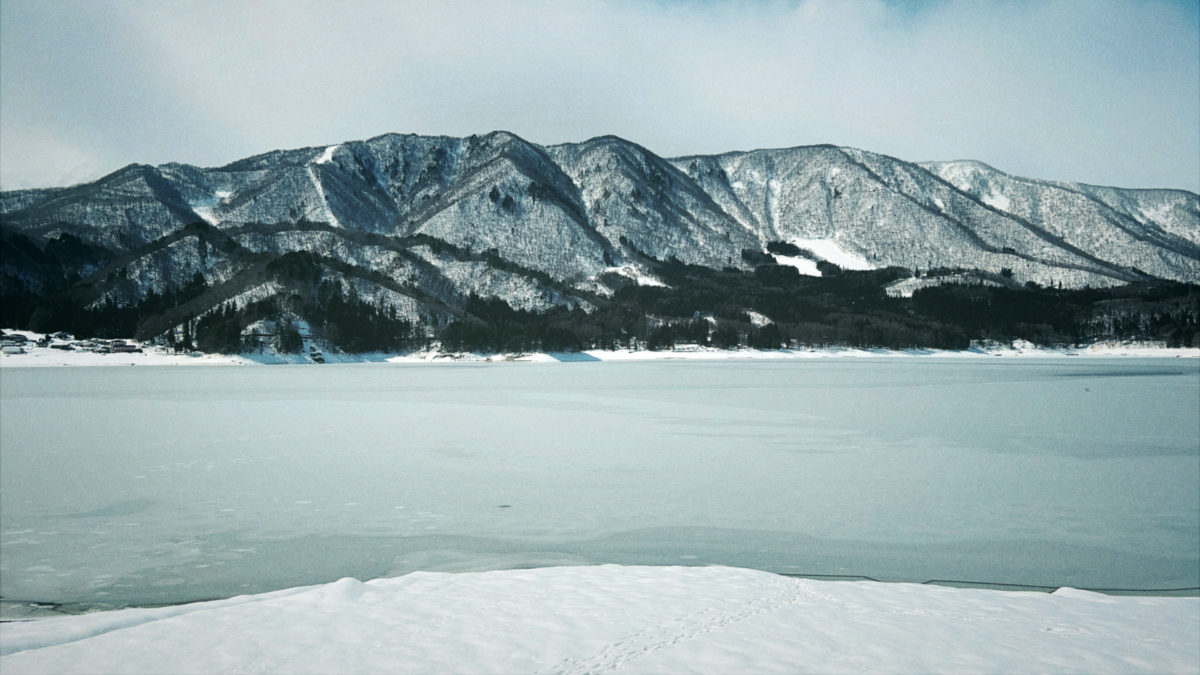
--Looking at this year alone, it seems like there's been a lot of snow, but if you broaden your perspective and look at it on a global scale, can you really feel that winters are getting shorter and there's less snow?
Komatsu: I think so. It's clear that summers are getting hotter, winters are getting warmer, and there's less snow. I couldn't have predicted that we'd have such little snow. It's a problem, but we just have to accept it as it is and face it
--In this situation where there is no time to wait, a campaign called "AT4NEN" has been born

Since the Industrial Revolution, the world's average temperature has already risen by more than 1 degree. In order to limit the temperature rise to 1.5 degrees, which is necessary to avoid the catastrophic impacts of the climate crisis, greenhouse gas emissions must be halved by 2030 compared to 2010 levels.
"AT4NEN"
To achieve this, the world needs to reduce emissions by 7.6 % , but for the five years from 2025, this would require a 15.4% reduction every year, which is said to be nearly impossible. In other words, we only have about four years left to achieve this.
Campaign http://ato4nen.com/
Komatsu: That's what they say. Arctic ice is disappearing at an incredible speed. The effects of excessive heat are being felt in many places. Without snow, some places will run out of meltwater, and at the same time, heavy rains are becoming more and more frequent. If we don't do anything about it, global warming will continue to progress, and these kinds of phenomena will become more frequent. Last year they said we only had four years left, so this year it's already three years away. There's no doubt that we need to act quickly
POW JAPAN launches in 2019!
The start of climate change action
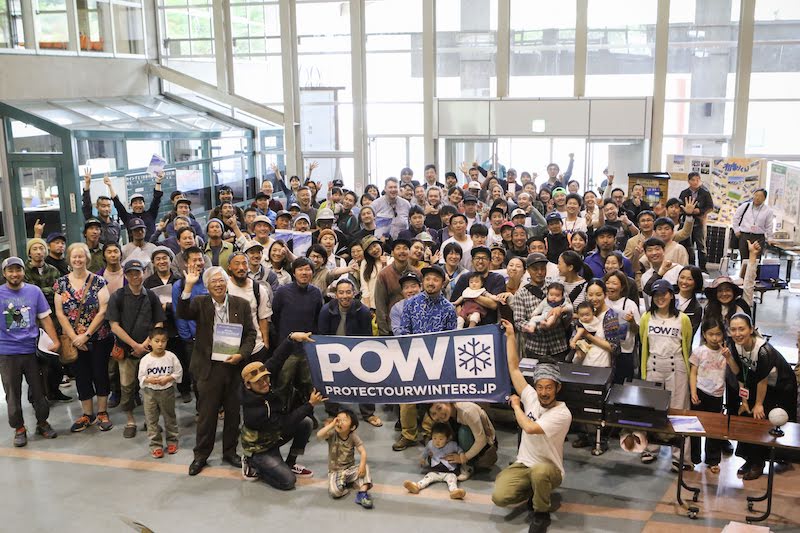
--It's been four years since POW was founded. In the Hakuba area in particular over the past three years . The number of supporting ski resorts has increased, and now the entire Hakuba Valley is starting to move in that direction. I think we can clearly see the results of POW's efforts to raise its voice and get others involved in tackling climate change, but what was that process like?
Komatsu: Up until then, I don't think there had been much action by the snow community to address climate change. But I think many people, including those at ski resorts, had noticed that the amount of snow was definitely decreasing. If we continued to stay silent, would the snow stop falling? I think one of the catalysts was that POW started at a time when people were beginning to feel a sense of crisis. For us, the decrease in snow was a negative, and I think the snow community as a whole had a general feeling that if there was anything they could do about it, they wanted to do it
At the time, the COVID-19 pandemic had not yet taken hold, so there were a lot of inbound tourists from overseas, and many foreigners working in Hakuba, but it seems that the ski resort had received feedback like, "Hakuba is a great place, but it's not doing much to protect the environment." In that sense, I felt that we had to do something, and I wanted to do it
So rather than us giving them a push, I think they were all waiting for some kind of trigger. So in 2019, we started concrete activities by holding a symposium. Yes, 2019 was the year Greta became very famous
--You Greta Thunberg ? She's a Swedish environmental activist who has spoken out against global warming. At the age of 16, she also gave a speech at the UN Climate Action Summit 2019.
Komatsu: Yes, it was the first year that there was a global atmosphere that something had to be done, that some kind of action had to be taken, to address the climate crisis and climate change, so I think the timing was perfect
From there, we held a symposium, where we had the opportunity to speak with Hakuba Village Mayor Shimokawa and Nagano Prefecture Governor Abe, and we also found friends who wanted to help us get started. Hakuba, as a world-renowned mountain resort representing Japan, was starting to make moves to promote environmental initiatives. The village as a whole was determined to move in that direction, and it was a really good time for this to start. You could even say that we were started at that opportunity. That was the background to how it all began
--A video about the Hakuba Valley SDGs was recently released on YouTube. Was POW involved in this too?
Komatsu: That's right. Hakuba Valley is a framework in which the three cities and villages of Omachi, Hakuba, and Otari began working together as a single tourist area, and various committees were formed under the guidelines of "How should Hakuba Valley change for the future?" One of these committees was the SDGs Subcommittee
It was around that time that POW was launched, so I was invited to join and was accepted. We had many discussions and conversations, and everyone on the SDGs Committee worked together to create this movie, booklet, SDGs action list, and other materials. It's been about two and a half years now, and these things are finally starting to take shape
Will environmental efforts become a standard of value for resorts?
--Have there been examples of environmental initiatives like this overseas for quite some time?
Komatsu: Luke Curtin from the United States, who we invited to a symposium we held, was the person who first established the sustainability department at VAIL Resort in Colorado. Apparently, Vail began its environmental initiatives 16 or 17 years ago. At the time, only Vail and another small resort had environmental departments
As the environmental department carried out various activities, the environment itself naturally improved, and more and more people around them began to support it. This created an atmosphere where everyone thought, "This is something everyone has to do," and now almost all large resorts in Europe and the United States have an environmental department.
Suzuki: I once saw a feature in the overseas outdoor magazine "OUTSIDE MAGAINE" called the Top 10 Sustainable Resorts. They were rated in various categories, and POW (USA) was one of the judges.
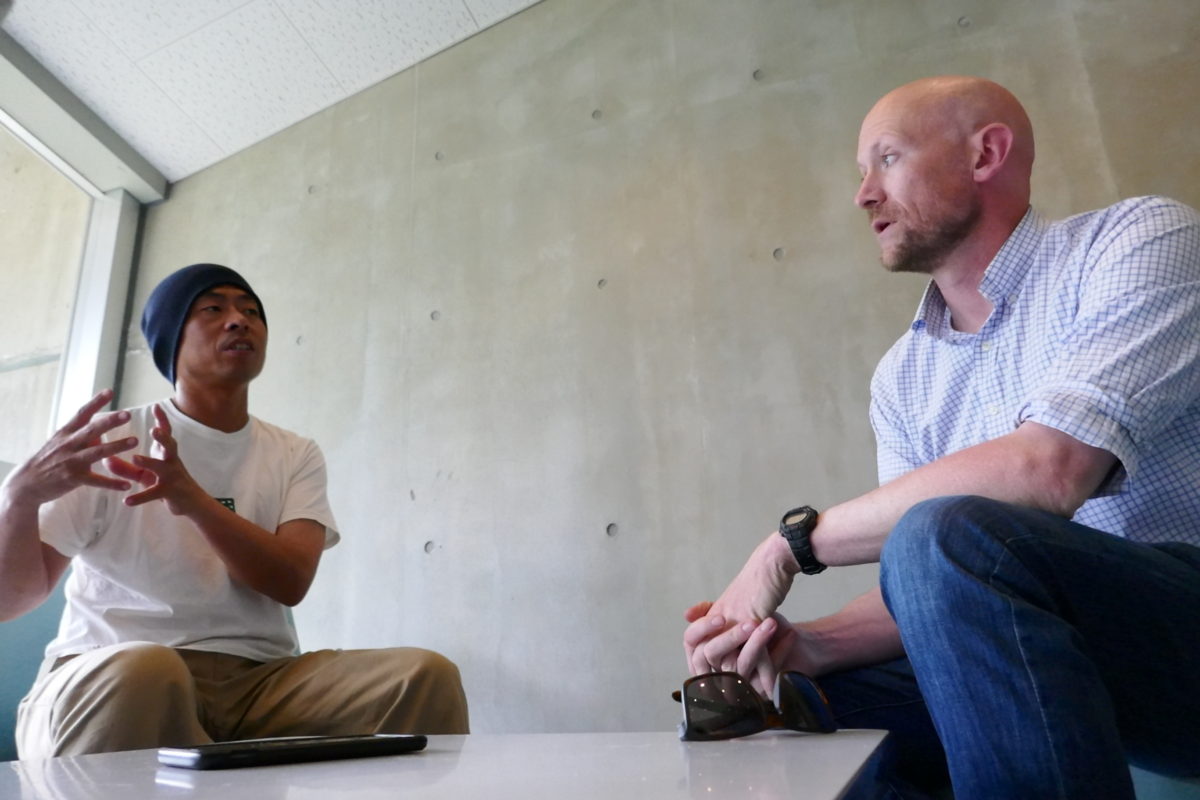
--Is it common practice overseas to evaluate ski resorts on their environmental efforts alongside criteria such as the size of the resort and the difficulty of the slopes?
Komatsu: One example is that they no longer need to advertise their services as they did in the past. Regarding environmental initiatives, they say things like "We've achieved this" or "We've started this," which has become an effective way to advertise, and I hear that more and more customers are including environmental initiatives in their criteria for choosing where to go skating
--In that respect, Japan still has a long way to go
Suzuki: We included this question in the recent "Climate Change Awareness Survey" that we conducted at POW. The question asked, "What are the criteria (reasons) for choosing a ski resort?" The results showed that reasons such as snow quality and good accessibility came out on top, with environmental initiatives coming in around fourth or fifth place
--But your environmental efforts are already in fourth place
Komatsu: If activities and awareness of this project progress further, I'm sure there will be a movement to recognize it
We'll definitely connect, now all we have to do is do it
--Do you have a vision for what you want to do in the future to spread your ideals and activities more widely?
Komatsu: I don't think it would happen if only POW said that. So I think it's really important to create an atmosphere where the entire snow industry, including manufacturers and the media, supports this kind of movement, and that we have to be mindful of the environment
Of course, we need to appeal to skiers and snowboarders, but I also think it's very important that this kind of atmosphere spreads throughout the town, just like in Hakuba
--Where are the places where activities are currently progressing using Hakuba Valley as a model case?
Komatsu: Katashina Highlands also wanted to take on environmental initiatives, and they contacted us two years ago when the COVID-19 pandemic began. POW arranged for us to hold lectures at all the ski resorts in the Katashina area to provide basic knowledge about climate change and global warming, as well as examples of cutting-edge research from overseas
Since then, we've been communicating and pushing each other to move forward, but the resort is now increasingly self-sustaining. It now uses about 30% renewable energy. It really shows how a ski resort with a strong passion can move forward with such vigor
--When skiers choose where to ski, do they look at whether a ski resort is run with environmental initiatives in mind, such as whether or not renewable energy is used for the lifts and snow machines?
Suzuki: That's true, but for example, Iwatake Snow Mountain Resort is trying to eliminate plastic, Able Hakuba Goryu's restaurant Sol is using locally produced ingredients, and Hakuba Happo is recycling lift tickets... I think there are a variety of initiatives, not just renewable energy. It would be great if a website had a list of initiatives with the ones that are being put into practice marked with a check mark, or if you could see them at a glance on the Yukiyama app or something. I would like to include that kind of information on the POW website as well
Komatsu: Plus, I think the perspective of the viewer is also very important. I think there are many ski resorts that are starting to take environmentally conscious steps, even if they haven't yet reached the stage of major movements like switching to renewable energy for electricity. I think it's important for visitors to have that perspective so that they can properly notice these initiatives, and that this will be an important point in developing this movement.
--Even if a company is taking environmental initiatives, if the people choosing don't really understand the criteria, they won't go. Is developing the ability to discern something something we users can do, in the same way as signing petitions, speaking out, and cultivating the eye for purchasing and choosing products? I think the accumulation of these small actions will lead to changes in social systems.
Suzuki: I think one key is how to broaden the base. Partner companies and POW ambassadors have many fans and users. I think it's important to borrow the power of such people and sow seeds in different categories that POW alone can't reach. It's a very steady step, though
Komatsu: I think that's a really good point. In the end, I think it's not about changing "that place," but rather about changing the people beyond that place. There are many places we just can't reach on our own, so it's really important that we increase the number of people who are willing to reach out to those places with us
Suzuki: We at POW also think that this is an issue. We want to collaborate more with many people. We will provide the knowledge and ideas that POW has on this issue, and if working together can help spread what the other party has, we would like them to use POW. I hope we can work together effectively
Komatsu: People who play in the snow may use different equipment, such as skis or snowboards, or have different aspirations, such as alpine skiing, basic skiing, or freeriding, but they are all the same kind of people who ski on the snow. I think that not only snowy mountains, but also people who enjoy the outdoors, have a desire to protect nature in their hearts, and it makes sense. That's why I don't think collaboration itself is that difficult. I believe we can definitely connect in that way, so I think all we have to do is just do it
To be continued in the second part
The person who taught me
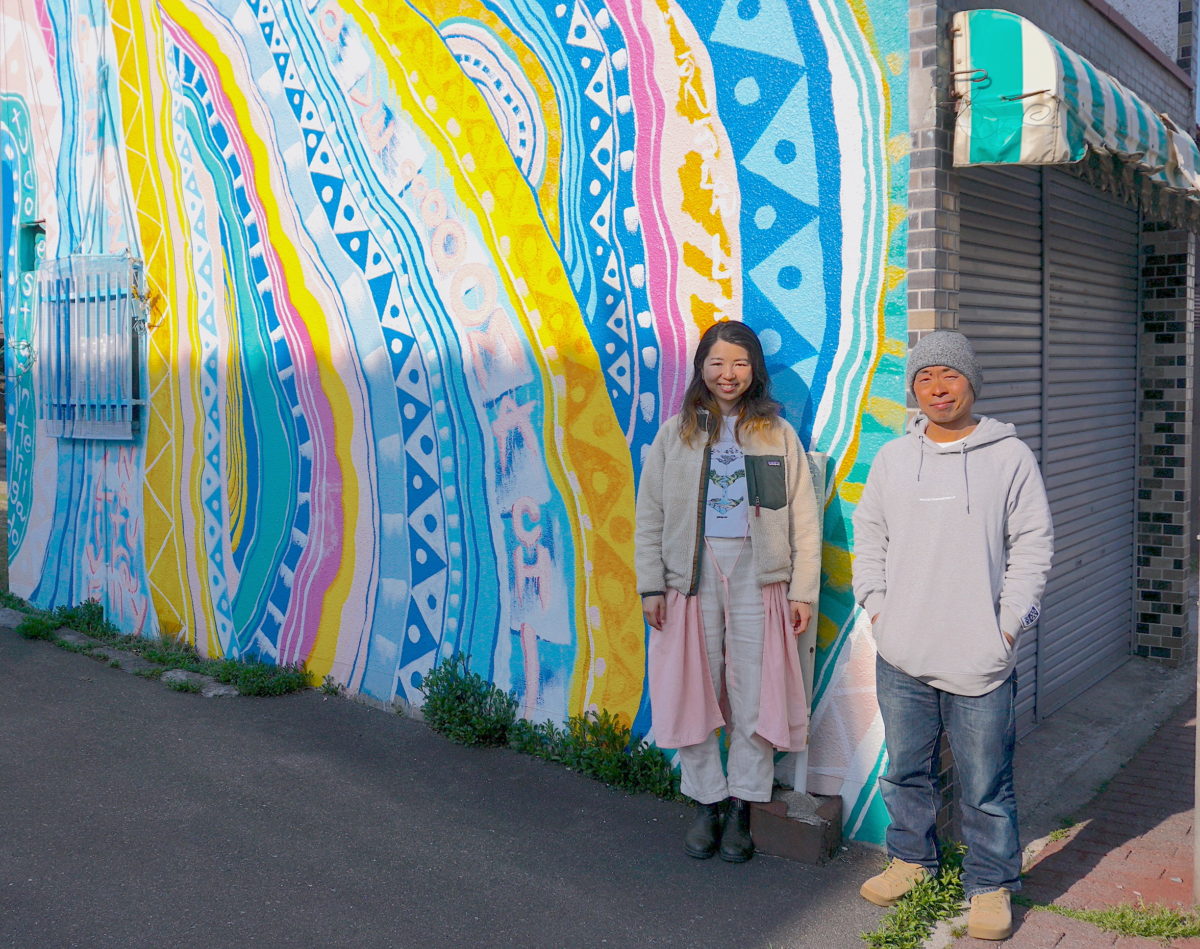
Hitomi
Suzuki
Digital Marketing Manager
Born in Fujisawa City, Kanagawa Prefecture, and currently living in Omachi City, Nagano Prefecture.
After working in customer service at Patagonia, he gained experience in digital marketing. Wanting to live closer to nature, he moved to Nagano Prefecture after meeting POW JAPAN.
Goro
Komatsu
representative director
Originally from Niseko Town, Hokkaido, he currently lives in Omachi City, Nagano Prefecture.
He began skiing at the age of four, moved to British Columbia, Canada at the age of 12, and became a professional snowboarder. Even before founding POW while living in Canada, he has been advocating for reducing the burden on the natural environment. In 2018, he launched POW JAPAN as its representative director.

https://protectourwinters.jp/
Narration: Goro Komatsu, Hitomi Suzuki (POW JAPAN) Interviewer: Takeru Ogawa (STEEP Editor-in-Chief)
Interview recorded: April 2022