

The Japan Mogul Team, said to be "undoubtedly the strongest in history," is taking on the Beijing Olympics. What kind of skiing will they show on the Olympic stage? Let's introduce the Japanese men's and women's mogul skiers, who are considered very likely to win gold medals. Also, check out the 2021-2022 World Cup competition footage, which will give us a glimpse into the Olympic battle!
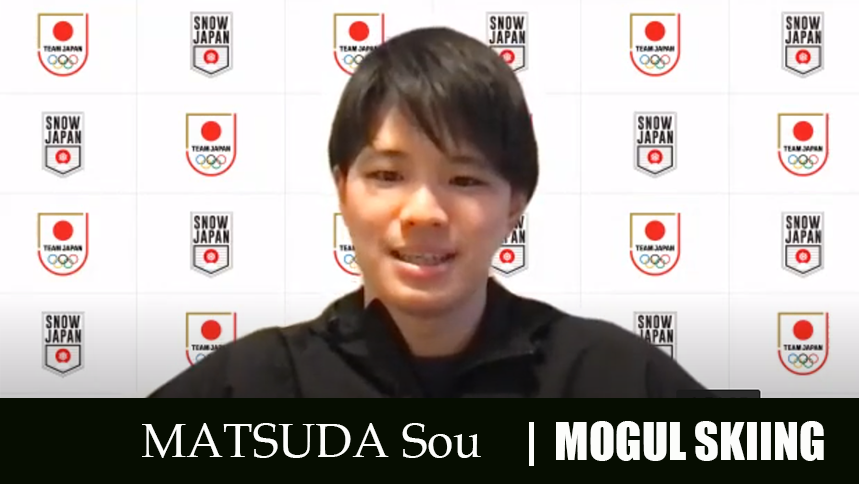
MATSUDA
Sou
Born in Kyoto Prefecture, he began mogul skiing at a young age, influenced by his father, who loved moguls. He attended Hakuba High School to train, and then went on to train in the United States, where he continued his ambitious endeavors. He is particular about his own style and even has a signature glove. This time, he grabbed the last ticket for the Beijing Olympic team selection, and made his first appearance, fulfilling his childhood dream
@mogul_sou about the crowdfunding campaign organized by his club to support his athletic activities at the Beijing Olympics.
■ Profile
| date of birth | Born September 24, 1999 |
| Birthplace | Nagaokakyo City, Kyoto Prefecture |
| Affiliation | Shimada Hospital Snow Team |
| Major battles in recent years | '21 41st All Japan Ski Championships Moguls Champion '19 Noram Tour Overall Champion / All Japan Championship Champion / World Cup Finland Tournament 12th Place / World Cup China Tournament 6th Place '18 US Selection DM Event Champion / Junior Olympics 2nd Place |
| Gear used | Skis: ID one |
| @mogul_sou |
■ Matsuda Hayate - Skating video
This video introduces the moguls and Matsuda Hayato to raise funds for a crowdfunding campaign organized by Shimada Musculoskeletal Care Hospital, where Matsuda Hayato is a member
■ Comments from the "Online Press Conference to Determine Representatives" just before the Beijing Olympics
With the Beijing Olympics just around the corner, the All Japan Ski Association held an online press conference to determine the Japanese representatives. We present an excerpt from a video of Hayato Matsuda's comments. "Q" is a question from a journalist
January 23rd (Sun) 19:00-19:30 From the online press conference to decide the representatives
Q. It feels like you made the decision at the very last moment, how are you feeling now?
- To be honest, it still doesn't feel real. I wasn't actually performing consistently well, and my seventh place and qualification to represent Japan was a bit of a blessing in disguise, as other athletes made mistakes. I've had to switch gears a bit, and there's still time, so I'd like to prepare my mind and skills for the Olympics.
Q. This will be your first time competing in the Olympics, so how do you feel about being on such a big stage?
Especially in moguls, unlike other sports, the Olympics is the biggest stage. In freestyle, there are the X Games and other events. It's a dream stage after all, and to be honest, I didn't think I'd actually be able to compete this season, so it still feels like a dream, but I hope to be able to take on the challenge with my feet firmly on the ground.
Q. What kind of performance do you want to show to the whole of Japan on this dream stage?
I want to show my unique style, my unique side, and my good points.
Q. What are Matsuda's strengths?
- I once based my training overseas, so I incorporate a variety of things from overseas as well as Japan, and like Hara, I also have a signature move where I grab the board, so I hope people will look at that.
Q. What are your goals for the Beijing Olympics
? Up until now, I have been able to achieve results if I have been able to skate my own style, so I would like to make it my first goal to skate my own style and not be swayed by what others think or what the stage is like.
Q. You were able to play this season, what areas do you think you have improved that led to your selection for the national team?
- I think it's because I'm gradually getting better at preparing for matches, and although I haven't been able to make it to the finals on average this year, I think it's a tournament where if I lose, it's all over, and this time, if I don't make it to the finals in December 2021, I won't be able to play in the North American match against Canada and the US, and I have to decide here if I want to play in the Olympics, so I think it's a big deal that I was able to grasp that and show that I was mentally and physically prepared in a way that I couldn't miss.
Q. It's not surprising to be nervous in a situation like that, so how did you overcome it
? Well, I'm actually quite a crybaby, so I'd bawl my eyes out the night before. It was exhausting. But then it came full circle, and I felt like I was able to relax.
Q. You said you were based overseas for a while, so please tell us when and what you studied
. After graduating from high school, I went to Colorado in the US to work with a coach who taught me the kind of skating I wanted to do. In fact, there were many skaters from his team who had gone on to represent the US in the Olympics, and it was the kind of skating I had always dreamed of, so it was great to meet someone who could teach me the kind of skating I wanted to do.
Q. How long did you stay?
- Actually, I was only there for about six months, so it was a short stay, but I was able to quickly become a valuable player, and the results came, and I was able to make the Japanese national team that year, so from then on I moved to Japan to train.
Q. Could you tell us how you ended up attending Hakuba High School, being from Kyoto? What exactly was the "skating style you wanted to do" during your training in Colorado? Are you still maintaining that style or has it changed?
I went to Hakuba High School because I went to America, but it was difficult to get to Kyoto by overnight bus every weekend to do the training I wanted, so I went to Hakuba High School and joined the Nagano Prefecture team. The skating I wanted to learn in America was a more scientific, aggressive style. I tend to fall backward, so I wanted to skate to compensate for that. There's a unique American style, and I admired that cool skating. Now I'm maintaining that style while incorporating sophisticated Japanese techniques, so I think I'm getting the best of both worlds.
Q. What prompted you to start moguls and what grade were you in?
- My father was a mogul skier as a hobby, and we lived in Kyoto, but I started skiing when I was about three years old. I remember I was in the fourth grade of elementary school when I decided to compete in competitions and aim for my dream of competing in the Olympics. When I was little, I met Janne Lahtera, who is now the coach for the Japanese national team, and I had the opportunity to see Toby Dawson, an American bronze medalist, ski at Hakuba 47, where I'm based. I actually joined a team in Nagano Prefecture and before I knew it, it had become a dream.
Q. Which grab is your signature move? And what's it called?
- I use grabs on both backflips and corks, but mine is the cork grab. A lot of skaters from other countries are doing it now, but the number of skaters using it exploded the year after I did it. It's called the Japan grab, where you grab the tail of your right foot with your left hand, and because you grab with the hand in the direction of rotation, it's also called a lead grab or near Japan. The good thing about this grab is that you can balance with your free right hand, making it really easy to land. Since my name is Hayate, I thought it might be the S grab, but the name itself is short, so I think the "SOU grab" would be fine.