


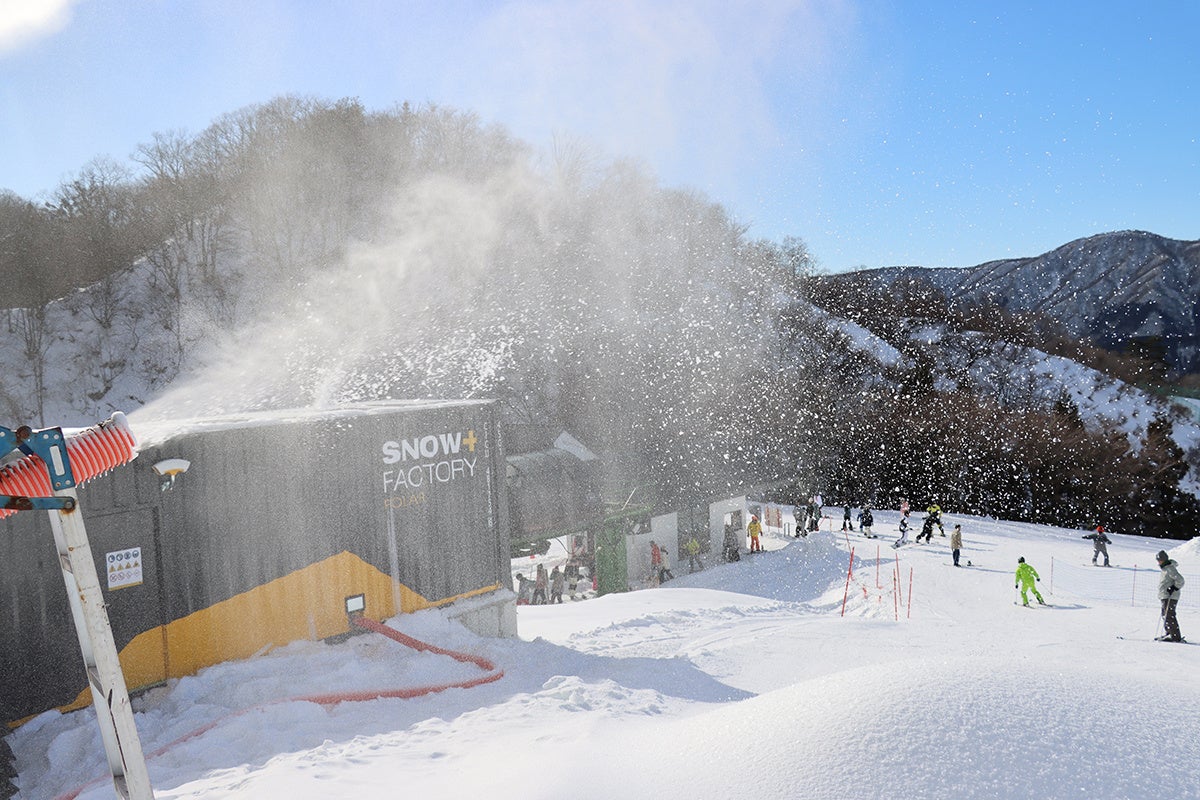
This news first broke in early June.
What is the current momentum behind Oku-Ibuki, which is said to be "a ski resort like no other"?
We spoke to the management team at Grand Snow Oku-Ibuki.
News release: "Business starts in November 2024-2025!"
Grand Snow Oku-Ibuki is an impactful ski resort with a number of flashy catchphrases, such as "Number 1 in the nation's most popular ski resort rankings*," "World's largest snowfall!", "Japan's fastest high-speed lift," and "50 million yen total rebate campaign."

* Weather News' 2020-21 ranking of popular ski resorts nationwide
With just nine lifts and 14 courses, Grand Snow Oku-Ibuki is not exactly large, but it attracted a cumulative total of over 250,000 skiers and snowboarders in the 2023-2024 season, putting it on par with Hakuba and Naeba as one of the top resorts in Japan for number of visitors. Despite being in Shiga Prefecture, it is conveniently located just 50 minutes from Nagoya, 80 minutes from Kyoto, and 100 minutes from Osaka, making it an ideal location for a day trip skiing, but even ignoring this, Oku-Ibuki's momentum is undeniable


During the three years of the COVID-19 pandemic, most ski resorts have seen a significant decline in business, but Oku-Ibuki has recorded its highest number of visitors ever. As you can see from the graph above, the growth has been astonishing, especially in recent years. The worst year of the season was a season of light snowfall due to a lack of snow
On weekends, nearly 7,000 people flock to the resort each day, filling up the 2,700-car parking lot early in the morning, creating long queues, and there are only 18 direct shuttle buses from JR Maibara Station in the morning. Even though there are 4,000 rental sets, they quickly sell out among young people. With the number of skiers continuing to decline and the COVID-19 pandemic causing financial difficulties for some ski resorts, the success of Grand Snow Oku-Ibuki is now the stuff of legend

It's only because Oku-Ibuki has been able to continue to achieve such incredible results that it was able to make this investment of 1.2 billion yen in snow-making equipment. Riding on this momentum, they will likely pursue aggressive management and further improve their performance by opening in November for the 2024-2025 season, a month earlier than planned, and achieving 150 days of operation per season. It's
easy to think so.
However, that is not all. In fact, it could be said that this is not the case. So, what does this mean?
Let's seek the answer by learning about his extremely unique management skills and corporate mindset.
It was true that the company operated on 100% renewable energy through self-sufficient hydroelectric power generation

Oku-Ibuki is always the subject of much discussion, drawing attention from the surrounding area. Recently, rumors have been circulating around the ski resort, such as, "Is it true that the ski resort is 100% self-sufficient and runs on renewable energy generated by hydroelectric power?" and "Is that okay?"
The most obvious example of a ski resort's SDGs and sustainability initiatives is the use of renewable energy for its lifts and facilities. As the number of ski resorts taking action on climate change steadily increases, an intriguing question naturally arises: "How much electricity does Oku-Ibuki's hydroelectric power plant generate?"
So we did a surprise interview with Grand Snow Oku Ibuki and asked them about it

According to President Kusano Jota,
"We have established a joint venture with Kansai Electric Power Co., Inc., with equal investment from both companies, and the first power plant will begin operations in 2022, followed by the second power plant in 2023, with electricity generation proceeding smoothly. Each power plant generates approximately 1,400 megawatt hour (MW) of electricity per year, for a combined total of 2,872 mWh for the two plants.
The total electricity used by the Okuibuki Group, including the ski resort, campgrounds, glamping facilities, motor park, green park, and the civil engineering and construction company Kusano Gumi, is around 1,150mWh, so we are certainly self-sufficient."
The rumors that Okuibuki is 100% self-sufficient with renewable energy are true! This is an incredibly amazing feat. Many ski resorts are now purchasing renewable energy and aiming to make their ski resorts renewable energy-based, so it is unusual to imagine a ski resort generating its own electricity from the river that runs through it and becoming self-sufficient in all of its power, from the ski lifts to the facilities. (Strictly speaking, the electricity generated is sold to Kansai Electric Power Company, which then purchases it from them...) Of course, you won't find a ski resort like this anywhere else in Japan, so it is one of a kind

Grand Snow Oku-Ibuki is located in the depths of Shiga Prefecture, home to Lake Biwa, a remote area so remote it is sometimes called the "Tibet of Lake Biwa," but it is also in an environment blessed with abundant water. The mountains are not particularly large, but they are gentle and the location makes it easy for rainwater and melted snow to accumulate. Hydroelectric power is overwhelmingly more stable than solar or wind power. Hydroelectric power is the most efficient and stable form of renewable energy
The move to start hydroelectric power generation about five years ago was apparently made after the Great East Japan Earthquake, when the government pressured electric power companies to develop renewable energy sources, and Kansai Electric Power Co. approached them. The land on which the power plant was built, drawing water from the river that flows through Grand Snow Okuibuki, was fully owned by the Kusano family, who run the ski resort, and the Okuibuki Hydroelectric Power Plant was completed miraculously smoothly. In just three years, they achieved "Japan's first self-sufficiency in the electricity used by their group's tourism facilities through renewable energy." This adds another layer to Okuibuki's legend
Raising the issue: "What CO2 reduction should ski resorts do?"
However, in reality, for Okuibuki, hydroelectric power generation is not at all a corporate effort to reduce CO2 that they undertake in order to be recognized by stakeholders and users
"If that's the result that happened, then that's fine too. So let's make it an easy-to-understand achievement that shows we're making serious efforts toward the SDGs," said the president with a smile. Indeed, if you the Okuibuki Group's website , you'll see that they have introduced a number of impressive initiatives toward the SDGs, including a reduction of 1,320 tons of CO₂ through hydroelectric power generation.

"But, since the SDGs are about sustainability, of course it's not just about preventing global warming, but when you think about ski resort operations and preventing global warming and reducing CO₂ emissions, the electricity used at ski resorts includes electricity for artificial snow machines, lifts, and facilities, and if you convert the electricity used in one season into CO₂, the amount of CO₂ emitted by one customer at a ski resort for 200,000 to 250,000 visitors is 4 kg
The journey to the ski resort by car or bus emits about 7 kg, but no one pays attention to the CO₂ emissions associated with this
I wondered what inbound tourists were like, and when I looked into it, I found that a round-trip economy flight from Sydney, Australia to Narita emits 988 kg of CO₂ per person. That's 250 times more than Japanese people. Even if a Japanese person spends a day at a ski resort, they only emit 4 kg of CO₂, yet they cut back on electricity and lower the heating temperature, causing inconvenience to customers, and work hard to create ski resorts that Japanese people don't want to go to, in order to enthusiastically attract foreigners from overseas...I wonder, "Is this okay in terms of the SDGs?"
People around me often say, "Europeans love sustainability, so I'm sure there will be a lot of inbound tourists," but guests from overseas say things like, "Japanese ski resorts seem to be doing some sustainable things, so I'd like to take a look," in a condescending tone, and ask, "Is it okay to emit several tons of CO₂ just to come to Japan?" (laughs)

Of course, it's really important to reduce CO₂ emissions in any way we can, but it would be more effective if people who live near ski resorts would eventually get to them by bicycle rather than building small power plants. The CO₂ emitted by one person at a ski resort per day is only 4kg, and when you consider that people spend all day driving, the environmental impact of a ski resort is very small
If you use lots of snow machines to make snow and operate that many lifts, the amount of electricity used is the same whether you have 10,000 visitors or just one. So to become a sustainable ski resort with a low environmental impact, we need to attract lots of people from nearby areas. That's what we need to do most right now. We think that focusing on attracting people from far away is a fundamentally wrong approach
Everyone is keen to reduce CO₂ emissions once they arrive at a ski resort, but if there are 5,000 visitors per day, that's 2 tons of CO₂. If 25 foreigners come, that's the same amount of CO₂. I understand that Japan's tourism industry has no choice but to rely on overseas sources, but if ski resorts are going on about the SDGs, the first priority should be to attract Japanese people. I think they need to work on that more enthusiastically
However, we cannot reject the idea of attracting inbound tourists solely from the perspective of reducing CO₂ emissions, and economic benefits and environmental issues cannot be separated. Therefore, we should encourage people to spend as much time in Japan as possible during each trip and visit as many ski resorts as possible. This will reduce the amount of CO₂ emitted per person, so I would like to propose more initiatives like this."

For the 2024-2025 season, Grand Snow Oku-Ibuki is considering something similar. It's about dual-pricing lift tickets. For example, what if they charged 5,000 yen for Japanese guests and 6,000 yen for overseas guests, and then pooled the 1,000 yen difference and disclosed it with evidence that it was used exclusively for environmental measures. Rather than using it to make money, it could be used as funds to create a comfortable environment for everyone at the ski resort
"If we want to reduce CO₂ emissions, it's most important to encourage Japanese people to do so. Ultimately, the best thing would be for local residents to come to the ski resort by bicycle. To that end, we've been promoting a service called the Eco Discount, which offers free direct bus rides for two days a month during the ski season. We encourage people to come to the ski resort by public transportation, such as trains and buses, rather than by car whenever possible. Buses reduce CO₂ emissions by about one-third compared to traveling by car."
Direct buses cost 1,000 yen one way from JR Maibara Station or Omi-Nagaoka Station. They arrive right at the bottom of the slopes, so there's no long walk from the parking lot. With plenty of rental gear and apparel, there's no need to prepare for skiing. Simply grab your smartphone and hop on the bus. It's incredibly convenient for users and has a significant impact on CO₂ reduction. In fact, more visitors are now using the bus to get to Grand Snow Oku-Ibuki than ever before.
"Just do it, and if it doesn't work, stop right away" is the Oku-Ibuki style
Where do the unique ideas and philosophies of Grand Snow Oku-Ibuki come from? The current president is the third generation to have been president since the small ski resort with one lift was founded in 1970. It is rare to find a ski resort of this size that is 100% family-run

"This is a remote area that has even been called the Tibet of Hubei. When the company was founded, the previous owner was apparently unsure whether to open a ski resort or make freeze-dried tofu. I'm glad he didn't choose freeze-dried tofu (laughs). Now, so many people are enjoying it
"Until now, we've always just done what we thought was interesting or good for our customers. If it doesn't work, we can just stop," says Chairman Kusano Takeharu (second-generation president) with a laugh
We have always prioritized customer convenience and comfort over profits. We have the "Alcande" escalator that connects the parking lot directly to the ski center, a powder room in the women's restroom, 100 yen drinks from vending machines, the fastest lifts in Japan, and the world's most advanced artificial snow-making machines from Italy's Technoalpin, which are being introduced to Japan for the first time..


"I think our strength is our overwhelming sense of speed. Everything is decided in the Kusano family in an instant, and instructions are immediately sent to the workplace, with implementation taking place in less than five minutes. It's fast. Judgments related to management decisions don't need to be submitted internally through a request form, and no stamp of approval is required (laughs). That's why we can be bold and I think it's easier to be original,"
says Managing Director Kusano Jouji, who is in charge of PR and marketing, the chairman's second son, and the younger brother of the president, Jota.

For example, the "50 million yen return campaign" and "free all-you-can-eat meal day" were all carried out with the idea that "it's fun, why not do it?", and they received a great response, undoubtedly increasing the number of visitors
"It's raining, I feel bad for you, so I'll park for free." "The wind is so strong the lift won't work, I'll give you a souvenir on the way back."
The service was added at the command of the chairman or president, and was instantly announced across the slopes via live broadcast by a ski resort radio DJ, a rare sight these days. Naturally, customers were delighted. This kind of thing happens all the time
Grand Snow Oku-Ibuki never stops
The Kusano family, who were born and raised in Omi Province, have always held dear the management philosophy of "Omi Merchants' Triple Win."
"Good for the Seller, Good for the Buyer, and Good for Society." It goes without saying that both the seller and the buyer must be satisfied, but a business can only be considered good if it contributes to society. It seems that Grand Snow Oku-Ibuki's unique way of thinking and actions have their roots here.
Hydroelectric power generation is a perfect example of what is good for society, and is an action in line with SDG goal 13, "Take concrete action to combat climate change." However, President Kusano says that the most important thing ski resorts need to do to reduce CO₂ emissions is to "engage local residents." This is in line with the Okuibuki Group's philosophy of "Skiing for local children in 2070."

As a direct action to this end, Grand Snow Oku-Ibuki is continuing its efforts to distribute 28,000 free lift tickets to all elementary and junior high schools in the nearby cities of Maibara and Nagahara through the Board of Education, in the hope that children will come and visit during their winter and spring breaks and learn about the wonderful things about their local area
I hope that these children will have the original experience of realizing that snowy mountains are fun and continue skiing and snowboarding for years to come. I also hope that these children will become parents and bring their families to ski resorts, be impressed, and spread the importance of cherishing nature and snow


This is an effort to awaken the Japanese people, especially the local people, in the long term, and at the same time contributes to the SDGs' goals of "3. Good health and well-being for all," "4. Quality education for all," "11. Sustainable cities and towns," and "13. Take urgent action to combat climate change."
"The SDGs are not just about climate change. We particularly value the creation of sustainable cities and towns, and believe that this is what we want to do most and the direction we should pursue. This is because ski resorts cannot operate unless the local environment and tourism coexist. The tourism business cannot continue unless the people who live there benefit
"We want local people to understand the value of the region's tourism resources and create new jobs by utilizing them as a business. We intend to advocate and put into practice new forms of tourism that will enrich the lives of local people," said the president
Oku-Ibuki has its sights set on 2070

"It's already 2024 now. Are the SDGs, which have been targeted for 2030, really okay? We're thinking even further ahead. Is this a declaration of abandoning the SDGs? (laughs) If we don't look ahead to sustainability 50 years from now, we can't make large-scale capital investments or develop attractive businesses. We can't develop truly talented personnel unless we provide stable employment and peace of mind. For us, people are an important asset and the foundation of management. That's why we need to ensure that the smiles of the precious staff and children who work with us continue into the future
So our vision is 2070."
In November 2024, snow filled with these thoughts will be produced by eight of the world's most advanced artificial snowmaking machines, manufactured by Italy's Technoalpin, in full operation. Many smiles will surely be spread across the slopes, which will be the first in the Kansai area to be covered in a blanket of snow
Towards true sustainability 50 years from now,
the Grand Snow Oku-Ibuki Kusano family's challenge continues.


Grand Snow Okuibuki Okuibuki,
Kozuhara, Maibara City, Shiga Prefecture
Official website: https://www.okuibuki.co.jp/
Official SNS: Instagram | Facebook | X | LINE | YouTube