
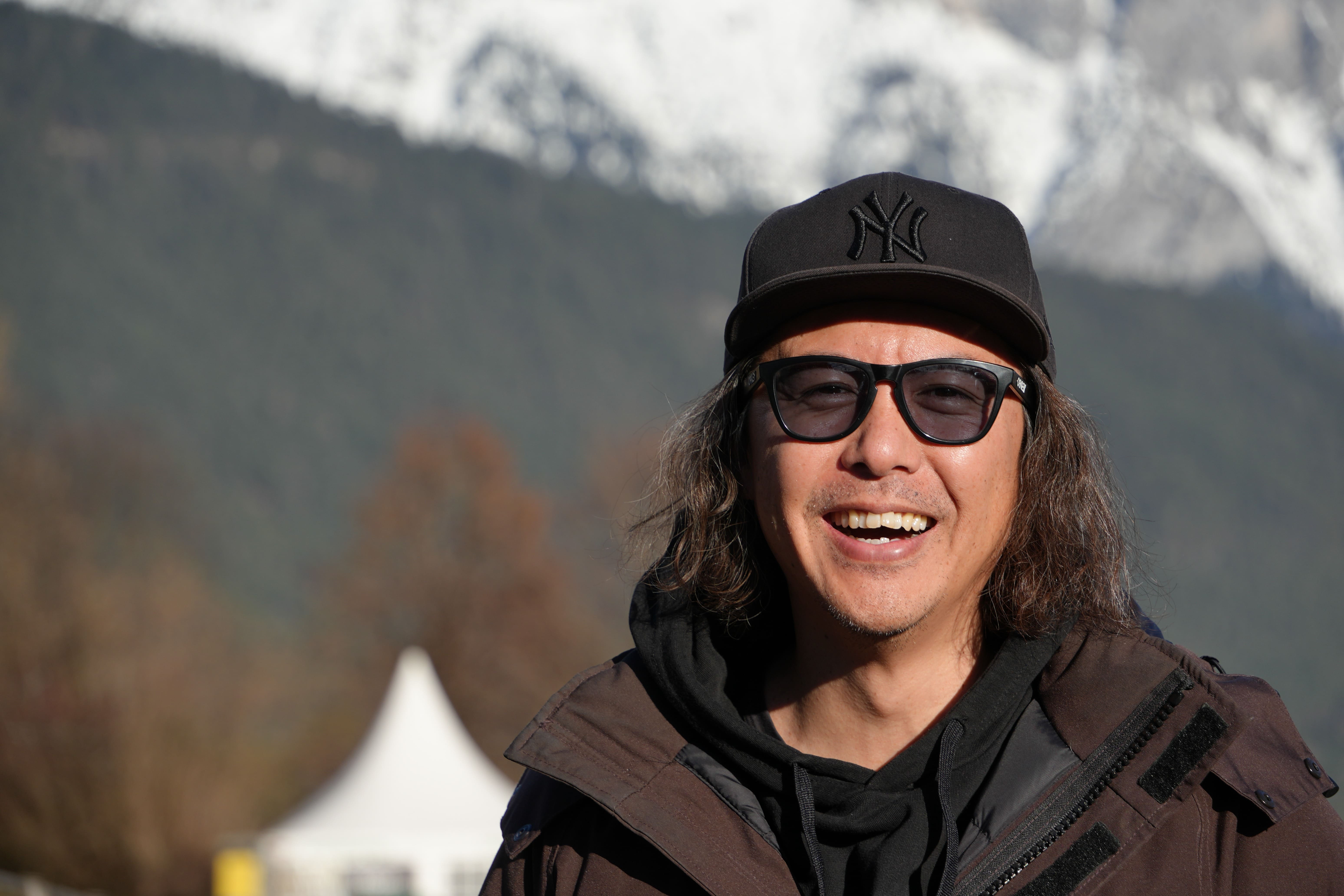

After competing in World Cup races, Kenta Uraki returned to the snow in 2018 as head coach of the All Japan Alpine Team. The following year he moved to Innsbruck, Austria, and is now the exclusive distributor of Kesle Ski in Japan. From a global perspective, he brings you the latest information and interesting topics on European snow culture, gear, and technology. This time, he focuses on Kesle Ski, which he is involved in
Reunion with KÄSTLE
In 2018, I took on the role of head coach of the Japanese national alpine skiing team, and the following year, in 2019, I moved with my family from Hawaii, USA to Innsbruck, Austria, to establish a base for the All Japan Ski Federation and strengthen Japanese alpine skiing. However, in April 2022, after the Beijing Olympics, I was dismissed as head coach by the alpine skiing management. As a result, I became unemployed and living in Austria, with my family to support. I spent a mentally difficult time thinking and worrying about what I would do to make a living. In this situation, the Austrian ski brand "KÄSTLE" was constantly on my mind.
KÄSTLE is a ski brand that I have a strong attachment to, as I used it when I was an active athlete. Immediately after graduating from high school, I joined Nordica Japan Co., Ltd., which was the sole distributor of KÄSTLE in Japan at the time, and competed in the World Cup and World Championships with KÄSTLE skis. However, in 1998, the KÄSTLE brand was absorbed by Nordica and ceased to exist, and my partnership with them was forcibly terminated.
More than 20 years later, I spotted the familiar logo at a ski resort in Europe. It was Kesle's skis. I was excited to see Kesle again after so long, and when I looked into it, I found out that they had just started moving towards returning to the international market.

The history of Kesle... from its disappearance to its revival
So, what kind of brand is Kässle? Founded in 1924 in Hohenems, Austria, bordering Switzerland, Kässle has since achieved great success with athletes like Toni Sailer and Pirmin Zurbriggen, winning over 130 medals at the Olympics and World Championships, in addition to overall World Cup titles. Kässle skis were also used by Chiharu Igaya, the only Japanese Olympic medalist in alpine skiing, when he won his medal at the 1956 Cortina d'Ampezzo Olympics.
Even after being acquired by Italy's Benetton in 1991, Kässle skiers continued to perform well, but the brand disappeared after the 1998 Nagano Olympics, absorbed by Nordica, surprising everyone involved.

A little over a decade later, a businessman from Vorarlberg, Austria, began working to revive the Kössle brand, and the company's headquarters reopened in 2015. The company relaunched with the ski manufacturing techniques that had proven their worth in alpine skiing, and added new technologies such as the brand's iconic Hollowtech (the oval shape and patented vibration-absorbing function at the tip of every ski)
In 2018, Czech company Konsilsport acquired a majority stake in Kösle, allowing the company to expand its product categories and make a full comeback to the global market

Expanding to Japan
After retiring as a skier, I've been involved in various jobs outside of skiing. Despite having no prior experience, I've started businesses in real estate and the bridal industry, managing to survive solely on my own ideas and passion. Perhaps because of this, the idea of expanding a ski brand into Japan and importing and selling it presented a significant advantage compared to my previous ventures in unrelated fields, leaving me no reason to hesitate.
A few weeks after being dismissed as head coach of the alpine team, I prepared documents and photographs proving my past involvement with Kessle and headed to Hohenems, a town on the western edge of Austria bordering Switzerland. It's the birthplace of the Kessle brand and where its headquarters are still located. I began
by speaking with the international sales representative, and on my second visit, I had a meeting with the CEO. Although I'd lived in Austria for five years, I couldn't speak German. Even though I could speak English, I often struggled to understand complex conversations. However, by sharing my passion for the brand and the future I envisioned with Kessle, I was able to gain the trust of the CEO and other key members of the headquarters. And so, the decision was made to fully relaunch the Kesleski brand in Japan, with me at the helm.

A diverse lineup
With roots in racing, Kössle resumed competing in the Alpine World Cup in 2019. Then, in January 2023, Ilka Stühetch (Slovenia) became the first Kössle skier to win the Alpine World Cup in over 20 years. Kössle skiers continued to perform well in the following 2023-2024 season, with Czech Republic's Ester Ledecka and Switzerland's Jasmine Fleury winning the Alpine World Cup. Kössle skiers have also been making notable achievements in other World Cup events, including ski cross, moguls, aerials, and cross-country skiing

With its revival, the brand has expanded its product categories to include freeride, all-mountain, touring skis, moguls, alpine boots, Nordic skis, and even mountain bikes. Among these, the freeride skis and alpine boots have been particularly popular.
There are two types of freeride skis with wider center widths: the ZX series (center width: 92mm, 100mm, 108mm, 115mm) which can be used freely from groomed slopes to powder, and the PARAGON series (center width: 93mm, 101mm, 107mm) which is a serious freeride ski that offers exceptional stability even at high speeds. Perhaps due to their design, they have become popular among powder skiers in North America and can now be seen at almost any ski resort.
The ski boots, which went on sale from the 22-23 season, are in Keslemint, the brand's signature color. They have an outstanding presence on the snow and are attracting attention for their K-blend, a unique, resilient material that is unaffected by temperature.


Expansion of ski production functions
The company continues to produce its top racing models at its headquarters in Hohenems, Austria, while its boots are made in the small town of Treviso in northern Italy, home to ski boot makers from around the world. Demand for Kesle skis has grown exponentially in recent years, leading to the decision in 2022 to expand, modernize, and automate its factory in Nove Mesto na Morave, Czech Republic. Furthermore, the company has made a major investment in a solar power generation system, enabling it to generate a large portion of its energy from renewable sources


In the photo above, the old factory is at the very back, and the building just before it is a huge new factory. Solar panels for generating electricity are lined up on the roof. The crammed piles of wood can be seen at the bottom of the photo. The most important core material in manufacturing skis is the wood core. Kessle's wood cores are exposed to natural air, rain, and wind for three to five years, which gives them the flexibility and strength that is ideal for use as a core material in skis
A management strategy that suits the times
When acting as an agent for an overseas brand in Japan, one would typically develop a business strategy based in Japan. However, since I am located in Austria, which is at the heart of the ski business, I thought I should take advantage of this. Fortunately, the internet connects the whole world, and we now live in an era where everything necessary for doing business—communication, marketing to build brand strength, and sales activities to expand products—can be done online. Furthermore, the impact of the coronavirus has made online meetings commonplace, making it easier than ever to do business with Japan from overseas.
For these reasons, I myself have based myself in Austria and am focusing on gathering information in Austria, a leading country in skiing. In addition, by building relationships with Kessle's headquarters, factory, and the people who work there, I am now being asked for advice on ski manufacturing, including ski design, function, and lineup. Furthermore, I can now make requests regarding ski development and production lines for the Japanese market, which will likely be a significant advantage as we expand into Japan.
On the Japanese side, Kessle's Japanese base and service center is located in Yuzawa Town, Niigata Prefecture, where I spent my elementary and junior high school years. Furthermore, preparations are slowly but surely underway, including Kessleski's racing service, a test ride center where new models can be tried throughout the season, and contracts with brand ambassadors and influencers. Incidentally, the previous name in Japan was "Kessley," but since it was slightly different from the Austrian pronunciation, it has been changed to "Kessle" to coincide with the brand's return to Japan.

By coincidence, I never expected that I would be reunited with Kössle at such a time, and that I would be able to restart my journey with Kössle, which was forced to end in 1998, and the challenges I left unfinished as an athlete, as the brand's director. I am grateful for this miraculous life, and first of all, I want to be myself and achieve solid results. In the future, I would like to go beyond the framework of ski sales and establish a sports culture like that found in Austria in Japan, while also revitalizing the local economy, working on initiatives that contribute to people's health and happiness, and handling products that contribute to these things

Information
Kaestle Japan Official Website:
https://kaestle.com/ja
Kastle Japan Official Instagram:
https://www.instagram.com/kastle_jp/
Please feel free to contact us after registering for our official LINE account:
https://lin.ee/QTPowQJ