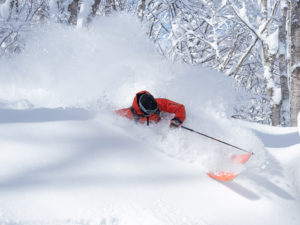

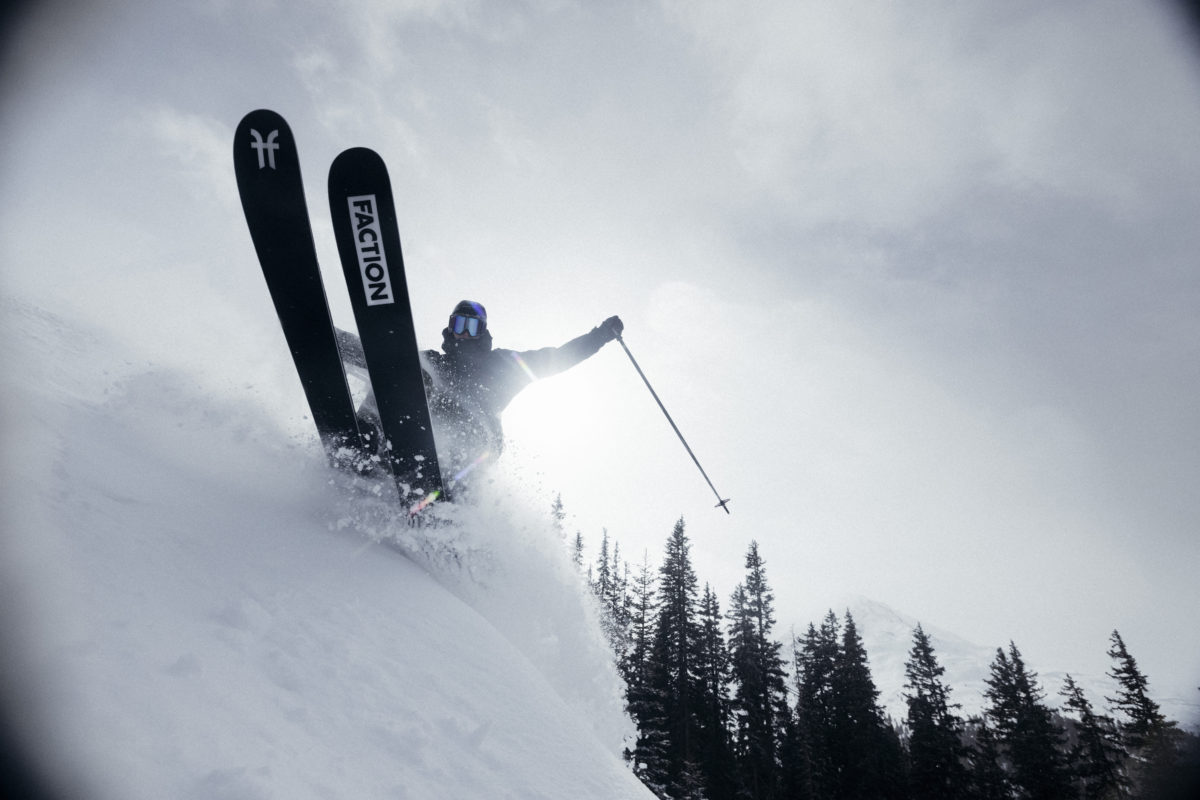
Drifting down freshly fallen snow, carving beautiful sprays of snow—the exhilaration of powder skiing is an irreplaceable experience. But what if there was a ski that allowed you to conquer powder more freely and comfortably than ever before? Wouldn't you want to try it?
That gear that dramatically elevates the quality of powder riding is "fat skis." The feeling of buoyancy that makes you feel one with the powder, the feeling of diving into a deep sea of snow, the rhythmic feeling of carving light turns—fat skis bring an unprecedented and exciting sensation. Let's introduce how to choose the perfect pair of skis to take you to a new world.
Fat skis are like this
Fat skis have a wider waist than standard skis and are designed to make skiing on ungroomed slopes easier. Standard all-mountain skis typically have a waist width of around 80mm. It's said that when the waist width exceeds 100mm, you feel a stronger buoyancy in powder, and the effect becomes quite noticeable.
Here, let's look at two models with significantly different waist widths.
Skis with a narrow waist allow for quick edge changes and are highly maneuverable. They are also suitable for enjoying sharp riding, focusing on carving on the slopes. Skis with a wide tip and narrow waist are more susceptible to snow resistance and sink in powder, requiring skill to handle smoothly


The wider the center section under your feet, the greater the buoyancy, preventing you from sinking into deep snow and improving turn stability, making them easier to maneuver in powder. The wider width also allows for more gliding and surface-level play on groomed slopes.
Furthermore, skis with wider waists tend to have larger turn radius (R), so shallow, wide turns are well-suited to powder riding styles.
So, what points should you consider when choosing fat skis for a truly enjoyable powder ride? There are three key points.
Point 1. Thickness determines buoyancy and stability
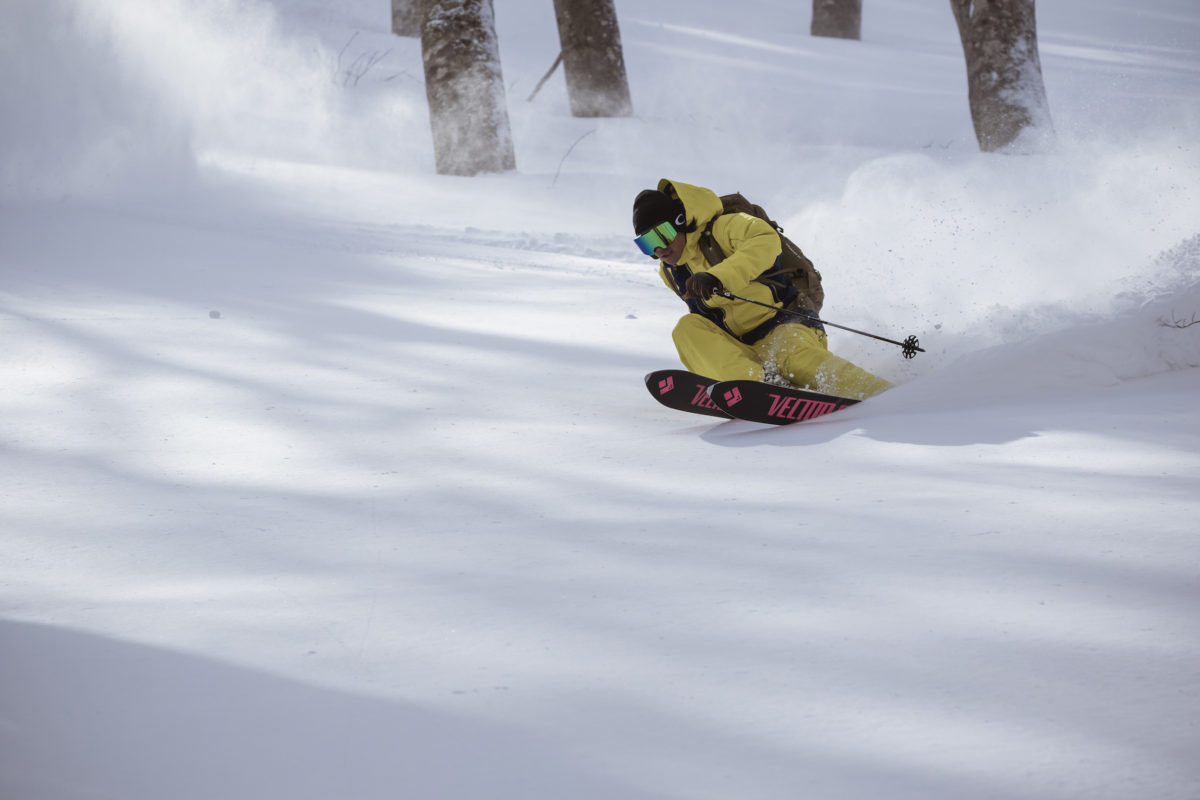
An iconic fat ski with a waist width of 100-110mm
The 100-110mm waist width is the signature width of fat skis. With the popularity of powder and freeriding, the lineup has expanded year by year, and now it is the most popular and voluminous line
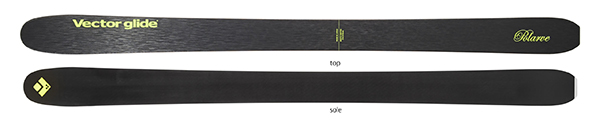
Let's take a look at the video to see what kind of skating you can do
VECTOR GLIDE POLARVE
Waist width of 90mm or so for middle fat
Skis with a waist width of 100mm or less, for example in the 90mm range, maintain a similar feel to on-piste skis and are also called mid-fat. They are easy to switch to from regular on-piste skis as there is little discomfort, but the floating feeling in powder is weaker than on fat skis over 100mm

Super fat with a waist width of over 120mm
Previously, many brands released fat skis exceeding 120mm in width, but this trend has subsided in recent years. Some brands have even removed fat skis exceeding 120mm from their lineups.
Nevertheless, due to their unique characteristics, they perform exceptionally well in deep powder where you sink up to your waist. For this reason, many skiers own them as a special pair for special occasions. They can be described as powder-only machines, exhibiting tremendous buoyancy as the powder gets deeper.
Check out the video to see how the Super Fat rides
Point 2. The shape of the bottom also has a big impact
When choosing fat skis, the shape of the bottom (the lower, bottom part of the ski) is just as important as the width. The shape of the bottom of the ski provides stability and also supports a feeling of floating. So, what kinds of shapes are there? The shape of a ski's bottom is determined by camber and rocker.
Broadly speaking, most skis can be divided into four types. Before that, let's review rocker and camber.
Rocker and camber
What is camber? When a conventional ski is placed on a flat surface, the center section is curved upwards. This raised section is the camber.
Camber allows for even pressure distribution across the entire ski from tip to tail, extending the edge contact with the snow surface and improving control. A steeper camber results in quicker response and increased propulsion in the latter half of a turn. It also performs well at high speeds. On the other hand, a weaker camber makes the ski easier to maneuver.
Rocker is the opposite of camber;it curves the parts that contact the snow surface, such as the tip and tail.The rocker section receives less resistance from the snow surface, increasing buoyancy in powder. The tip and tail don't catch in deep snow, making the ski easier to handle. The ease of initiating turns is a major advantage.
The combination of camber and rocker changes the ride feel
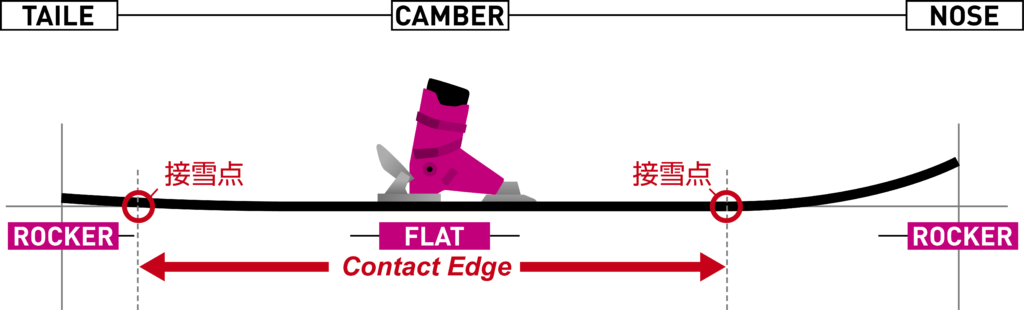
The combination of camber and rocker makes a big difference in the feel of the ski. The key is whether there is camber or not, and how much rocker is used in which areas, which affects the length of the contact edge
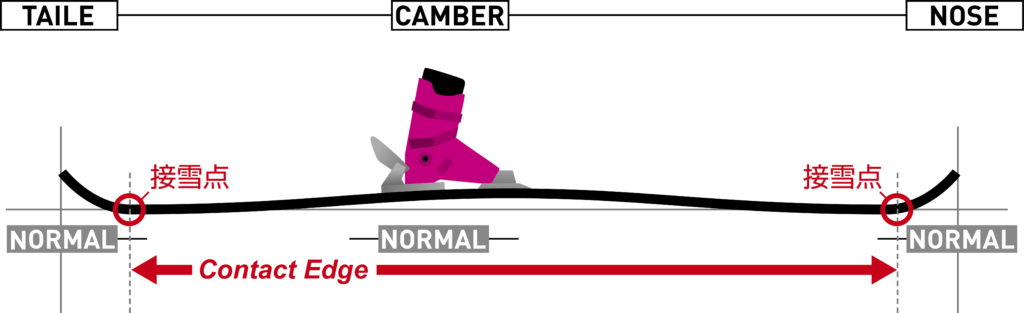
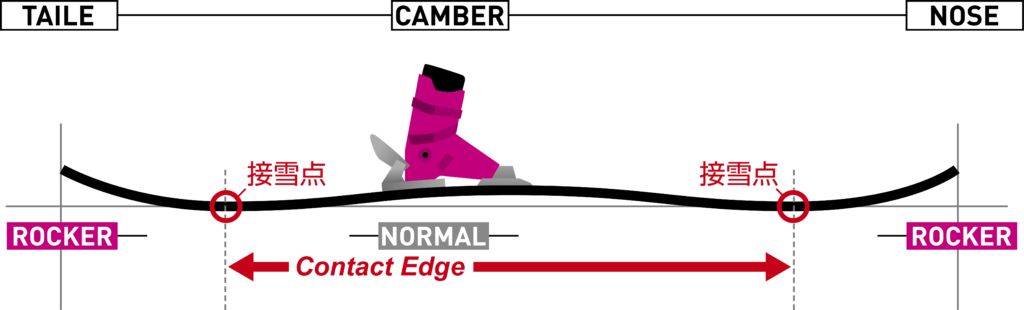
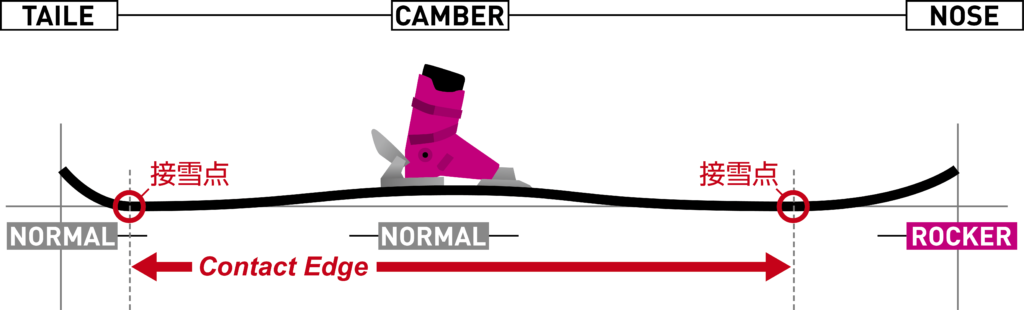
Looking at the four illustrations below, you can see that the length and position of the contact edge differ depending on the combination of camber and rocker. A longer contact edge naturally makes it easier to control, resulting in easier gliding on groomed slopes and better speed.
The opposite is true if the contact edge is short. The skis feel shorter and are easier to maneuver, allowing for greater freedom and a more playful style of skiing. However, on hard slopes, the edge grip is weaker compared to camber skis.
Also, keep in mind that two important factors to consider when choosing skis are the flex, or how strongly the board bends, and the torsion, or how strongly it twists
◆Camber only
This is the traditional type of ski, often referred to as the standard. It features long contact edges that provide excellent grip on the snow. The camber underfoot distributes pressure evenly across the entire ski, making it flexible and facilitating turn transitions.
<Ease of Use Guide>
Groomed Slopes: ◎ High maneuverability and stability
Powder: 〇 Requires familiarity and a certain level of skill
Rocker on nose and tail, with camber
The rocker on the tip and tail creates float and maneuverability in powder. The camber underfoot gives you control even on hard runs. It performs best in powder, but can also be enjoyed on smooth ground
<Ease of Use
Guide> Groomed slopes: △ Operable
Powder: ◎ Easy to slide and turn freely
◆ Rocker on the nose, with camber
The nose rocker brings out the lift and turning ability in deep snow, while the camber and contact edge extending to the tail provide stability at high speeds and on steep slopes. Excellent maneuverability and suitable for all-around riding
<Ease of Use Guide>
Groomed slopes: ○ High maneuverability
in powder: ◎ Nose rocker effect allows the board to float from the nose.
Rocker on the nose and tail, flat bottom
Because there is no camber, there is full contact with the snow surface, and the edges hardly catch. Just by tilting the board, it curves along the R (arc) of the side, allowing for smooth turns. The front and rear rocker prevents it from sinking even in deep snow, and it is extremely maneuverable in powder. You can also enjoy freestyle-style playful riding
<Ease of Use Guide>
Groomed slopes: △ Somewhat difficult to control
Powder: ◎ Easy to slide and turn freely
That being said, it might be difficult to visualize it just by thinking about it on your own. To find out what kind of riding experience different types of skis offer, it's a good idea to participate in a test ride event or consult with a knowledgeable professional ski shop
Point 3. Decide on "the one" by taking into consideration the length
The third important thing to consider when choosing fat skis is length. Longer skis have more contact between the base and the snow, which means more buoyancy and stability in powder. The skis will float up and slide forward on their own, allowing for a relaxed and comfortable ride
When choosing fat skis, some recommend a length of around 10 cm, even for groomed slopes. On the other hand, shorter skis offer increased maneuverability and allow for more playful skiing. For playing on natural terrain with fresh snow or freestyle in the backcountry, it's definitely better to choose skis that aren't too long.
Some models offer multiple lengths, while others are limited to one size to maximize the ski's performance. To determine which fat skis are best for you, it's a good idea to consult with a shop, taking into account your skiing style, physique, and physical strength.
Point 4. Consider your skating preferences and style
When choosing fat skis, you should consider not only the hard aspects of the gear, such as length, thickness, board shape and structure, but also the soft aspects, such as the rider's preference and style of skiing and their goals, to find the fat skis that are best suited to you. For example, the following points should be taken into consideration:
●What kind of skis can you enjoy from powder and ungroomed snow to groomed and park runs with just one pair
? ●If you originally had a focus on basic or alpine skiing, what kind of fat skis should you choose
? ●What kind of fat skis should a primary park skier use to enjoy powder?
●How do you choose fat skis that can also be used in the backcountry?
●What kind of fat skis should you get if you have a dedicated pair of skis for deep powder? ●
If you have fat skis with a waist width of around 100mm, what width would be good for enjoying powder more aggressively?
●What kind of fat skis are good for skiing on ungroomed snow?
●What kind of fat skis should a female skier who is primarily a resort skier and a powder beginner start with?
●What kind of fat skis would be suitable for middle-aged and senior skiers who used to ski but are losing confidence in their leg strength and stamina?
What kind of fat skis would be a good match for these situations? Be sure to check out this article.