

Skimo is attracting attention as it will be added as an Olympic sport at the 2026 Milan-Cortina Olympics (Italy). Some
people may have heard of the name but not know what kind of sport it is, or may be hearing about it for the first time. Its official name is Ski Mountaineering, and it is abbreviated to Skimo.
Let's take a look at the competition details, rules, and appeal of this sport.
What is Skimo?
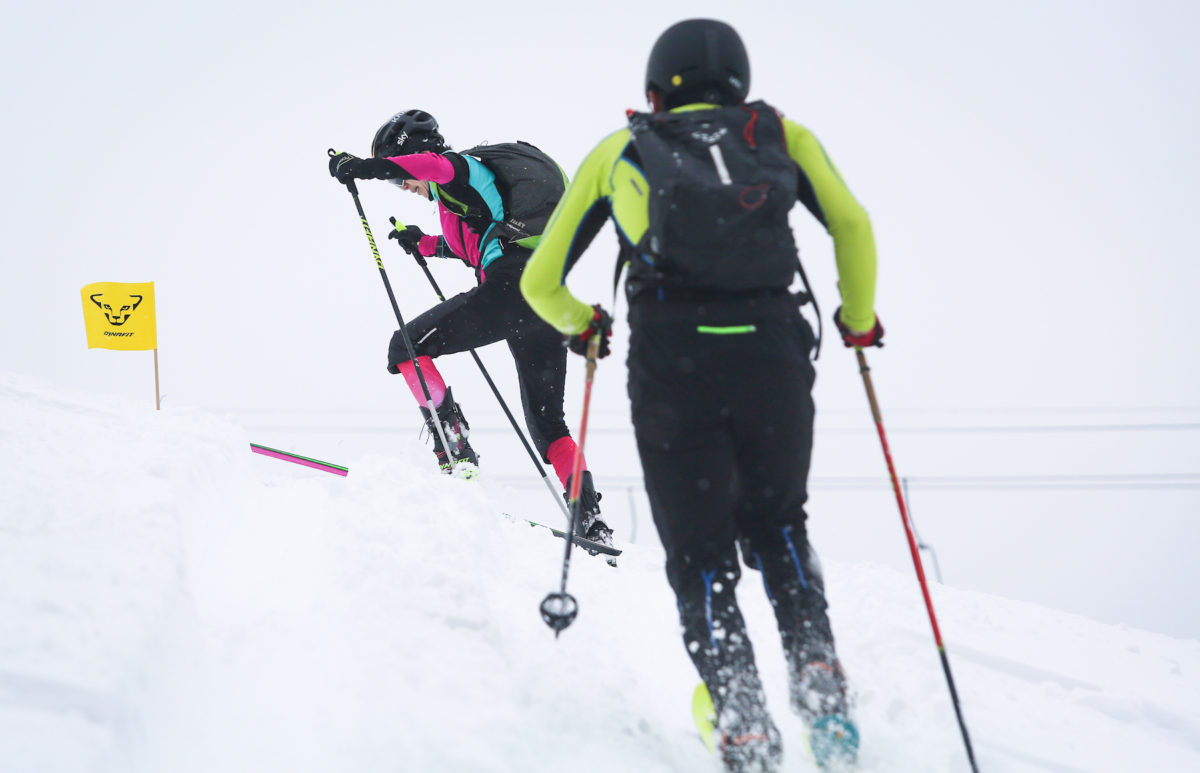
Skimo is a sport in which participants climb snowy mountains, ski down, and compete to see who can reach the finish line the fastest. It may be easier to understand if you think of it as a variation of the backcountry skiing that you normally enjoy, where participants compete for the fastest time from the top to the bottom. The courses for both the climb and skiing sections are marked by flag gates, and participants race through the snowy mountains in three different ways for each section: walking on skins, climbing with their skis on their backs, or skiing in alpine mode. The winner is determined by their overall skiing technique and physical strength
Events to be competed
The events are divided into the following four categories:
1. Sprint
: " A short-term competition " -
in which skiers climb a slope with an elevation difference of about 70m on skis with skins, then take off their skis and walk uphill, then ski downhill on skis, all in a course of about 3 to 3.5 minutes. This is the sprint that will be contested at the Milan-Cortina Olympics.
② Individual
"Snow Trail Running" This race is mainly held off-piste, with a total elevation difference of 1,300 to 1,600m for men and 1,150 to 1,400m for women. The race lasts for 1 hour 15 to 1 hour 30 minutes, and it is a dynamic event that involves multiple climbs up and down the mountain, making it the highlight of the tournament.
3) Vertical
: "Compete for the fastest time climbing only ."
This is a competition that literally competes for the fastest time climbing, climbing a course with an elevation difference of about 500 to 700 meters in one go. The time is around 40 minutes.
4. Team
"Relay": A competition in which two or three people climb together. The course is longer than the Individual.
It's easier to understand by watching video of the actual competition. Let's take a look at the sprint competition at the All Japan Championships held at Unazuki Snow Park in January 2022
As you can see from the video, athletes are required to walk, put away their skins and skis, and even slide with refined movements in order to move forward even one second faster. If you look closely, you'll see that the athletes are carrying backpacks. These contain the equipment needed on snowy mountains, such as beacons, probes, and shovels. This is essential in line with the Skimo philosophy of skiing safely and as quickly as possible in the backcountry. There are also other detailed rules, such as penalties if skins stick out when storing them inside the ski gear, or if the zipper on the ski gear is not completely closed. This is because the premise of the competition is to ski down snowy mountains safely
Gear used in Skimo
Because the competition is about speed, the equipment is also lightweight.
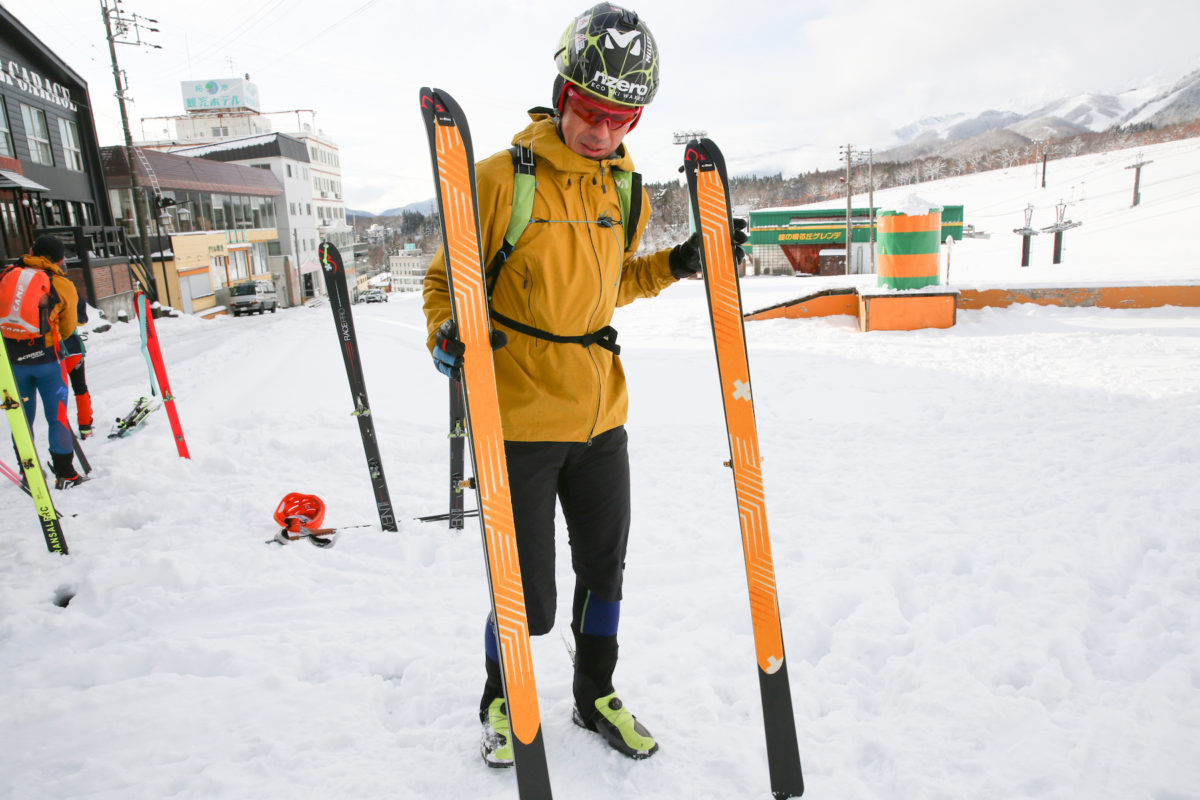
For example, the skis themselves weigh only 600-700g per pair, and the bindings weigh only about 100g. This lightness is possible because they are made of lightweight materials, but this also means that they can easily break while skiing.
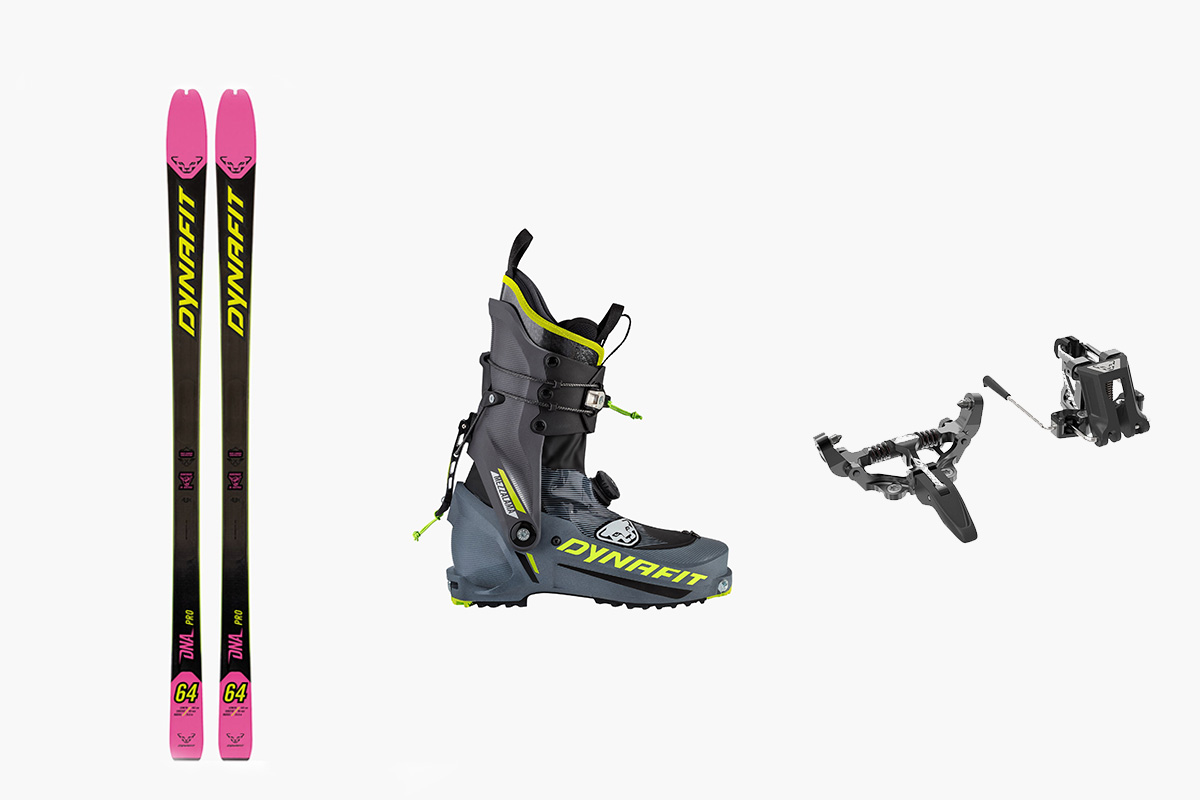
Left: Dynafit DNA PRO 162cm | 690g | 132,000 yen
; Middle: Dynafit MEZZALAMA BOOTS 875g | 121,000 yen;
Right: Dynafit DNA+ 128g | 116,600 yen
Not only are the boots thinner overall, but the tongue is simplified as well. For racing boots, they are even lighter and do not have a tongue. The price also skyrockets.
The seals are also as short as possible, and the seal clip on the tail is omitted. Once attached to the nose, they remain taut. This simplifies the process, allowing you to remove the seals while still wearing your skis, and allows for quick transitions from touring mode to alpine mode. One of the things that makes Skimo boots so interesting is seeing the stripped-down movements and gear.
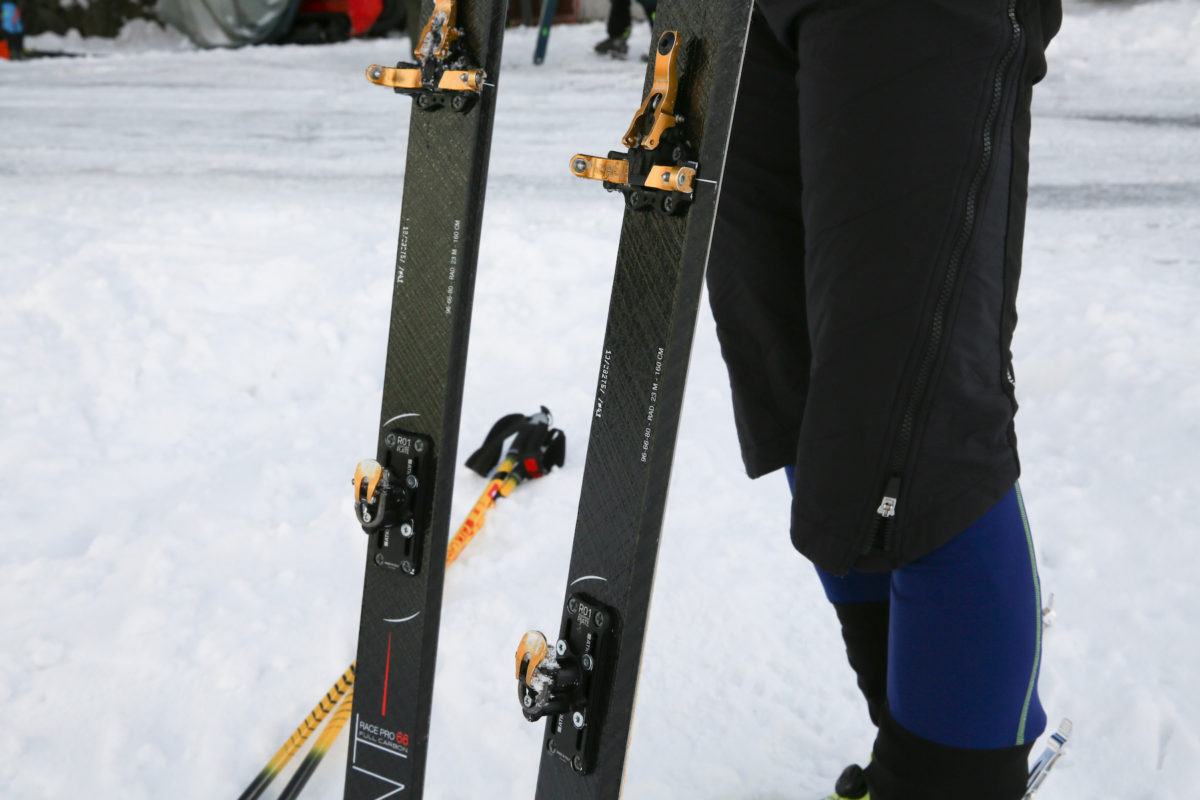
Skis so light you can lift them with one hand
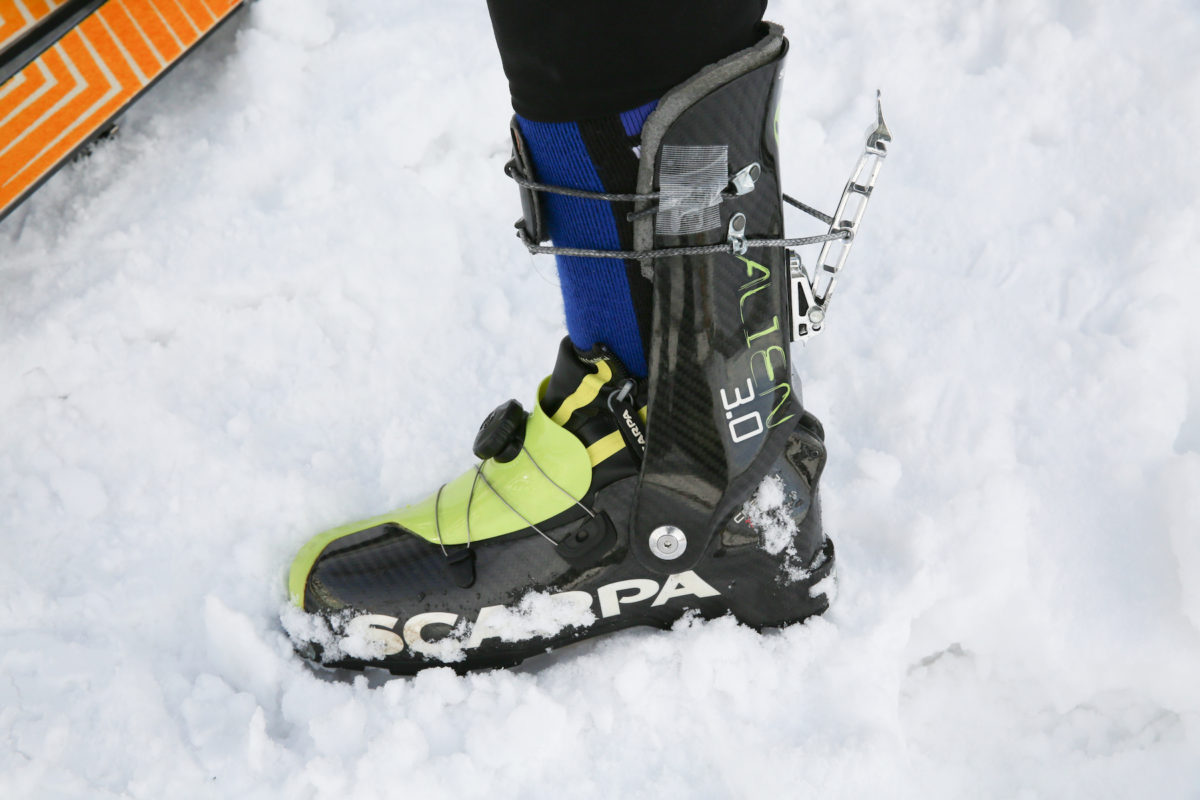
To close the gap with overseas
Skimo is a sport that originated in Italy. It is popular in Switzerland, France, and Italy, and has a large pool of athletes. The sprint events at the 2026 Milan-Cortina Olympics are scheduled to be contested by 18 athletes from around the world, both men and women, but the number of participants per country has not yet been determined. Due to the limited number of participants, there may be regional quotas for Asia, Europe, America, etc. In that case, neighboring China will be Japan's biggest rival
In Japan, it is still a sport that has yet to develop. However, when Japan's ace athlete, Shima Tokutaro, competed for the first time in the World Cup held in France, he finished 52nd with a time of 3 minutes 17 seconds, compared to the top qualifying time of 2 minutes 46 seconds for the French athlete, Shima was 17 seconds away from the 30th place qualifying line of 3 minutes 00 seconds. Although there is still a gap in strength between Japan and the rest of the world, with continued training it is realistic that Japan could qualify in the near future, and this result showed a ray of hope
"The biggest difference between us and overseas athletes is power and skating technique," says Yukiyasu Matsuzawa, head coach of the Japanese national team. The sprint, an Olympic event, is contested over a short competition time, so endurance is of course important, but climbing speed, or power, is also an important factor. Also, overseas, there are increasing cases of athletes who originally mastered their techniques in alpine racing switching to Skimo. Athletes who not only have physical strength but also high-level skating technique will become an even greater threat. Overseas athletes have the advantage of having a long competitive history, and if they go to high-altitude mountains, there is snow, and they can practice a lot and do high-altitude training
It is undeniable that there is a gap between Japan and Europe in terms of both physical strength and skating technique due to differences in experience, training environment, and physical physique. So what does Japan need to do to improve its ranking?
"Japanese track and field is strong in relays. That's because they've practiced a lot and gotten good at passing the baton. In Skimo, too, although there is a difference in physique between us and overseas athletes, the part where we can definitely improve our times is the transition part where we switch running styles. I think Japanese people are good at the small details like shouldering and putting on skis and taking off the skins. Overseas athletes are fast, but this is an area where we can win if we focus on it. It's basic, but there is a lot we can teach Japanese athletes who are still inexperienced," says Matsuzawa
To gain the necessary experience and basic skills, the first ever training camp for the Japanese national team was held at Tsugaike Mountain Resort in Hakuba from December 16th to 18th. Our editorial team accompanied the camp for a day and discovered that Skimo is a much harder sport than we had imagined